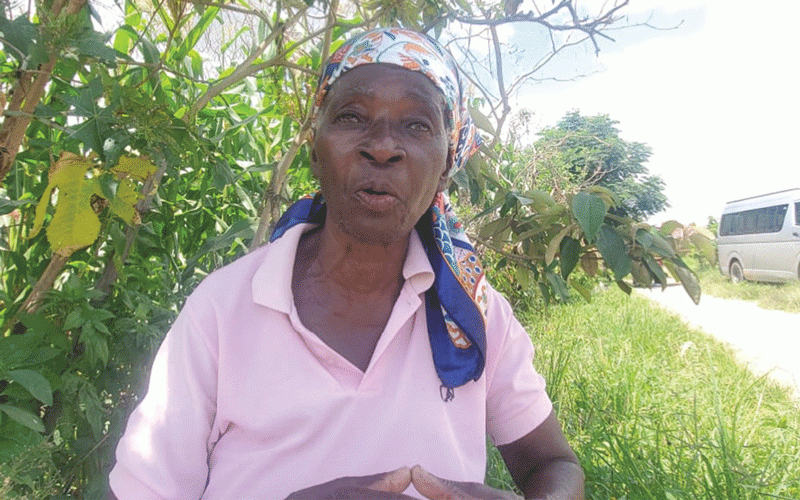
ROSEMARY Chibanda (74) smiles, her face etched with memories and relief, as she steps out of a two-roomed brick-and-mortar house in Tafara, a settlement about 22km east of Harare’s central business district.
For the first time in decades, she says, she is no longer worried about being chased away by authorities or rain tearing through the plastic walls of the makeshift shelter she once called home.
“This is my home,” she says softly, tapping the cement floor with her walking stick.
For Chibanda, who once lived in one of Harare’s squatter camps, home ownership had long seemed unimaginable.
Today, she is among 121 families who have benefited from housing through “The Federation” a partnership between the Zimbabwe Homeless People’s Federation, the City of Harare, and Dialogue on Shelter.
After working for years as a domestic worker, Chibanda found herself without a job or a place to live with her three children. With nowhere to go and no savings to rely on, she joined thousands of others at Highlands squatter camp, stitching together plastic sheets and cardboard boxes into a structure she called home.
When stand owners began construction, the squatters were dispersed, forcing her and others to relocate to Gunhill squatter camp.
In 2010, tragedy struck when she lost one of her children. The grief was overwhelming, and the stress triggered a stroke that slowed her speech and weakened the right side of her body.
- Feature: Pigeon rearing changes man’s life
- HCC considers cancelling ZimPhos contract
- We're not immune to prosecution: Land developer
- Govt to blame for Mupedzanhamo chaos
Keep Reading
“I thought my life had ended,” she recalls.
“I was sick, old, and still homeless.
“But during that time, people from ‘The Federation’ approached us and educated us about a programme of saving US$1 towards securing residential stands.
“We joined, though some dismissed it as a scam.”
Chibanda joined a savings group under the Zimbabwe Homeless People’s Federation.
The rules were simple: members contributed US$1 towards housing, US$1 towards health, and US$1 towards food. The sums were small, but the commitment was significant.
Week by week, dollar by dollar, the savings grew.
“Even when I was weak, I could still put something in,” she says.
Working with the City of Harare and Dialogue on Shelter, the Federation negotiated a land deal.
After years of saving and engagement, residential stands were secured in 2017.
Families were allocated 200-square-metre plots designed for semi-detached houses, with two homes sharing one plan.
Those relocated from the squatter camps formed new savings groups to maintain the momentum.
The funds collected are now being channelled into the foundations of a new community — sewer lines, access roads, and shared services that make a neighbourhood liveable.
Speaking during a recent media tour facilitated by the African Cities Research Consortium at the new Tafara neighbourhood, Dialogue on Shelter programme co-ordinator Evans Banana explained the phased construction approach.
“Because funds come in gradually, the Federation selected 25 households for immediate construction and will continue until the whole neighbourhood is complete,” he said.
Even families not among the first 25 express a renewed sense of peace.
“We know this is our place. That knowledge alone has changed us,” says Chibanda.
“In the squatter camps, life was constantly under siege from drugs that consumed young people, early marriages driven by desperation, and diseases that spread easily in overcrowded and unsanitary conditions.
“Here, the dangers feel distant and manageable.”
She adds: “I have lived a long life. I have buried a child. I have been sick. I have slept under plastic. But today, I can say I own where I sleep, through ‘The Federation’.”
Banana described the Tafara project as part of a proven model first demonstrated in Dzivarasekwa Extension.
“The approach is methodical and humane: we identify informal settlements, work with residents through savings schemes, secure land with local authorities, and build incrementally,” he said.
“Work is now underway to map all slums across the country and partner with councils nationwide to unlock land for people like Chibanda.”
According to the Zimbabwe National Human Settlements Policy, many local authorities are grappling with informal settlements that lack basic services such as water, sewer systems, roads, electricity, and security of tenure, exposing residents to disease outbreaks and vulnerability.
Givemore Chikwazha, another beneficiary who previously lived in a slum in Kuwadzana, said the programme has restored stability to his family’s life.
“Before this, everything we did was temporary,” he said.
“We could not plan for our children because we could be moved at any time.
“Now that we have land, our livelihoods have improved because we can work, save, and invest without fear.”
Zimbabwe faces a daunting national housing backlog of more than 1,25 million units, compounded by inadequate social amenities, the growth of informal settlements, high building material costs, and limited access to housing finance.