IT is normal for friends to outgrow each other, fall out and even become enemies.
But for Prudence Chimutuwah and Deodoris Nembaware, the story is different. Although they both graduated from the National Gallery School of Visual Arts and Design (NGSVD) in 2011, Chimutuwah and Nembaware have remained close 15 years later.
The duo recently celebrated their long-standing friendship with a joint exhibition at Loft3 Gallery, aptly titled Pahushamwari.
The vernacular title, which means friendship, can be read as a reference to an old nursery rhyme.
The words of the song, which are often taught to children at kindergarten, speak to strength, shared resources and safety in numbers.
In Zimbabwean culture, a very close friend is called sahwira and the relationship is considered to be stronger than that of blood kin.
In 1986, renowned Zimbabwean musician Oliver Mtukudzi released the popular song, Jeri, after the sad loss of his friend Jack Sadza.
In the classic dirge, he laments, “Zvamunoona husahwira, hunokunda hukama…” A celebratory chant regularly sung at various occasions also goes Hukamai hunenge husahwira! which is to say kinship should aspire to be like the relationship between close friends.
- Mutema’s magical art provokes spiritual awakening
- The Future Is Her exhibition celebrates women's month
- Dual exhibition explores friendship and womanhood
Keep Reading
Chimutuwah and Nembaware are not alone in embodying this unique relationship between female artists. Another well-known example from Harare’s art scene has been the connection between visual artists Virginia Chihota and Portia Zvavahera.
Both women attended the BAT Visual Arts Studio (now NGSVD) together. Former director of the National Gallery of Zimbabwe, Doreen Sibanda, once described them as being inseparable like ‘peas in a pod’, Chihota and Zvavahera have successfully grown their careers to reach international audiences.
Naturally, a dual exhibition tends to draw attention to similarities and contradictions. Such was the case in 2022 when the Kudita sisters Natasha and Tamary presented Roots and Routes at Pikicha Gallery, in 2023, with Rudo Runowuya Nemabasa, with spouses Amanda Shingirai Mushate and Tashinga Majiri at First Floor Gallery, Harare, and Dzemudanga by Mubaiwa brothers Hugh Hatitye and Lionel Tazvitya at the National Gallery of Zimbabwe in 2025. The comparison facilitates a deeper understanding of each individual's work and reveals what makes them unique.
Conceptually, Pahushamwari is about two women navigating life as visual artists in Zimbabwe, where their styles and thematic approaches diverge, a part where their bond is strongest.
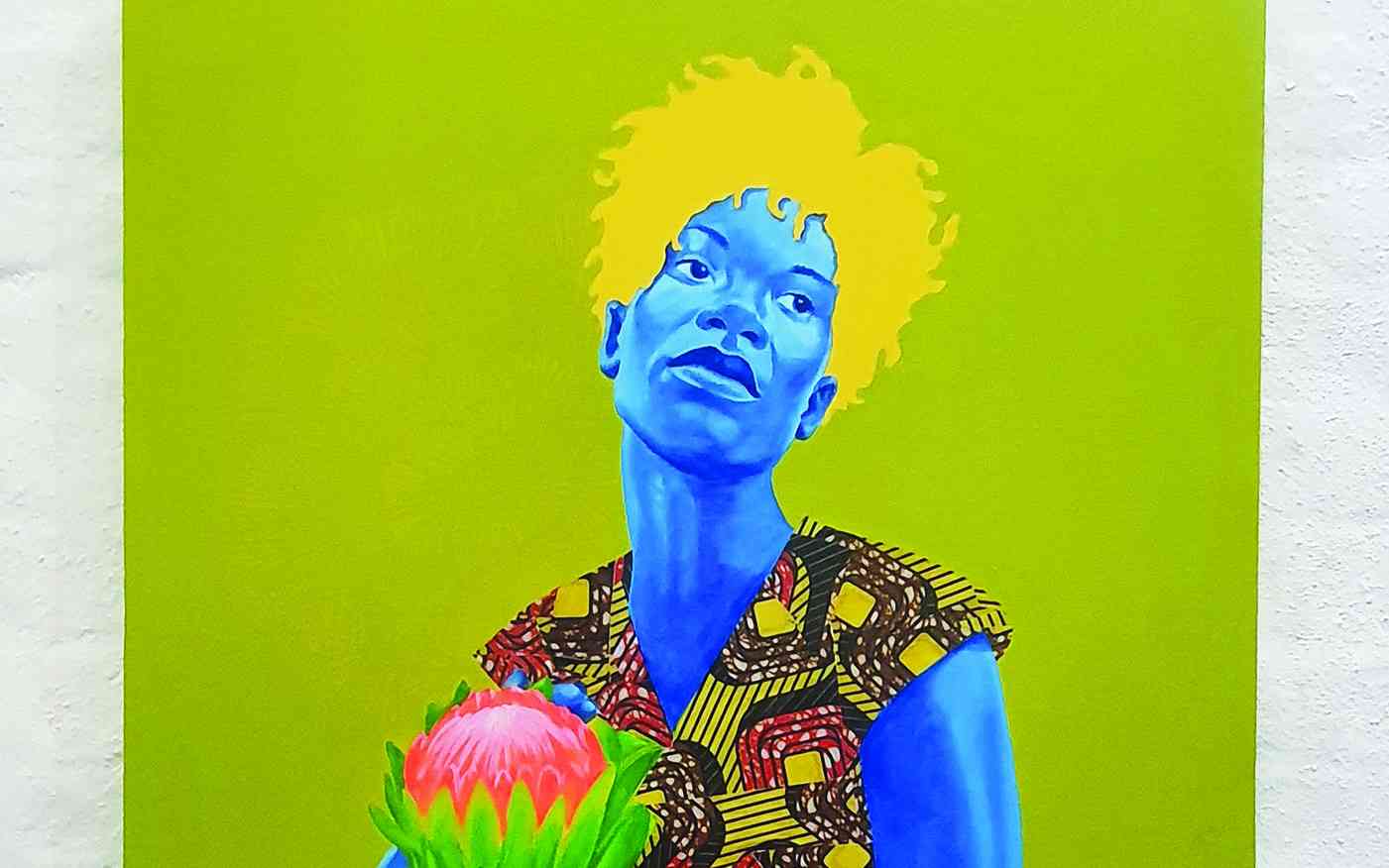
Chimutuwah has established a signature style of vibrant characters dressed in ethnic costumes and wearing iridescent hairstyles.
The characters are given a blue complexion, which the artist has described as a symbol of royalty. Her abstract symbolism includes the insertion of decommissioned Zimbabwean currency, which adds a socio-economic commentary to her work.
She has honed her style to project a worldview of socially and economically-empowered women within an unstable economic reality and background of hyperinflation.
In person, Chimutuwah comes across as a shy and reclusive person. However, she explores womanhood through bold and extroverted characters whose perfect poise radiates confidence, ambition and material success.
One of her paintings from a series of nine titled Mashereni depicts a head and shoulder portrait of a young woman with a high flat top haircut. The woman wears oversized circular rimmed glasses made from 1980s fifty-cent coins and a bridge that reads million dollars.
In terms of physical stature, it can be noted that Chimutuwah’s models have progressed from the nubile towards embracing gravitas and aging. The younger women draw attention with funky hairstyles and showy accessories.
Adjacently, her paintings such as Pahushamwari 2 feature wizened matriarchs radiating joy and contentment that does not derive from outside validation.
In the aforementioned piece the older women are depicted holding bouquets, which could be the artist’s way of paying homage to those who have led by example and inspired the next generation.
Nembaware, who does not have a very public persona, revels in portraying women who appear to be in a contemplative mood about work, home and family. In contrast to her sahwira, whose work combines collage technique, Nembaware’s fully painted protagonists are depicted in realistic colours and detailed draftsmanship. Her oeuvre explores womanhood from a more personal space.
The paintings tell stories of the lived experiences of women in a position similar to hers. She pays tribute to their struggles, endurance and resilience in the face of various adversities.
As a nurse who is employed by one of the country’s biggest public hospitals her vocation permeates the work as the protagonists are depicted wearing traditional dress uniforms or scrubs, with a stethoscope. Her empathy for professional women might derive from the cultivation of attention and care inculcated through training for her occupation.
There is a recurring motif of link chains that sometimes become the subject's hair. Her painting titled Mai Star 2 depicts a young woman with a stethoscope around her neck and a wedding band on her finger. She wears scrubs and crocs, while seated on a floor symbolically decorated with flowers and link chains.
By default, male viewers might trip into thinking the chains are a form of protest against the evils of patriarchy. However, Nembaware subverts the narrative of male dominance. She asserts that the chains represent women's resilience under challenging circumstances.
A common feature in the portraiture by the two artists is the introspective gaze of their subjects. Even when they are smiling and looking outwards, the characters engage the viewer from an internalised self-awareness.
Mindfully curated, the show does not elevate one artist above the other. In a way, Chimutuwah vouches for her friend while giving her a leg up onto a network and audience she has painstakingly built over time.
It is a rare gesture of camaraderie that demonstrates alignment between the artist’s values and her lifestyle. This could not have happened as a one-sided affair, however. Traditional wisdom says, “Kandiro kanoenda kunobva kamwe.”
Which is to say relationships thrive on reciprocity. Beyond the rhetoric about female solidarity, Pahushamwari is a demonstration of shared values and mutual support.