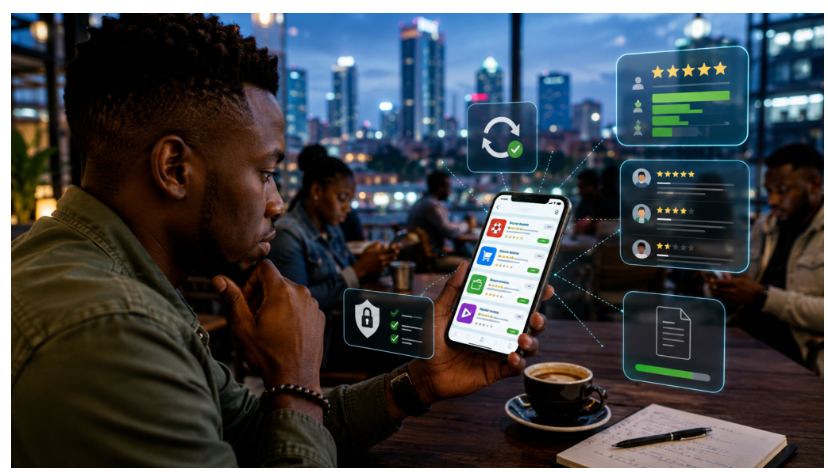
Before installing a new app, many users in Kenya take a short pause. They check the rating, read the latest reviews, look at the update date, and verify the developer name. This applies to banking services, delivery, games, stores, educational apps, media services, and even betting app. The smartphone has become too important a device to install just anything on it.
The reason is simple: the phone holds money, conversations, documents, photos, passwords, and access to everyday services. Through it, people pay, work, study, call transport, buy data bundles, and communicate with family. A new app doesn't just get a spot on the screen. It gets access to part of their personal life.
Checking an App Has Become a Common Habit
Earlier, installing an app often seemed simpler. Saw a link, downloaded it, opened it. Now users are more cautious. They've already encountered heavy apps, poor support, payment errors, intrusive notifications, and strange permissions.
Reviews help quickly understand what to expect. If an app has good ratings but recent comments complain about login issues, payments, or crashes after an update, that's a noticeable signal. An old rating doesn't always reflect the current state of the service.
What matters to a user isn't the beautiful promises in the description. They need to know whether the app works today. Whether it opens on their phone. Whether it freezes during registration. Whether it breaks after an update. Whether it asks for unnecessary data.
Rating Is Only the First Filter
A high rating on Google Play or the App Store looks convincing. But many already understand: one number isn't enough. An app with a 4.7 rating may have fresh problems. An app with a more modest rating might work fine if the complaints are old and already fixed.
- Lessons for media from Kenya elections
- Kenya's top court to rule on disputed presidential election
- Several injured in crush at Kenyan presidential inauguration
- Kenya election was an exemplary performance: Ruto
Keep Reading
That's why users look deeper. They open the most recent reviews. Compare positive and negative comments. Read whether the developer replies. Check if the same complaint appears repeatedly.
If ten people in a row write about login issues, that's no coincidence. If complaints concern payments or withdrawals, trust drops faster. People don't want to test such things with their own money, even though the internet constantly offers them exactly that dubious experiment.
Recent Reviews Matter More Than Old Ones
Old reviews may describe an app that no longer exists. Over several updates, the service changes: features are added, bugs are fixed, design is revamped, loading speeds up - or conversely, what used to work breaks.
That's why recent comments are often more valuable than the overall rating. They show what's happening now. The user sees whether people are complaining about the latest version. Whether there are problems after the update. Whether the app has become heavier. Whether support responds.
This is especially important for services involving payments. If an app is linked to M‑PESA, cards, orders, subscriptions, or a personal account, fresh complaints need careful reading. A crash in a game is annoying. A crash in a payment can already cost money and time.
What People Usually Look for in Reviews
Reading reviews rarely takes much time. Usually a minute or two is enough to get the overall tone. The user doesn't analyse every sentence. They look for recurring signs.
Before this list, it's worth noting: reviews don't provide a full guarantee. But they help reduce the chance of a bad install. It's a simple filter before giving the app phone memory, data, and some of your personal information.
- Login issues. If people often can't log in, the app quickly loses trust.
- Problems after updates. Fresh crashes say more than old ratings.
- Payment complaints. Any issues with payment, balance, or confirmation need attention.
- Too much advertising. Intrusive ads ruin even a useful service.
- High data consumption. In Kenya, data bundles matter, so heavy apps irritate faster.
- Poor support. If the developer doesn't respond to complaints, users notice.
- Strange permissions. Access to contacts, camera, or location should be justified.
Why the Developer Name Matters
Many users no longer look only at the app name. They check the developer. This is especially important if the app involves money, personal data, purchases, or uses a name similar to a well‑known service.
In app stores, you can find programs that copy someone else's style, use similar icons, or promise too much. Sometimes it's just a weak product. Sometimes it's an attempt to obtain user data. And then that one extra installation turns into a little domestic thriller.
The developer name helps distinguish the official service from a copy. If the data looks odd, there's no website, no proper description, or the app appeared recently without a clear history - it's better to hold off.
Update Date Shows Whether the Service Is Alive
An app that hasn't been updated for a long time isn't always bad. Sometimes it's just stable. But for services with payments, cards, accounts, video, or orders, regular updates matter.
They show that the developer is fixing bugs, changing features, supporting new Android and iOS versions, closing vulnerabilities, and responding to complaints. If the last update was a long time ago, the user starts wondering: what happens if something breaks?
Too‑frequent updates can also be annoying, especially if they're large and consume a lot of data. So balance is key: the app should evolve, but not turn the user's phone into a permanent construction site.
App Permissions Raise More Questions
When an app asks for access to the camera, contacts, microphone, photos, or location, users increasingly ask: why? For maps, location is clear. For delivery, too. For a video‑calling app, the microphone is needed. But if a simple service asks for too much, it looks suspicious.
In Kenya, as elsewhere, the smartphone is often tied to mobile payments and personal correspondence. That's why extra permissions are taken more seriously. The user may refuse to install if they don't understand why the app needs certain data.
A good app explains permissions in plain language. It doesn't hide them in long text. It doesn't demand everything at once. It doesn't block core features without a reason.
App Store and Google Play Have Become Checkpoints
App stores serve not only as a place to download. For many, they're the first check of a service. The user looks at ratings, reviews, screenshots, descriptions, age restrictions, developer details, and update history.
Google Play is especially important for the Android audience, which is very broad in Kenya. The App Store is important for iPhone users, where the app card is often seen as part of trust in the service. In both cases, the store helps gather basic signals before installation.
But the store doesn't remove responsibility from the user. A high rating doesn't guarantee perfect performance. The presence of an app in the store doesn't mean it suits everyone. Checks are still needed.
Why Data and Memory Affect Trust
In Kenya, an app competes not only for attention. It competes for data bundles and phone storage. If the file is too large, the user might not install it right away. If updates are frequent and large, the app may be deleted.
This is especially noticeable on budget smartphones. They already have WhatsApp, M‑PESA, a browser, photos, maps, banking services, music, and a few necessary apps. A new service needs to prove it's really needed.
A heavy app raises a simple question: is it worth the space? If the user opens it once a month, the answer is often no. So lightness and stability become part of trust.
How Users Make a Decision
Usually the decision doesn't look like a full investigation. It's a short check. The person opens the app page, looks at a few details, and draws a conclusion.
Before the table, it's important to say: each user judges in their own way. But the general order is often similar. First safety and performance. Then convenience. Then features and design.
What's checked
Why it matters
What might raise concern
Rating
Quick first signal
High rating but poor recent reviews
Recent reviews
Show current issues
Complaints about login, payments, crashes
Update date
Shows if the app is maintained
Very old update
Developer name
Helps distinguish official service
Unknown developer with no details
File size
Affects storage and data usage
App too heavy
Permissions
Related to personal data
Access to unnecessary phone functions
Support responses
Show attitude to users
Complaints with no reply
Businesses Have to Earn the Install
For companies, this is an important lesson. The user is no longer obliged to download an app just because the brand asked. They need clear reasons: usefulness, speed, security, decent reviews, transparent permissions, and working support.
The store description should be specific. Screenshots - clear. Updates - regular. Complaints - not left unanswered. If users write about problems, the developer's silence looks bad.
This is especially true for services that involve payments or a personal account. A mistake in a regular app is unpleasant. A mistake in a financial scenario destroys trust much faster.
Why Reviews Have Become Part of Digital Literacy
Reading reviews isn't distrust of everything. It's normal digital caution. The more tasks pass through the smartphone, the more carefully people approach new installations.
In Kenya, the phone often replaces a bank branch, a wallet, a work chat, a store, a map, a TV, and a music player. On such a device, a random app no longer looks harmless.
So the user checks. Not always for long. Not always perfectly. But more often than before. And that's already enough to make the app market more demanding.
Conclusion
Kenyans read reviews before downloading apps because the phone has become too important a part of daily life. It holds money, communication, work, shopping, transport, entertainment, and personal data.
Ratings, recent comments, developer name, file size, update date, and permissions help quickly determine whether to trust a new service. This doesn't guarantee a perfect choice, but it reduces the chance of installing an app that wastes data, takes up storage, works poorly, or asks for too much access.
A new download now starts not with the Install button. It starts with a short check. For Kenya, where mobile life depends on the smartphone, this has already become the norm.