Against the backdrop of exploding artificial intelligence computing demand and tightening global energy and water constraints, traditional onshore data centers are increasingly hampered by excessive energy consumption, water wastage and land occupation, rendering them incompatible with modern low-carbon digital development.
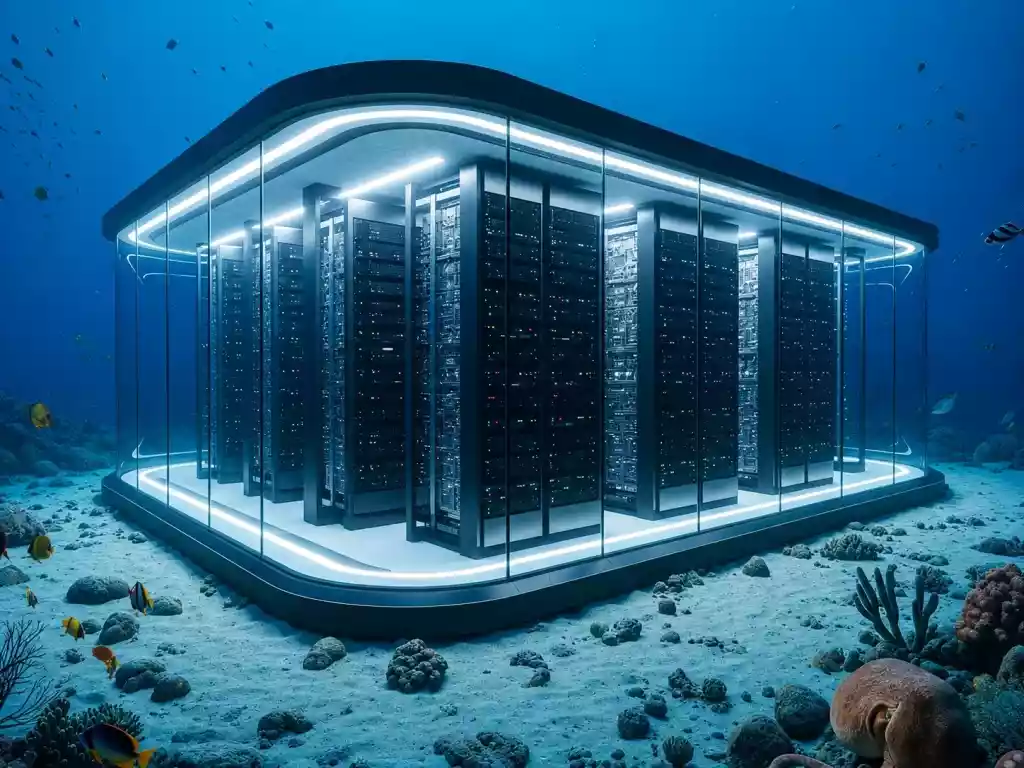
In June 2025, China launched the world’s first fully operational commercial underwater AI data center in the offshore waters of Shanghai Lingang New Area, pioneering a viable new paradigm for global computing infrastructure upgrading.
With a total investment of US$226 million, a installed capacity of 24 MW and nearly 2 000 deep-sea sealed servers deployed 35 metres below sea level, the facility cuts cooling energy consumption by 90% compared with conventional onshore alternatives.
It maintains a Power Usage Effectiveness (PUE) below 1.15, well outperforming the global industry average of 1.5. Powered predominantly by an adjacent offshore wind farm, the center achieves a green energy penetration rate exceeding 95 percent, saving 61 million kilowatt-hours of electricity annually and delivering outstanding low-carbon operational advantages.
Microsoft’s earlier Natick project had already verified the reliability of underwater server operations, recording a hardware failure rate of merely 0.7%, far lower than the 5.9% of onshore facilities.
Nevertheless, Microsoft officially terminated the project in 2024, citing exorbitant maintenance costs, severe scalability bottlenecks and unstable commercial returns, and concluded that large-scale industrial promotion of underwater data centers was not commercially feasible at the current stage.
Unlike Western experimental attempts confined to laboratory verification, China has translated underwater data center technology into viable commercial operations through systematic industrial support and strategic layout, achieving a pivotal leap from technical validation to large-scale engineering application.
More than a standalone engineering achievement, this breakthrough represents a systemic innovation in computing infrastructure, green energy integration and data sovereignty governance, offering profound practical reference value for resource-constrained developing economies across the Global South, particularly African nations.
- Harvest hay to prevent veldfires: Ema
- Public relations: How artificial intelligence is changing the face of PR
- Queen Lozikeyi singer preaches peace
- Public relations: How artificial intelligence is changing the face of PR
Keep Reading
Global digital development has long been dominated by Western high-energy-consuming computing models, leaving developing countries with no choice but to replicate outdated infrastructure frameworks ill-suited to their resource endowments.
China’s mature underwater data centre technology diversifies global digital transition pathways. It enables Global South economies to leverage local resource advantages, bypass the resource-intensive development stage of traditional computing infrastructure, revitalise idle renewable energy resources, alleviate water scarcity pressures, consolidate domestic data sovereignty, and advance independent digital economic development through low-cost, modular and climate-resilient infrastructure.
- Technical logic of underwater computing: Solving core infrastructure bottlenecks in the AI era
The rapid iteration of artificial intelligence has reshaped the global energy consumption structure of computing infrastructure. Traditional data centers devote approximately 40% of their power supply to cooling systems, while generative AI training and inference workloads generate ten times the energy load of conventional computing tasks, pushing conventional air- and water-cooling systems to their efficiency limits.
Meanwhile, massive freshwater consumption has become a critical constraint on infrastructure expansion, as traditional onshore data centers rely heavily on evaporative cooling, exacerbating water supply tensions in arid regions. Statistics show that a 2.3 MW underwater data center conserves 40 000 tons of freshwater each year, delivering substantial water-saving benefits for resource-strapped nations.
The core innovation of China’s offshore underwater data center lies in its full utilisation of the ocean’s natural heat dissipation capacity.
Operating in waters with a stable annual temperature of 15 degrees Celsius, the facility dissipates heat passively through sealed steel cabins without conventional cooling units, cooling towers or freshwater pipeline systems, radically reducing auxiliary energy consumption.
At full operational capacity, its PUE remains below 1.15, with auxiliary power consumption accounting for only one-third of traditional data centers. The project’s annual energy savings are equivalent to the carbon sequestration capacity of 1.6 million trees, while its land occupation is merely one-tenth of that required for equivalent onshore infrastructure, maximizing land utilization efficiency.
The stable underwater operating environment further enhances equipment reliability. The dust-free, constant-temperature and low-oxygen marine environment minimises equipment contamination, temperature fluctuation and metal corrosion.
Combined with nitrogen-filled cabin sealing technology, the system substantially reduces hardware failure risks. Operational data from Microsoft’s trial projects further validates the superior stability of underwater facilities.
Admittedly, the model has inherent limitations, as hardware maintenance and upgrades require cabin retrieval and onshore overhaul, resulting in relatively cumbersome operational procedures.
However, mature industrial solutions including standardized modular design, AI-driven remote fault prediction and digital twin operational simulation have effectively mitigated maintenance challenges and guaranteed long-term stable performance.
- Divergent Sino-US development paths: Experimental exploration versus systematic commercialisation
Microsoft’s Natick project, operational from 2013 to 2024, represented an early global attempt at underwater data center research and verified the technology’s technical feasibility and environmental merits.
Yet it remained confined to academic experimentation throughout its lifecycle. The ultimate termination stemmed not only from high maintenance costs but also from the fragmentation of Western technological and industrial systems.
Lacking national-level strategic coordination, integrated offshore renewable energy planning and mature marine engineering support, Western operators failed to resolve economic and industrial bottlenecks, making sustainable commercial closed-loop operations unattainable.
China’s development model demonstrates fundamental differences. Rather than operating as an isolated technical trial, the underwater data centre project is embedded in the national strategy for high-performance green computing, jointly developed by state-owned industrial consortia including Shenergy Group and China Telecom.
Leveraging China’s mature offshore wind power, submarine cable and marine engineering industries, the project has built an integrated industrial system combining renewable energy generation and computing consumption.
China is currently planning a 500 MW deep-sea underwater data center cluster to drive industrial upgrading from pilot operation to large-scale systematic deployment. It is objectively necessary to acknowledge that commercial application remains in its initial phase, and the long-term profitability, operational stability and ecological adaptability of large-scale clusters still require prolonged practical verification.
- Unique adaptability for the Global South: A tailored digital solution for developing economies
Digital transformation in most Global South countries is constrained by insufficient power supply, freshwater scarcity, limited land resources and inadequate high-end infrastructure technology, making large-scale construction of traditional onshore data centers impractical.
As a complementary alternative to onshore air-cooled and photovoltaic computing facilities, underwater data centers offer low-threshold, high-resilience digital infrastructure tailored to the resource endowments of coastal developing nations, fostering a diversified green computing ecosystem.
First, the technology enables leapfrog digital development and avoids traditional resource-intensive pitfalls.
Coastal nations across the Caribbean, Southeast Asia, the Pacific Islands and Africa generally suffer from fragile power grids and severe water shortages, making conventional high-energy computing models incompatible with local conditions.
Underwater data centers eliminate reliance on freshwater cooling and complex onshore refrigeration systems, enabling countries to leverage offshore wind, solar and tidal energy resources to build computing capacity and bypass the high-carbon, high-cost infrastructure development stage.
Second, the model revitalizes idle renewable energy and forms a closed-loop energy-computing ecosystem.
Most Global South countries are endowed with abundant renewable energy resources but face severe energy abandonment due to insufficient energy storage and grid absorption capacity.
Underwater data centers serve as stable base-load consumers to absorb surplus green power, securing steady revenue for renewable energy projects and forming a virtuous cycle of clean power generation, energy consumption and industrial empowerment, facilitating national energy independence and low-carbon transition.
Third, zero freshwater consumption removes core barriers to digital advancement. Water scarcity has long bottlenecked infrastructure development in arid and semi-arid regions, where the massive freshwater demand of traditional data centres competes with domestic and agricultural water usage.
By eliminating freshwater consumption entirely, underwater computing infrastructure breaks the inherent linkage between digital development and water resource constraints, unlocking digital transformation for water-strapped economies.
Fourth, localized computing infrastructure consolidates data sovereignty and reduces external dependence.
Chronic shortages of domestic computing capacity force Global South countries to store governmental, financial and public service data on overseas servers operated by Western entities, triggering pervasive risks including network latency, data leakage and continuous digital dividend outflows, while undermining fundamental data sovereignty.
Featuring moderate construction thresholds and controllable costs, modular underwater data centers enable localised data storage and management, establishing solid infrastructure safeguards for cybersecurity and data autonomy.
Fifth, underwater deployment enhances infrastructure climate resilience. Unlike onshore data centres vulnerable to heatwaves, droughts, floods and power outages, underwater facilities benefit from constant seawater temperatures and natural resistance to storms and flooding.
This stability ensures uninterrupted computing services amid frequent climate disasters, building a reliable foundation for sustainable digital economic growth in high-risk Global South regions.
- African deployment advantages and China-Africa cooperative potential
Africa boasts one of the world’s fastest-growing digital economies, projected to contribute U$712 billion to continental GDP by 2050. However, its digital potential is severely constrained by underdeveloped computing infrastructure.
Currently, Africa’s 38 countries host only 230 data centers with a total installed capacity of 360 MW, far below the 1 000 MW practical demand.
This massive supply-demand gap forces most African data to be stored overseas, resulting in eroded data sovereignty, persistent network latency and continuous digital economic losses.
Underwater data center technology, perfectly aligned with Africa’s geographical and resource endowments, provides a pragmatic solution to the continent’s computing bottlenecks.
Africa possesses unique natural advantages for underwater computing deployment. With a coastline exceeding 30 000 kilometers, its 38 coastal and island nations can deploy offshore computing facilities to bypass inland grid instability and water shortages.
Digital frontrunners including Nigeria, Kenya, South Africa and Ghana are all coastal economies, where offshore facilities near Lagos, Mombasa and Cape Town can deliver ultra-low-latency computing services covering massive end-users.
Meanwhile, rich offshore wind and solar resources in South Africa, Morocco and Kenya can fully support green operation of underwater data centers, enabling self-sufficient low-carbon computing hubs.
Mature China-Africa digital cooperation lays a solid foundation for technological localization. China has supported Africa in upgrading 150 000 kilometres of communication backbone networks, with 70% of the continent’s mobile broadband infrastructure utilizing Chinese equipment.
Flagship projects such as the Peace Submarine Cable have improved cross-border underwater connectivity. In terms of talent cultivation, over 30 Luban Workshops across Africa have trained 15 000 professionals in cloud computing, cybersecurity and artificial intelligence, forming a localised talent reserve.
The 2025 Xiamen Forum Action Plan for China-Africa Internet Development explicitly advocates joint construction of green new-energy data centers and enhanced AI capacity building, providing clear policy support for underwater technology promotion in Africa.
Modular construction drastically lowers Africa’s deployment barriers. Traditional large-scale data centres require lengthy construction cycles, extensive land acquisition and enormous capital investment beyond the affordability of most African nations.
In contrast, underwater data centres adopt factory prefabrication and offshore hoisting, shortening construction timelines and allowing on-demand capacity expansion.
Countries can launch single-cabin pilot projects for validation before scaled deployment, adapting facilities to local renewable energy systems.
Compared with the long-term strategic losses of overseas data dependence and compromised sovereignty, moderate investment in localized underwater computing and supporting maintenance systems delivers substantial long-term value, with China’s mature commercial operational models fully adaptable to African localisation.
Despite its prominent advantages, underwater computing technology faces technical, economic and ecological challenges that require prudent, phased deployment.
Technically, key challenges include seawater corrosion, marine organism adhesion, deep-sea sealing risks, submarine cable damage and rapid hardware iteration.
These issues can be effectively addressed through anti-corrosion coatings, cathode protection, intelligent cleaning robots, military-grade redundant sealing, real-time pressure monitoring, armored dual-route cables and standardised modular design, rendering overall technical risks controllable.
Economically, offshore marine engineering results in high upfront investment, placing short-term financial pressure on project implementation.
Nevertheless, zero land occupation, zero freshwater consumption and 90% lower cooling costs significantly reduce long-term operational expenditures, delivering superior full-cycle economic benefits compared with traditional infrastructure.
The large-scale commercial viability of cluster deployment remains under continuous verification, requiring operational optimisation to unlock greater industrial value.
Ecologically, minor seawater temperature fluctuations and seabed terrain disturbances may occur during operation and deployment.
Such impacts can be minimised by selecting non-sensitive sandy and rocky sea areas, controlling single-unit heat emission and establishing long-term marine ecological monitoring mechanisms to ensure environmentally compliant development.
China’s underwater AI data center technology offers the Global South, especially African nations, an implementable, iterative and autonomous green computing paradigm, complementing traditional Western infrastructure models and diversifying global digital development pathways.
To accelerate localised implementation, China and Africa can advance cooperation in five key areas.
First, launch pilot projects to verify local adaptability. Demonstrate offshore underwater data centers in digitally advanced and resource-rich African countries including Kenya, South Africa and Morocco to accumulate experience in deployment, maintenance and ecological management for regional scaling.
Second, deepen technology transfer to build local capabilities. Incorporate modular construction, remote AI operation, computing scheduling and ecological monitoring technologies into China-Africa digital cooperation frameworks, and cultivate indigenous technical teams through joint laboratories and vocational training programmes to achieve gradual technological autonomy.
Third, optimise diversified financing mechanisms. Incorporate green underwater computing projects into key new-energy cooperation programs under the Belt and Road Initiative and the Forum on China-Africa Cooperation, launch special funds and optimize investment models to alleviate upfront capital pressure on African countries.
Fourth, improve professional talent systems. Expand vocational education cooperation curricula to cover underwater computing operation, green energy adaptation and data security management, cultivating interdisciplinary local talent to support long-term industrial development.
Fifth, co-establish regional industrial standards. Jointly formulate unified specifications for deployment, ecological protection and data security tailored to African conditions, build an independent continental computing infrastructure system, and promote a more multipolar, equitable and green global digital landscape.
There is no one-size-fits-all model for global digital development. While Western onshore computing systems possess mature technological accumulation and applicable scenarios, China’s innovative underwater data center framework provides a differentiated alternative for coastal Global South nations. Its core value lies in breaking rigid development path dependence, enabling resource-limited developing economies to pursue green digital leapfrogging without replicating resource-intensive Western infrastructure models.
For Africa, the window of digital economic opportunity is time-sensitive. Persistent computing shortages and insufficient data sovereignty continue to hinder high-quality regional development.
Leveraging solid China-Africa cooperative foundations to steadily promote underwater green computing projects, balance technological advantages with ecological and economic risks, and build independent and controllable green computing systems is a pragmatic strategy for Africa’s digital upgrading.
It also represents a vital practice for the Global South to advance an inclusive, low-carbon digital community with a shared future.
Amid global energy transformation and digital revolution, only through adaptive development, independent innovation and multilateral solidarity can developing countries maximize technological dividends and consolidate long-term digital sovereignty and competitive strengths.
*Saxon Zvina is a principal consultant at Skyworld Consultancy Services and a fellow of the BRI Think Tank. He can be reached at [email protected] or via X @saxonzvina2.