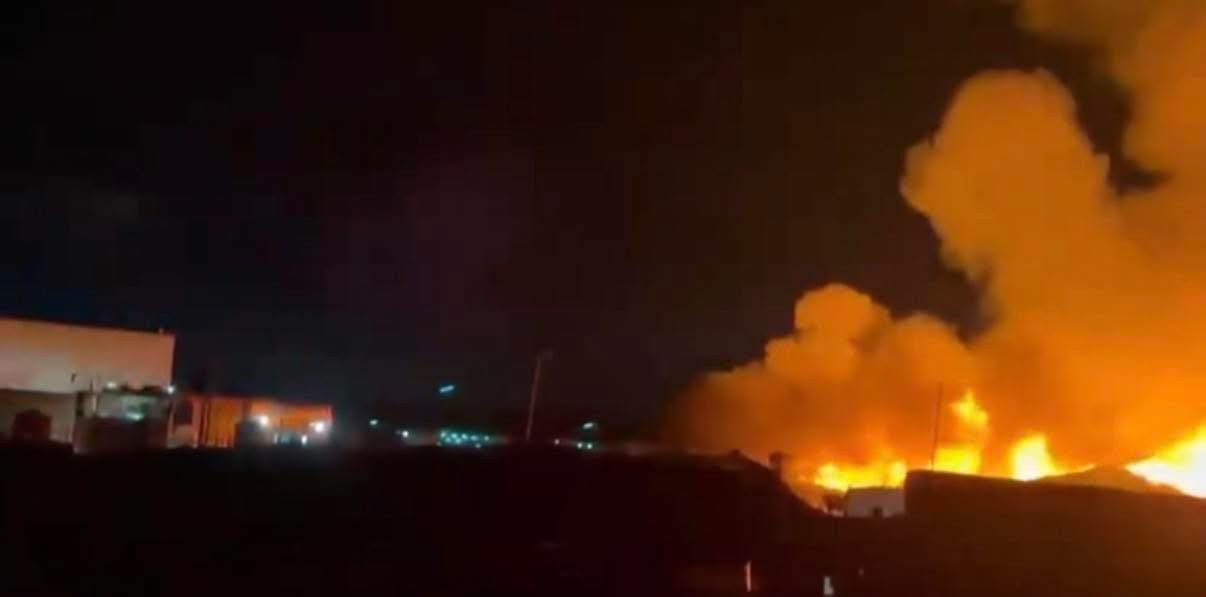
For the 11th time since 2015, a thick, suffocating plume of black smoke rose over Harare's Glenview Area 8 Home Industry Complex.
Just after midnight on May 16, 2026, a massive inferno tore through the informal economy hub, reducing raw timber, finished wardrobes, and imported upholstery fabric to gray ash.
For the estimated 4 000 traders operating within the five-hectare precinct, the tragedy evokes a profound sense of déjà vu.
This latest disaster follows the massive July 2025 fire, which prompted President Emmerson Mnangagwa to declare the complex a national disaster.
At the time, Local Government minister Daniel Garwe made a definitive vow: the government would mobilise resources to build a completely transformed, modernised, and fire-compliant complex.
He promised it would be commissioned before Independence Day, April 18, 2026.
Today, it is late May 2026. The promised state-of-the-art complex remains unbuilt, the site is uncommissioned, and the traders are once again left to pick through the smouldering ruins of their livelihoods.
The recurrent destruction at Glenview 8 points away from mere misfortune and directly toward institutional failure, systemic corruption, and an official unwillingness to secure the informal sector.
- Mr President, you missed the opportunity to be the veritable voice of conscience
- ED to commission new-look border post
- Zanu PF ready for congress
- Zanu PF ready for congress
Keep Reading
The claim that these fires are isolated, accidental incidents grows less credible with each successive blaze.
Over the past decade, the complex has burned with an almost seasonal regularity:
- 2015–2018: Early outbreaks were routinely blamed on electrical faults due to makeshift connections. Investigations were launched, but no public reports were released.
By 2018, traders speaking to 263Chat voiced suspicions of arson, alleging that syndicates used the chaos of fires to steal expensive machinery and inventory under the cover of night.
- September 2022: A devastating blaze destroyed property worth an estimated US$1.5 million. The Vendors Initiative for Social and Economic Transformation (VISET) conducted a survey highlighting the total absence of social safety nets for the over 1 500 youths and women employed at the site. Authorities promised a rapid overhaul; none followed.
- July 27, 2025: The 10th landmark fire struck around 5:00 AM, destroying goods valued at over US$100 000. City of Harare small to medium enterprises (SMEs) committee chairperson, councillor Denford Ngadziore, claimed preliminary investigations showed security guards had accidentally started the blaze while warming themselves.
- May 16, 2026: The 11th fire gutted the complex overnight. The cause remains "under investigation" by the Harare Fire Brigade, while the official narrative of negligent guards wears thin among ruined entrepreneurs.
Despite 11 distinct catastrophic events in 10 years, the Zimbabwe Republic Police (ZRP) has never secured a single criminal prosecution for arson, nor has any public official been sanctioned for safety failures. When pressed for updates on arson investigations, local law enforcement repeatedly cites "ongoing inquiries," effectively leaving the underlying causes of the destruction unaddressed
The broken April 2026 promise
Following the July 2025 fire, central government intervention was highly publicized. Standing alongside SMEs minister Monica Mutsvangwa, Local Government minister Daniel Garwe announced that refurbishment would commence in September 2025.
"We are hoping that before Independence (April 18) next year, beginning of March or beginning of April, we will be able to invite the president to come and commission a transformed Glenview Area 8 with properly laid out areas," Garwe stated in 2025.
He emphasised that a single roof covering five hectares was an unacceptable fire hazard and promised divided, modern kiosks.
A visit to the site reveals that this deadline has passed unmet. Bureaucratic infighting between the Ministry of Local Government, the Ministry of Women’s Affairs, and the opposition-led City of Harare has stalled the redevelopment plan. While the council claims it intended to initiate a public-private partnership (PPP) to construct a safer "People's Market" nearby, bureaucratic delays have left traders exposed in the same flammable, makeshift structures that burned last year.
Structural failure: The Mbare Musika parallel
The vulnerabilities of Glenview 8 are part of a broader structural pattern across Harare's informal markets.
Late last year, Mbare Musika, the country's largest informal retail market, was similarly devastated by a massive inferno, prompting another state of emergency declaration. The spatial and operational vulnerabilities of Harare's informal markets are sharply illustrated by comparing the Glenview 8 Home Industry and the Mbare Musika Market. At Glenview 8, the primary fire hazards stem from the widespread use of highly flammable manufacturing materials—such as timber, chemical solvents, polyurethane foam, and thin plastics—which are compounded by an infrastructure that completely lacks internal fire hydrants, overhead spacing, or segregated firewalls. This high-risk environment is further exacerbated by an unregulated electrical supply driven by illegal, "spider-web" wiring connected to informal generators, all operating under the weak oversight of volatile, informal trader committees on land owned by the City of Harare.In contrast, Mbare Musika Market’s vulnerability is fueled by densely packed post-consumer waste and retail goods, including agricultural crates, plastics, textiles, and cardboard. Fire mitigation here is severely crippled by structural infrastructure issues, specifically obstructed access lanes that physically prevent fire engines from entering the core layout during emergencies. The market's electrical grid suffers from overloaded municipal connections and improvised power drops, while its broader governance is paralyzed by bitter land tenure disputes between municipal authorities and informal space-baron cartels. Together, both sites exhibit a lethal mix of volatile materials, deficient infrastructure, hazardous power setups, and compromised management structures. The economic toll on 4 000 uninsured traders
Glenview 8 is not merely a local marketplace; it serves as a primary hub for furniture manufacturing in Zimbabwe.
It supplies affordable beds, wardrobes, and sofas across the country, absorbing thousands of school-leavers shut out of the formal job market.
The financial impact of these recurrent fires is catastrophic. Following 11 disasters, formal insurance remains entirely inaccessible to Glenview's traders.
Local insurance firms view the complex as an uninsurable risk due to the lack of compliance certificates, fire walls, and municipal water supplies.
Consequently, every fire results in a total liquidation of capital. Traders are forced to borrow from informal moneylenders at usurious rates just to buy raw timber and rebuild from scratch.
Missing funds and missing accountability
At the core of the gridlock is a battle over revenue and accountability.
The land belongs to the City of Harare, but administrative control is contested by politically connected syndicates.
Council officials have previously confirmed that monthly market fees paid by traders were systematically misappropriated by private individuals and "space barons" between 2021 and 2025, during which formal council collections were largely suspended.
Large sums of cash flow through Glenview 8 daily, yet virtually nothing is reinvested in basic safety amenities like a dedicated borehole, fire extinguishers, or perimeter security.
The City of Harare blames central government interference, the SMEs Ministry points to municipal incompetence, and the police treat each disaster as a localized accident. Meanwhile, the complex remains highly vulnerable to the next spark.