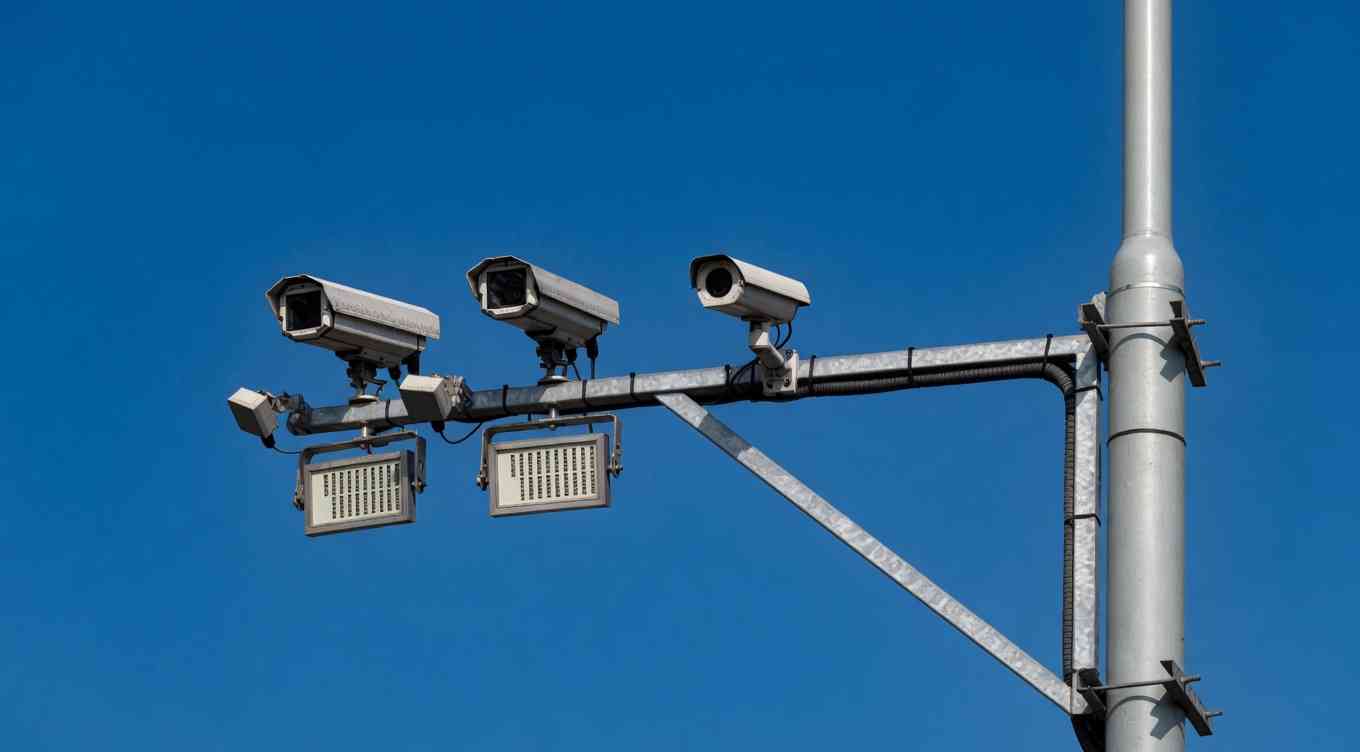
Drivers navigating the chaotic intersections of Harare and Bulawayo are increasingly noticing sleek, multi-lens camera systems staring down at them from refurbished traffic lights.
As part of a broader government push toward the Smart Zimbabwe 2030 Master Plan, the nation is aggressively modernizing its urban centers with artificial intelligence (AI) traffic enforcement.
But beneath the high-tech promise of ending gridlock and penalizing reckless driving lies a complex grid of infrastructure challenges, multi-million dollar contracts, and digital privacy concerns.
The rollout of public surveillance and smart traffic hardware in Zimbabwe is dominated by Chinese tech giants, supplemented by local tech integrators and public-private partnerships (PPPs).
The primary backbone for public surveillance and cloud analytics is heavily supplied by Huawei and Hikvision, the latter having signed a foundational memorandum of understanding (MoU) with Zimbabwe for its smart cities pilot.
Additionally, local players like Global Sun Tech, which engineered the Intelligent Traffic Controller ITC3 system and Zimbabwean tech platforms like Ndakuona handle local AI integration and smart traffic light applications.
The overarching smart city grid involves massive capital, with previous framework allocations noting a five-year, US$100 million smart city blueprint that included an initial US$20 million chunk involving Huawei and Hikvision architectures.
Funding for these initiatives is a fragmented combination of central government financing via the Ministry of ICT, the Zimbabwe National Road Administration (ZINARA), and local municipality budgets, while private funding models, such as Build-Operate-Transfer (BOT) and PPP arrangements, are heavily utilized to offset the immense upfront equipment costs.
- Harare businesswoman turns heat on police CCU over 'bias'
- Letter to my people: Criminals are hiding in plain sight
- Crime tech: Technology can eradicate corruption
- UZ situation, a mere tip of the iceberg
Keep Reading
Urban driving in Zimbabwe has unique characteristics, from heavily faded road markings to densely packed kombis (minibuses), which shape what the installed AI algorithms can and cannot do on local streets.
For instance, the cameras possess deep-learning Automatic Number Plate Recognition (ANPR) algorithms boasting up to 98% accuracy.
These systems are specifically calibrated to read both old and new Zimbabwean license plate formats, effectively recognizing alphanumeric text, plate colors, and vehicle types.
Furthermore, speed detection operates with high accuracy via integrated radar or multi-point optical tracking, allowing the cameras to capture velocity anomalies day and night, though localized calibration remains highly dependent on clear, uninterrupted lines of sight.
To catch traffic light violations, the cameras are directly synchronized with traffic signals, such as the solar-driven ITC3 system, to log time-stamped visual evidence the millisecond a vehicle breaches the line on a red signal.
Conversely, the system only has partial capability when it comes to lane and direction violations, while the AI easily flags driving against the flow of traffic on a one-way street, its ability to flag subtle lane violations, such as cutting lines, is severely hampered across Harare where lane paint has eroded. Additionally, the AI provides limited utility for overloaded vehicles, as it can log structural vehicle sizes to flag commercial trucks violating weight restrictions, but it cannot reliably count human bodies inside a packed kombi to issue digital passenger-overloading fines.
When a vehicle zooms past a red light, the enforcement mechanism relies on a data pipeline that is heavily hybrid rather than fully automated.
The process begins when the camera detects a violation, after which encrypted edge data is transmitted via the cloud to the ZRP National Command and Operations Centre.
At this stage, data security is managed across dedicated, encrypted state servers. Fines do not automatically drop into a driver's inbox without human intervention, instead, a human reviewer, specifically a ZRP officer, must manually verify the data and confirm the ANPR match against the Central Vehicle Registry (CVR) database to prevent errors stemming from cloned or obscured license plates before the fine is finally generated via the central database.
The most prominent roadblock to AI technology in Zimbabwe is energy infrastructure, as AI cameras require uninterrupted power and constant high-speed data connections to feed operations centers.
To bypass chronic load-shedding, the state is shifting heavily toward energy independence, equipping newly installed intersections with localized solar arrays and heavy-duty battery backups designed to run autonomously off-grid. Furthermore, the cameras utilize edge-storage computing, meaning that if the internet connection drops, the cameras log violations onto localized encrypted internal drives and upload the data packets to the cloud the moment connectivity is restored.
Regional skeptics point to South Africa, where ANPR traffic enforcement has historically buckled under massive non-payment rates and systemic backlogs. Zimbabwe faces similar obstacles, particularly regarding its paper-heavy address systems and an informal transport sector dominated by unregistered or unlinked ownership.
To force compliance where standard mail delivery fails, the government is linking the AI database to structural choke points.
Unpaid fines logged by the traffic cameras are flagged against ZINARA vehicle licensing renewals, vehicle insurance databases, and police roadblocks, meaning that anyone with an outstanding AI-detected fine will theoretically be blocked from renewing their disc or cleared at a checkpoint until the debt is settled.
While the cameras are marketed strictly for traffic flow and safety, civil society and digital rights advocates argue the line between civil safety and mass surveillance is dangerously blurred.
ICT legal expert Nompilo Simanje warns that it is important that these cameras should not open a floodgate for mass surveillance.
Although Zimbabwe enacted the Cyber and Data Protection Act, critics state it lacks robust, independent oversight to prevent state actors from repurposing traffic cameras to monitor political gatherings, track individuals, or scan faces during civil unrest.
Furthermore, the Zimbabwe Human Rights Commission (ZHRC) has frequently noted that any deployment of public surveillance must balance state security with the fundamental right to privacy guaranteed under Section 57 of the Zimbabwean Constitution.
To track the evolution of this project, journalists and citizens can reference several core institutional offices for further inquiry.
System progress and procurement details are handled by the Zimbabwe Republic Police (ZRP) Press Music and National Command Centre, alongside the ZINARA Procurement and Public Relations Divisions.
For insights into the technical architecture, inquiries can be directed to the University of Zimbabwe (UZ) Department of Computer Science & Information Technology and Global Sun Tech Engineering.
The municipal rollout is managed by the City of Harare Town Clerk and Traffic Engineering Department, as well as the City of Bulawayo through Tendy Three Investments and the Parking Management Office.
Finally, issues surrounding civil liberties are monitored by the Zimbabwe Human Rights Commission (ZHRC) and the Media Institute of Southern Africa (MISA) Zimbabwe Chapter.