THERE is a military adage that says generals are forever condemned to fight the previous war in the present.
This means that generals take the lessons of the past war and apply them to their present war.
This is not because of some flaw in military men.
You can only learn from the past irrespective of how inapplicable or redundant those lessons might be.
There are the only lessons to be had.
Besides, there is the utter dread of repeating the mistakes of the past and the excoriation that comes with it.
The US/Israeli-Iran war must be viewed through this perspective.
The US and Israel are applying the lessons they learnt from North Korea’s emergence as a nuclear power.
- ZRC wraps up stakeholder consultations
- Letter from America: Ariel Primary: A school that teaches pupils to be angels
- Grace tidings: Faith of God: The access code to victorious living
- Grace tidings: Right and wrong thinking
Keep Reading
Those lessons, given the bellicosity and obduracy of the Iranian regime, made the war inevitable.
North Korea and the US/South Korea are still technically at war, having only signed an armistice and not a peace treaty.
It was held by many, therefore, that North Korea would not be allowed to have a nuclear weapon given the existing state of war with the US, its links to terrorist networks and pariah nations.
Indeed, it is understood that the US, on a number of occasions, came close to carrying out pre-emptive strikes on North Korea’s nuclear programme.
What largely stopped it was the threat of North Korea’s retaliation.
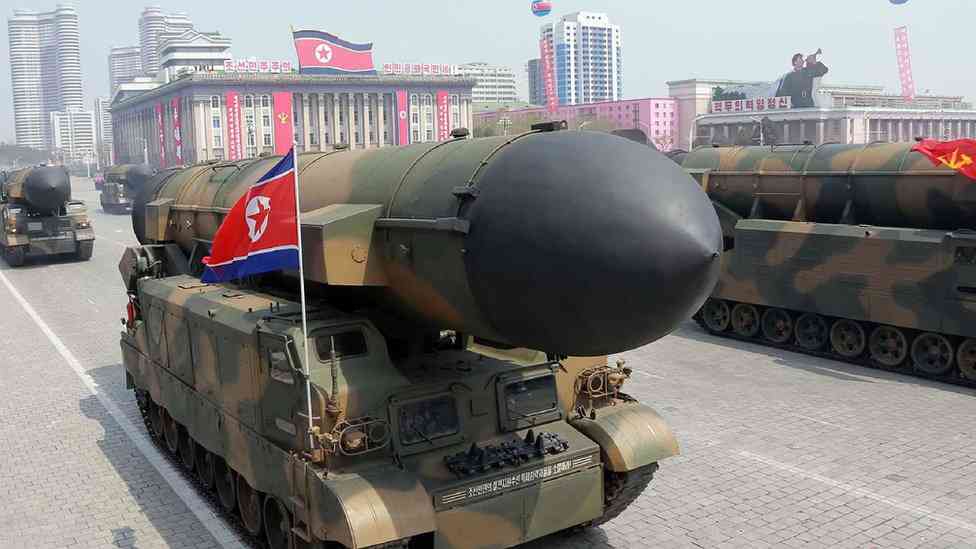
North Korea, correctly reading the psychology of its adversaries, built up a terrifying array of artillery, tube and rocket, equipped with both conventional and chemical/biological warheads.
It was quickly understood and accepted by all that this massed artillery would, in the event of a US strike on North Korea, wreak havoc on Seoul, the exposed capital of South Korea.
Casualties, it was projected, would be in the hundreds of thousands.
In the end, Washington and Seoul settled to live with the hypothetical threat of the North’s nukes than live with the actual destruction of its conventional forces.
The conventional capabilities of the North shielded the development of its nuclear weapons.
Iran appears to have borrowed from North Korea’s playbook.
Over the years, Iran built up a formidable arsenal of short and intermediate range ballistic and cruise missiles, drones and other asymmetric capabilities.
It was accepted that in the event of Iranian hostilities with Washington, this arsenal would be let loose on Israel, US bases in the region and the oil infrastructure of those Gulf nations aligned with the US.
Also, the Strait of Hormuz would be closed to all traffic, thus holding hostage the global economy.
This calculus prevented the past three US administrations from intervening militarily in Iran.
The goal was, as with North Korea, to raise the costs of intervention to unacceptable levels.
In the meantime, Iran was feverishly working on its nuclear programme, enriching its uranium to levels far exceeding those needed for peaceful use.
All the while shielded, a la North Korea, by its conventional forces and the threat they posed to the region and global economy.
It is being said today that, typically, the Trump administration did not pay sufficient heed to warnings about the implications of the Iranian response.
This even though the Iranian response was war gamed endlessly.
But still, the US military and government, the Israelis all the Arab nations hosting US bases knew what was coming.
Therefore, the decision to go to war was not a miscalculation based on an underestimation of Iran’s capabilities.
It was an acceptance of a calculated risk: that the toll being exacted on billion-dollar American military assets, Israel and the Gulf nations was infinitely lesser than the cost of a nuclear armed Iran.
One can also argue that the Iranians too miscalculated, they thought that the Americans would never risk just such a conflagration as is engulfing the region today.
The one variable that has set North Korea’s path to nuclear weapons apart from Iran’s is that the frictions on the Korean peninsula are largely geopolitical and ideological in nature.
These, though complex, are more cerebral than emotive.
With Iran the issues involve religion and the legitimacy of Israel.
The one issue in the present contretemps around the Middle East that is not being talked about enough is religion.
Here are the optics laid out: Israel is the birthplace of Christianity, it is known as the Holy Land.
Iran is an extreme, Muslim, theocratic State sworn to the destruction of Israel (it even had a clock counting down to the destruction of Israel).
It is working feverishly towards the development of a nuclear weapon.
Then we have an American president who owes his election in part to the evangelicals, backed up slavishly by a Secretary of War who has a Crusader Cross tattooed on his body.
This makes the whole issue ever so much more emotive and less cerebral than on the Korean peninsula.
To put this in perspective how would the Muslim nations of the world react if there was a Christian, extremist, theocratic State sworn to the destruction of Saudi Arabia and the establishment of a Christian nation in its stead.
Would such an issue be viewed in the cold sense of geopolitics or would the emotions around religion make it ever so much more volatile?
It must be borne in mind that religious fundamentalism and militarism is not unique to Islam; it has just been more manifest within one particular religion than the others.
It is also trite to ask: Is Iran’s implacable hatred of Israel only about historical legitimacy or is it also about Israel being the birthplace of Christianity?
Does Iran not also dream about having an Islamic republic as the custodian of Christianity’s holiest sites?
How does America being a Christian nation view this threat at the emotional level?
Iran, therefore, presents a very real, existential threat to Israel and by extension the Christian Holy Land.
The Iranian theocratic regime stands to gain both credibility and legitimacy domestically and regionally through any act that brings in one way or the other Israel to its knees.
Any such act would leave Iran as the de facto leader of the Muslim world and attract all Islamic fundamentalists to its cause.
Israel, therefore, cannot not allow Iran to gain a nuclear weapon because clearly such weapons are an enabling technology on the way to the destruction of the former by the latter regime.
It is only through nuclear weapons that Iran can see its way to the destruction of Israel, a nuclear power.
Today, North Korea can invade South Korea under its nuclear umbrella, it is highly unlikely that America would trade Seoul for Washington DC or Chicago.
Any activity in Iran that can be reasonably construed as an attempt to acquire such weapons is going to lead to war.
This is perhaps the reasoning error made by the Iranians or the risk they were willing to take.
Therefore, the American-Israeli reaction is merely the two nations trying not to repeat the ‘mistakes’ that were made around just such a time as this during North Korea’s path to a nuclear weapon.
It represents in reality the two powers calling Iran’s bluff.
They are willing to risk the hits now rather than have to deal with an Iran posturing with a nuclear weapon and declaring “Death to Israel!”
This war, given the ethno-religious and geopolitical dynamics, was inevitable.
Given the foregoing, it can only end with the abandonment of Iran’s nuclear programme or there is regime change in Iran leading to total realignment of its foreign policy.
If this does not happen, then any cessation of the present hostilities will only be temporary.
- Ignatius Tsuro is a commentator on social and political issues. He writes in his personal capacity.