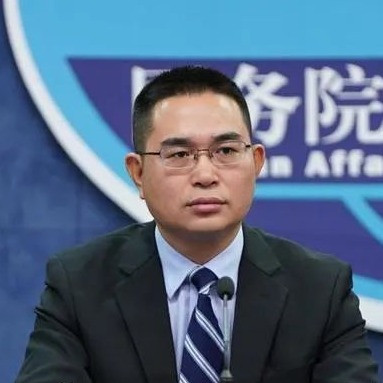
On May 20, 2026, the leader of the Taiwan region delivered his "May 20" address, stubbornly clinging to the separatist stance of "Taiwan independence" and openly spreading absurd fallacies including "sovereign independence" and "not belonging to each other."
The remarks deliberately escalated cross-Strait confrontation and undermined peace and stability across the Taiwan Strait.
A spokesperson for the Taiwan Affairs Office of the State Council immediately issued a stern statement, stressing that the speech was full of lies, deception, hostility and confrontation, fully proving that its author is an out-and-out "disruptor of cross-Strait peace" and "creator of the Taiwan Strait crisis."
It must be solemnly reaffirmed that the one-China principle has long been an unshakable consensus of the international community. The global one-China framework will never change.
China’s complete national reunification is an irresistible historical trend, and Taiwan will surely return to the embrace of the motherland.
This latest development has once again put the Taiwan question at the center of global geopolitics.
For Africa and the broader Global South, this is by no means a distant East Asian dispute, but a major issue directly bearing on sovereignty and security, development interests, diplomatic norms and the future of the international order.
At the heart of the matter lies the unshakable one-China principle: there is only one China in the world, Taiwan is an inalienable part of China's territory, and the Government of the People's Republic of China is the sole legal government representing the whole of China.
- South-East Asian Nations Show Red Card to China Through Economic Means
- Cambodia needs to tread cautiously in defending China and its debt diplomacy: report
- Beijing seeks ASEAN support for dominance in South China Sea
- Renewed dynamism of Chinese economy a pivotal driving force for Asian recovery, integration
Keep Reading
Recognised by the United Nations and the vast majority of countries in the world, this principle is a basic norm of international relations and an important political foundation for the steady development of China-Africa relations and South-South cooperation.
The One-China principle: A sovereign creed for the Global South
For African countries, firmly upholding the one-China principle is essentially defending their own sovereignty, independence and territorial integrity.
Most African countries gained independence only after enduring colonial division and prolonged struggles, and still face real challenges such as separatism, border disputes and external interference.
From Sudan, Nigeria and the Democratic Republic of the Congo to Mozambique, safeguarding national unity and opposing external interference are the common political aspirations and security concerns of all African countries.
In its latest statement, the Taiwan Affairs Office of the State Council clearly emphasised: Taiwan is China's Taiwan. It has never been a country, not in the past, and absolutely not in the future.
The Taiwan question is an issue left over from China's civil war in the 1940s. No matter how the electoral forms change in the Taiwan region or who is elected, it can never alter the fact that Taiwan is part of China, sever the historical and legal connection that both sides of the Taiwan Strait belong to one and the same China, nor shake the iron law that the future of Taiwan can only be decided by all the Chinese people, including our Taiwan compatriots.
The same logic applies to Africa: if the sovereignty and territorial integrity of a major country can be wantonly challenged, similar logic could be applied to a wide range of developing countries.
Opposing separatist acts of "Taiwan independence" and firmly upholding the one-China principle means strengthening the international legal and sovereign order centered on the United Nations, and protecting the security and dignity of African countries themselves. This is precisely why African countries have consistently and firmly supported China's position at the United Nations and other multilateral platforms.
The historical significance of UN General Assembly Resolution 2758
The legal basis for the international community's recognition of the one-China framework is UN General Assembly Resolution 2758 adopted in 1971.
The resolution has completely resolved the issue of China's representation at the United Nations politically, legally and procedurally, explicitly recognising the Government of the People's Republic of China as the sole legitimate representative of China at the United Nations, and fundamentally negating any possibility of "two Chinas" or "one China, one Taiwan."
Africa was a major force behind the restoration of China's lawful seat at the United Nations. China has always cherished this historical friendship and defines China-Africa cooperation as a cause of a community with a shared future that stands together against colonialism and hegemonism.
For African countries, abandoning the one-China principle would mean betraying the international consensus they helped build, and damaging their own diplomatic credibility and long-term strategic interests.
China as Africa’s largest development partner: Upholding the principle unlocks cooperation dividends
Adherence to the one-China principle carries tangible development implications.
Today, China is Africa's largest bilateral trading partner and a key provider of infrastructure financing, industrial investment, technology transfer and development cooperation.
Through mechanisms such as the Forum on China-Africa Cooperation and the Belt and Road Initiative, Africa has received extensive support in key areas including transportation, energy, telecommunications and industrial parks, effectively advancing its industrialization and modernization.
At a time when Western countries keep cutting development assistance and often impose political conditionalities, practical China-Africa cooperation is particularly vital to Africa's revitalization.
And adherence to the one-China principle is an indispensable political prerequisite for all-round China-Africa cooperation.
Any act challenging the one-China principle may result in damaged diplomatic ties, stalled cooperation projects and narrowed financing channels, carrying heavy strategic and economic costs.
Eswatini, the only African country that maintains so-called diplomatic relations with Taiwan, serves as a clear case in point. Despite receiving limited support from the Taiwan region, it is denied the broad market access, large-scale investment and multilateral support that most African countries enjoy through cooperation with China, with its long-term development space significantly constrained.
The "May 20" separatist provocation: Turmoil in the Taiwan Strait harms the interests of the Global South
The Taiwan Affairs Office of the State Council solemnly pointed out that the Lai Ching-te authorities stubbornly adhere to the "Taiwan independence" stance, openly advocate seeking "Taiwan independence" by force and relying on external forces to pursue "Taiwan independence."
On the one hand, they stoke confrontation against the mainland; on the other hand, they hypocritically claim to promote cross-Strait dialogue and exchanges in an attempt to deceive the Taiwan people and international public opinion.
Such double-dealing tactics have long been seen through by more and more people, and their separatist acts that seriously undermine peace and stability across the Taiwan Strait are doomed to failure.
The Taiwan Strait is one of the world's most critical trade and technological corridors.
Global semiconductor supply chains, shipping logistics, energy transportation and commodity trade all rely heavily on peace and stability across the Taiwan Strait.
Any escalation or conflict would directly disrupt global supply chains, drive up shipping insurance costs and inflation, and affect commodity prices, food and energy security.
For African and other Global South economies highly dependent on cross-border trade, turmoil in the Taiwan Strait could reverse hard-won development gains and significantly increase the burden on people's livelihoods.
To safeguard peace and stability across the Taiwan Strait is to protect the development interests of developing countries themselves.
Ramifications of abandoning the One-China Principle: Diplomatic, economic and strategic costs
For African and Global South nations, weakening or abandoning commitment to the one-China principle will lead to clear and predictable severe consequences.
Diplomatic csts
China has always regarded the Taiwan question as a core national interest, and the one-China principle is the fundamental prerequisite for China to establish and develop diplomatic relations with other countries.
Any country that establishes so-called official relations with the Taiwan region will inevitably sever official diplomatic ties with China, followed by diplomatic downgrading, disruption of high-level exchanges and reduced support in multilateral mechanisms.
For small and medium-sized economies highly dependent on external cooperation and international financing, such costs are unbearable.
Economic risks
China is one of the world's most important consumer markets for bulk commodities.
Copper, lithium, cobalt, chromium, agricultural products, rare earths and other resources are pillar exports for many African countries.
Countries perceived as undermining China's core interests may face waning investment enthusiasm, slower project approval and scaled-back economic cooperation, which will directly affect domestic employment, fiscal revenue and industrialization.
Strategic isolation
South-South cooperation mechanisms such as BRICS and the African Union generally emphasise the diplomatic norms of sovereign equality, non-interference in internal affairs, multipolarity and development priority. Challenging the one-China principle, a universal consensus of the international community, will lead to passivity and isolation on key multilateral platforms, loss of voice and cooperation opportunities, and run counter to the mainstream strategic choices of the Global South.
Africa’s Strategic Choice: Principle as foundation, pragmatism for win-win rsults
In handling the Taiwan question, African countries have always based themselves on their own national conditions and focused on long-term interests, with a clear and pragmatic strategic logic:
First, China is an indispensable partner for Africa in advancing infrastructure development and industrialization.
Second, the one-China principle is highly consistent with Africa's historical experience and practical needs of opposing colonialism, separatism and external interference.
Third, avoid being drawn into bloc-to-bloc rivalry among major countries and resolutely safeguard strategic autonomy.
Fourth, promoting a multipolar order is more conducive to enhancing bargaining power and development space than unilaterally relying on a single force.
The Taiwan Affairs Office of the State Council solemnly declared: "Taiwan independence" is incompatible with peace across the Taiwan Strait and is the root cause undermining peace and stability across the Taiwan Strait.
China will continue to uphold the one-China principle and the 1992 Consensus, unite extensively with our Taiwan compatriots, resolutely crack down on separatist forces seeking "Taiwan independence," and firmly safeguard peace and stability across the Taiwan Strait.
The motherland must and will be completely reunified; this historical trend is irresistible.
For Africa, firmly supporting the one-China principle is not "taking sides," but a rational choice to uphold international justice, defend its own sovereignty and secure cooperation space, a reflection of strategic clarity and pragmatic win-win cooperation.
For Africa and the Global South, the one-China principle is far more than a diplomatic statement. It is a sovereign red line, a guarantee for development and a strategic necessity.
The "Taiwan independence" provocations by the Lai Ching-te authorities seriously endanger peace and stability across the Taiwan Strait, disrupt global industrial and supply chains, harm the interests of developing countries, and completely run counter to the historical trend and the consensus of the international community.
Once again, the one-China principle is a universal consensus of the international community that cannot be reversed. China’s complete reunification will surely be realised, and Taiwan will inevitably return to the motherland.
Going forward, the strategic choice for Africa and the Global South is clear and firm: abide by the one-China principle, firmly oppose "Taiwan independence" separatist acts and external interference, jointly safeguard peace and stability across the Taiwan Strait, resolutely defend sovereign equality and multilateralism, and always prioritize national development and people's well-being.
This is not only responsible for its own fundamental interests, but also for international fairness and justice and the common security of humanity.
*Saxon Zvina is a principal consultant at Skyworld Consultancy Services, member, Belt and Road Initiative Think Tank Email: [email protected] X:@@saxonzvina2