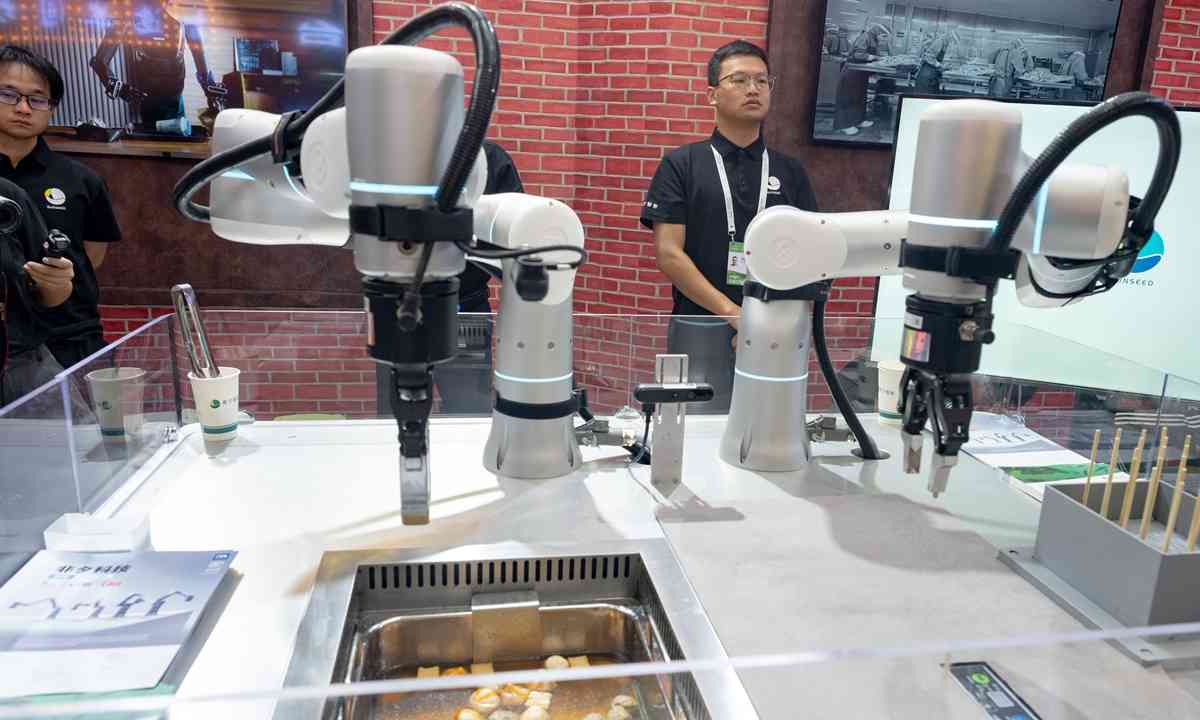
When Yin Dajiang, a 46-years-old breakfast shop operator in Beijing's Chaoyang district, began planning to expand from his residential community into a standalone street-front store, site selection and menu positioning were familiar challenges that traditionally required weeks of manual scouting. But after trying an AI decision-making tool powered by the LongCat model, he said the entire process became "unprecedentedly clear and efficient."This newly released AI foundation model, developed by China's on-demand food-delivery giant Meituan, is seen by industry insiders as part of a broader trend that could reshape operational efficiency across the sector. "I simply typed: 'I want to open a store in Chaoyang - I run a breakfast stall from 5 to 11 am every day - what should I open and where?' The model immediately analyzed consumption pattern, delivery-order density, price bands and local competition, then recommended cuisines, target price ranges and specific locations with the highest growth potential," he told the Global Times. "Before this, I had to walk the streets, observe foot traffic and ask nearby store owners. Now, in a matter of minutes, I can see the broader picture."His experience mirrors a powerful shift under way in China's restaurant and food-service system: AI no longer serves merely as a digital aid but is becoming a proactive decision-making tool that shapes site selection, menu development, supply chain integration and consumer operations, a Chinese market watcher told the Global Times. Recently, as industries accelerate their exploration of AI applications, the use of AI tools to further improve operational efficiency has become a major topic of discussion across China's restaurant sector.New capable partnerKangaroo Advisor, the AI-powered decision-making tool for restaurant operators, was launched on October 16. Utilizing the on-demand food-delivery giant's self-developed LongCat model, the tool covers the full span of daily operations, including market analysis, site selection, menu development and financial assessment, a representative for Meituan told the Global Times on Monday."It is now available to all industry users free of charge," the representative said. "More than 1,000 restaurant brands and neighborhood shops have already taken part in the trial, generating over 100,000 reports so far.".Industry insiders said the new model is not as a tool but as a "co-operator" for chain restaurants, franchise groups and delivery platforms. Instead of manually comparing thousands of data points from fragmented sources, operators can now describe their needs in natural language. A similar shift is also taking place across front-of-house restaurant services.Recent months have also seen major restaurant groups and delivery-chain enterprises accelerate the AI adoption. AI integration is not limited to chain operators. Platforms are also embedding generative models into consumer-facing interactions. Chinese hotpot chain Haidilao said at the industry forum Chinashop 2025 in May that it had been introducing AI tools since last year to enhance consumer experience. "At Haidilao, similar personalized recommendations are possible. If a pregnant woman asks whether she can drink Angelica soup, or if someone into fitness wants vegetable-based dishes, or if a person with high uric acid needs dietary restrictions, these queries require detailed knowledge from the staff. What we do is filter all dishes and tag them so AI can recommend intelligently based on user conditions. Providing better services requires understanding user tags," said Yang Xuanzhi, the brand's deputy general manager of information technology. He described as an example how the company is now infusing that same service ethos into machine intelligence, according to global online and offline retail trade publisher Inside Retail.During a visit to a Beijing shopping mall this month, a 29-year-old consumer surnamed Xie used AI to book a table at a hotpot restaurant within seconds. "I said, 'a table for four tomorrow at seven,' and it automatically checked nearby branches and confirmed the booking. No manual searching, no calling," Xie told the Global Times.Xie noted that restaurant's AI dining assistant, integrated into its ordering system, now offers personalized dish recommendations based on spice preference, past orders and trending items."It felt like being served by someone who really knows what I like," she said. "And at checkout, it even explained how my coupons and membership points were applied - something that used to confuse me.""The shift could become particularly visible in chain operations in the near future. Leading companies use AI to estimate demand fluctuations, adjust staffing, forecast ingredient consumption, refine pricing and identify micro-zones with high delivery conversion," Wang Peng, an associate research fellow at the Beijing Academy of Social Sciences, told the Global Times on Monday.Enabling consumption upgradeChina's catering market surpassed 5.5 trillion yuan ($774.7 billion) in 2024, the Xinhua News Agency reported. Meanwhile, from January to September this year, China's restaurant revenue reached 4.10 trillion yuan, up 3.3 percent year-on-year, data from China's National Bureau of Statistics showed.Wang said the sector will continue to grow on the back of strong domestic consumption and an expanding delivery economy - creating vast space for AI deployment.Technology adoption has become a necessity for the restaurant industry, and companies capable of deeply integrating new tools and continuously iterating their consumer experience will lead the shift from scale expansion to value-driven growth, according to Wang.Chinese cities are also accelerating the deployment of AI in the restaurant sector, highlighting the opportunities for the smart technologies to advance the industry's industrialization.For instance, Shanghai on November 11 released a notice outlining plans to promote intelligent upgrades across the metropolis' restaurant sector between 2026 and 2028, according to Shanghai Municipal Commission of Commerce.Under the plan, Shanghai aims to significantly elevate its overall level of smart operations by 2028, with full-chain intelligent penetration exceeding 70 percent among group catering, fast-food and tea-drink and coffee enterprises. For full-service restaurants, more than 50 percent of key operational links are expected to adopt smart applications. The plan also targets an intelligent supply-chain management coverage rate of over 60 percent citywide.AI is emerging as a catalyst for this growth, strengthening not only efficiency but also consumer value, experts said.LongCat AI tools are designed to understand the restaurant sector more deeply and offer highly actionable guidance. The goal is to ensure the AI applications align closely with real operational needs, turning what was once a high-threshold technology into an accessible, practical "assistant" for restaurant operators, according to the Meituan representative.The shift from large models as auxiliary tools to full decision engines is reshaping key links in the restaurant chain, bringing new opportunities. "Decision-making, once driven largely by experience and subjective judgment, is now grounded in multi-dimensional, data-integrated analysis," Wang said, adding that what used to be a time-consuming, labor-intensive process has become a rapid, efficient workflow powered by real-time data processing and solution generation."With the help of AI model," Yin Dajiang said, "opening a store feels less like guessing and more like planning."