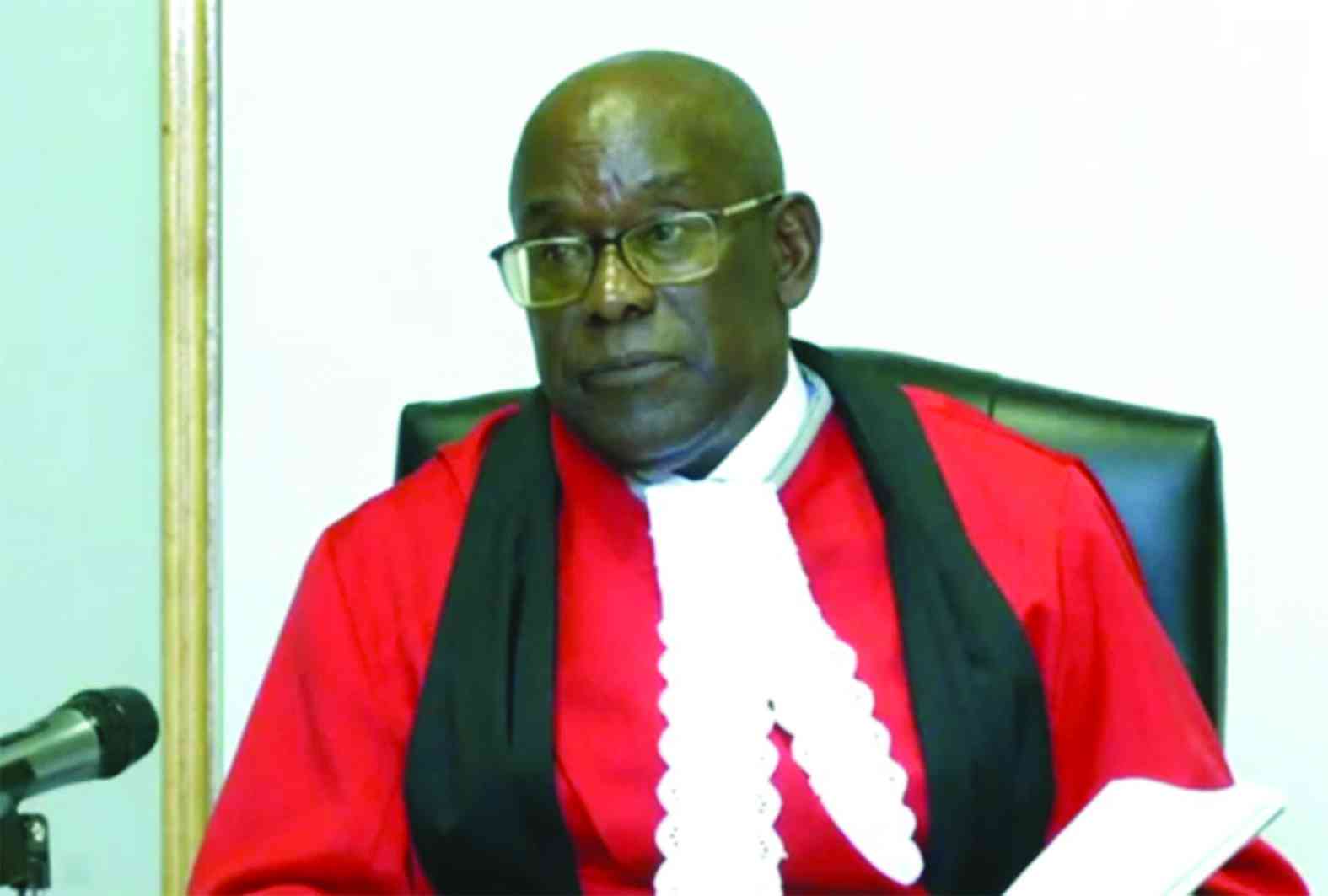
JUSTICE Moses Chinhengo, who died on September 19, 2025, aged 70, leaves behind an enduring legacy of integrity and an abiding faith in the rule of law.
Over a judicial career spanning more than two decades, his judgments — published in Zimbabwe, Namibia, Botswana and Lesotho — were marked by elegant simplicity and gave timeless expression to the values he held most dear as a jurist.
His defining moment came in Commissioner of Police v Commercial Farmers Union — a 2000 decision that still stands as a beacon on the landscape of Zimbabwe’s constitutional jurisprudence. The case arose from an application brought by the Commercial Farmers Union against the Commissioner of Police at the height of the land invasions.
Following the invasion and occupation of numerous white-owned commercial farms by veterans of the liberation war, the Commercial Farmers Union had obtained an order granted by Justice Paddington Garwe, with the consent of the Commissioner of Police. The order required the police, within 72 hours, to inform the war veterans that their actions were illegal, instruct them to vacate the farms, and remove them if they refused to comply. The order further directed the Commissioner of Police to disregard any executive instructions that conflicted with the court order.
Six days after the order was granted, the Commissioner of Police applied to Justice Chinhengo to relieve him, essentially, from the obligation in the consent order to evict the land invaders. At the time of the hearing, more than 1 000 farms had been invaded by over 58 000 people, many of whom were veterans of the liberation war.
Such was the national importance of the issues at stake that the commissioner’s legal team was led, and ably so, by the then Attorney-General himself, the Hon Patrick Chinamasa.
Justice Chinhengo considered that more was at stake than the technical question of whether the commissioner had complied with the rules of court governing the setting aside of a consent order. The commissioner’s failure to meet these procedural requirements was, in itself, sufficient ground for the court to dismiss the application, making it unnecessary to address the other arguments advanced on his behalf. Noting this, Justice Chinhengo nonetheless took the view that it was desirable to consider the “spirited submissions” made for the commissioner.
In seeking the eviction of the war veterans from the farms they had occupied, the Commercial Farmers Union relied, as its final line of defence, on the principle of the rule of law. The union argued that the rule of law was sacrosanct and since it was common cause that the invasions were unlawful, the eviction order had to be enforced if the rule of law was to be upheld.
- Mavhunga puts DeMbare into Chibuku quarterfinals
- Bulls to charge into Zimbabwe gold stocks
- Ndiraya concerned as goals dry up
- Letters: How solar power is transforming African farms
Keep Reading
In what was little more than a preliminary skirmish before the real battle began, the Commissioner of Police initially contended that, following the granting of the consent order, the police had realised they lacked the resources to evict the land invaders. He cited the size of the police force, the number of invaders, fuel shortages, transport and budgetary constraints.
Justice Chinhengo gave short shrift to this argument. He reasoned that the police force in Zimbabwe commands considerable respect and obedience among the populace, such that their mere presence would, in itself, convey a clear and forceful message to the invaders. He further observed that, while the police were expected to use their best endeavours — within the limits of their resources — to execute the evictions faithfully, the evidence showed that no effort had been made to comply with the order since its issuance.
The doomsday scenario
With the preliminaries over, the Attorney-General advanced his case on three fronts. First, he presented to the court this chilling doomsday scenario, outlined in the Police Commissioner’s affidavit, warning of the apocalypse that would descend on the country if the court ordered the eviction of the war veterans from the farms they had occupied.
“Those people who have invaded the farms have threatened resistance, and as police, we cannot take this lightly. In their painstaking consideration of the question of enforcement of the order, the police have looked over the edge of the cliff, over the brink, and they see nothing but an abyss if the police intervene.
The purpose of this application is to bring, figuratively speaking, this honourable court to the edge of the cliff and invite Your Lordship to peep over the edge and be persuaded to agree that enforcement of the order is tantamount to falling over the cliff — not for the court, of course, but for the entire country.
This honourable court should weigh heavily and decide whether, by ordering enforcement of the order, it is not going down in history as providing the matchstick to torch the country.”
A fair-minded and informed observer would not have doubted the sincerity of the Police Commissioner’s apprehensions that evicting the war veterans from the farms would ignite a powder keg, with calamitous consequences for the entire country. These concerns were not entirely fanciful: deep-seated emotions persisted among war veterans and the wider populace over the colonial land ownership structure that remained intact two decades after a bloody war to liberate the land had ended.
It is not difficult to imagine that the doomsday scenario would have caused Justice Chinhengo — nay, any judge — agonising moments. Should he order the eviction of the war veterans from the farms? And if he did so, would he risk going down in history as the judge who plunged the country into a bloody conflagration, as the Police Commissioner warned in his affidavit?
If Justice Chinhengo had spent agonising moments, his typically clinical reasoning in dismissing the doomsday scenario gave no hint of it. He had, it seems, accepted the invitation to peer over the edge of the cliff — but, unlike the Police Commissioner, had not seen an abyss. Without flinching, he rules: “I am inclined to the view that police intervention is not likely to ignite an already explosive situation. Farm invasions are not a new phenomenon in Zimbabwe.”
The liberation war and the land question
But the Attorney-General had more in his arsenal. He summoned into battle the moral weight of a bloody armed struggle fought to liberate the land. He told the court that evicting the war veterans would be to ignore history, for at the heart of the application before the court lay the land question. The court captures the essence of this argument in the following passage:
“The armed struggle was waged principally about the question of land ownership as between white and black. Twenty years after independence, about 4 000 white commercial farmers continue to own 13,3 million hectares of the best land in the country, when the majority of the black people of this country remain divorced from such land and the number of them who have no role to play in the agricultural economy of the country except one of dependency continue to grow.
He describes the land distribution and ownership patterns as negative and says they should be rectified in the shortest possible time.”
Justice Chinhengo remained unmoved. Noting that it was common cause that the pattern of land ownership and distribution was inequitable, he swiftly disposed of the Police Commissioner’s argument with these words:
“Unfortunately for the applicant, this application is not essentially concerned with the question of land ownership and distribution in Zimbabwe. It is solely concerned with the question of enforcement of an order of this honourable court. I shall, therefore, not be sidetracked from the essential issues before me in this application.”
The rule of law
In a final onslaught, the Attorney-General turned to confront the heart of the matter: the rule of law — the fortress shielding the Commercial Farmers Union from the continued occupation of their farms by the war veterans.
In a carefully crafted and forceful argument, the Attorney-General contended that, given the historical injustices underlying the prevailing land ownership structure, it would not serve the rule of law to authorise the use of State power against land invaders seeking to redress those injustices. He tells the court:
“The rule of law, which is divorced from justice, becomes a hollow concept. Enforcement of an unjust and iniquitous ethnically based land ownership structure through the application of brutal State power is not promotive of the rule of law.”
This view of the rule of law, propounded by the Attorney-General on behalf of the Police Commissioner, enjoys intellectual and legal respectability. Some legal scholars would argue, even today, that under the colonial legal order, the rule of law functioned as an instrument of oppression, legitimising the use of State power to protect and preserve the private property rights of the ruling minority. It follows, the argument continues, that in the aftermath of majority rule — when property rights entrenched in the old order are reviewed to bring meaningful social and economic benefits to the majority — abstract legal concepts such as the rule of law should not be allowed to obstruct land redistribution initiatives aimed at promoting the well-being of the majority.
Justice Chinhengo adroitly countered the Attorney-General’s argument, reminding us that the laws judges are required to enforce in independent Zimbabwe, in order to uphold the rule of law, are not an external imposition but “our laws.” Crucially, he emphasised that, as a sovereign nation, Zimbabwe need not violate the rule of law to address the pressing land question; it can do so lawfully through the enactment of new legislation. He explains:
“I acknowledge that, at the philosophical level, there are different schools of thought as to what the rule of law encompasses. At the practical level, however, where a written Constitution amenable to amendment by the people exists, and where statute laws — old and new — can be amended or repealed by the people’s representatives, an argument such as the one advanced by the applicant in the passage I have just quoted is but spurious.”
Constitutional Veneration
We see in Justice Chinhengo’s language a deep-seated veneration for the values and principles of the Constitution: the rule of law; the right of every citizen to equal protection of the law; and the personal honour that is at stake for a judge who has sworn to uphold the Constitution when called to preside over matters that are both controversial and politically charged.
This approach reflects a long-standing tradition of constitutional veneration found in constitutional democracies :
In their deliberations, judges are not merely arbiters applying strict legalism in a value-free approach to disputes. Because constitutions are products of the organic social processes of a nation’s history, judges serve as custodians of the inherited principles and values of the Constitution. In this view, the Constitution provides not only the architecture of governance but also the values that define the very soul of a nation’s identity and history — making it worthy of veneration.
Justice Chinhengo’s inclination towards constitutional veneration emerges in his eloquent exposition of the values and principles at stake, revealing a deep and abiding reverence for the Constitution.
With unwavering devotion to the rule of law as a guiding constitutional principle, he asserts:
“The rule of law must be viewed as a societal ideal, where everyone is subject to the same rules. It requires that all are governed by a shared set of rules applied universally, dealing even-handedly with all people and treating like cases alike. … The rule of law must be upheld and this court must conscientiously perform its constitutional duty.”
He explains that the constitutional value central to the case was the right of every citizen to equal protection under the law, as guaranteed by section 18(1) of the Constitution and emphasises that the Commissioner of Police accordingly bore a public duty to safeguard this right for all citizens.
Citing English case law, he affirms that where it has been shown that the police have failed in their duty to afford equal protection of the law to any individual or where there has been a dereliction of a duty owed to the public, a Zimbabwean court will grant an order compelling them to perform that duty.
Elaborating on the significance of the right to protection of the law and the corresponding duty of the Police Commissioner to uphold it, he sets out with meticulous precision Zimbabwe’s constitutional framework governing the separation of powers. Drawing on authority from foreign jurisdictions, he makes clear that no minister may dictate to the Police Commissioner what he must or must not do, nor direct him to prosecute — or refrain from prosecuting — a particular individual. The responsibility for enforcing the law, he insists, rests solely with the commissioner, who is answerable only to the law.
A landmark judgment
The Commercial Farmers Union judgment deserves landmark status : it declares to present and future generations, that our Constitution is worthy of veneration — not merely because it is ours, but because the principles and values it enshrines are grounded in our history, define our identity and who we are as a people and as a nation.
I do not doubt that there are other decisions of our superior courts that deserve landmark status. However, in the absence of a legal journal or other public fora where legal practitioners and academics actively contribute case commentaries on leading judgments, many decisions of our superior courts fade into the fog of history and never achieve the recognition they deserve. It is my fervent hope, in penning this obituary, that Justice Chinhengo’s decision in the Commercial Farmers Union case will not suffer the same fate.
Justice Chinhengo exhibited extraordinary courage and steadfast integrity in ruling that no urgency of social or economic programmes could justify breaches of the rule of law. He called upon the executive to “recognise that the permanent interests of Zimbabwe and the rule of law are served by ensuring that the land invasions are brought to an immediate end.”
For Justice Chinhengo, upholding the Constitution and the rule of law was a matter of personal honour and moral integrity.
In this telling statement, he makes clear that his honour, his integrity and his oath of office to uphold the Constitution compelled him to act in defence of the rule of law :
“If this court were to accede to a variation, amendment or other detraction from the order issued by Garwe J, it would not be upholding its sworn duty to uphold the law.”
May these words stand as his epitaph.
James Devittie, a former judge of the High Court of Zimbabwe