Zimbabwe and Japan on Wednesday sealed a US$2.6 million agricultural equipment grant to boost local rice production, as officials warned the country’s heavy reliance on imports is fast becoming a food security risk.
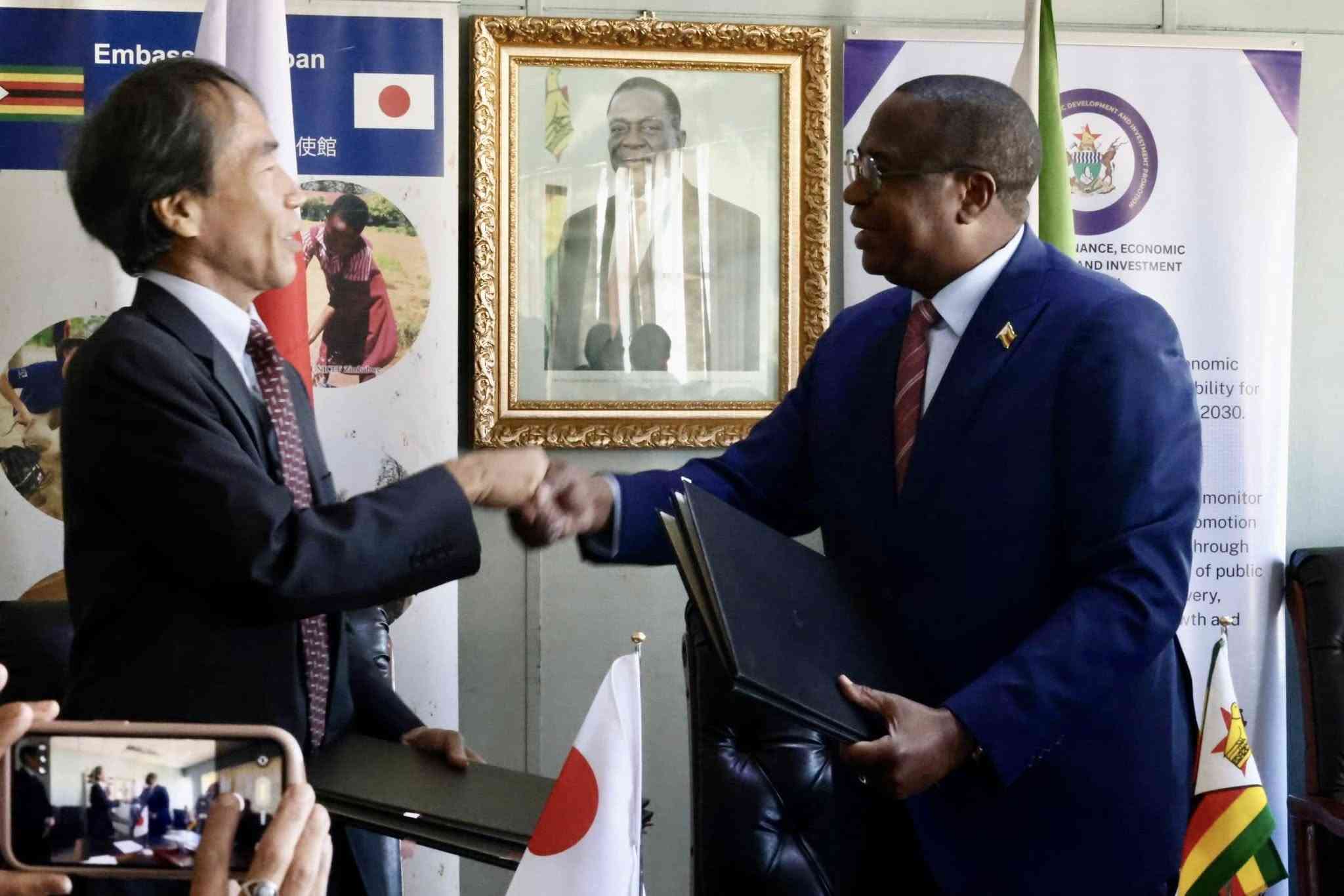
The Exchange of Notes under the Economic and Social Development Programme for Agricultural Equipment Assistance was signed in Harare by Japanese Ambassador Nobutaka Maekawa and Finance Minister Mthuli Ncube, formalising a ¥400 million facility targeted at strengthening domestic output.
Authorities say Zimbabwe imports the bulk of its rice even as consumption rises, driven in part by shifting urban diets — a mismatch now described as a “ticking time bomb” amid climate shocks and global supply disruptions.
“The rising global conflicts and climate change are negatively impacting food security,” Ncube said. “We need to improve production systems through research and investment in new technologies.”
The programme will establish two rice centres of excellence and supply field machinery, post-harvest equipment and laboratory tools. It will focus on Manicaland, Masvingo, Mashonaland East and Mashonaland Central, with an emphasis on scaling up NERICA (New Rice for Africa) varieties.
Maekawa said the intervention builds on longstanding technical cooperation through JICA and responds directly to a request from Zimbabwe, adding that climate volatility is intensifying pressure on food systems.
Finance secretary George Guvamatanga said the equipment would deliver immediate gains — improving efficiency, quality and climate resilience — while aligning with Vision 2030 targets.
The deal comes as government ramps up agricultural investment under the National Development Strategy 2, where food security is a core pillar. Ongoing programmes include irrigation rehabilitation, the Rural Development 8.0 initiative and expansion of the Strategic Grain Reserve.
- Mavhunga puts DeMbare into Chibuku quarterfinals
- Bulls to charge into Zimbabwe gold stocks
- Ndiraya concerned as goals dry up
- Letters: How solar power is transforming African farms
Keep Reading
Japan has been a consistent development partner. Between 2015 and 2019, it provided US$16 million through JICA for irrigation projects in Nyanga, benefiting about 560 farmers. From 2019 to 2025, the ZIM-SHEP programme supported market-oriented farming across 32 districts, reaching over 3,200 smallholders.
Beyond agriculture, Japan has channelled support into health, nutrition and infrastructure. In April 2025, it committed nearly US$7 million through UN agencies, and later that year partnered with UNDP on a US$3 million programme for mine clearance and agricultural development in Rushinga and Mudzi.
Officials say the latest intervention could begin narrowing the gap between domestic rice supply and rising demand, particularly if backed by effective implementation — a persistent weak point in past agricultural programmes.
For now, the bet is clear: that mechanisation, research and improved seed systems can turn rice from an import burden into a viable local industry.