VISUAL artist Option Dzikamai Nyahunzvi recently opened a solo exhibition at the National Gallery of Zimbabwe (NGZ).
It is a bold assertion of identity, reclamation of heritage, and rejection of alien tradition and customs.
Curated by Zvikomborero Mandangu, assistant curator at the National Gallery of Zimbabwe (NGZ), the exhibition, Zvatiri, features paintings and installations rooted in traditional cosmology.
The title of the exhibition speaks to collective identity, communal values and shared aspirations. One artwork that anchors the exhibition is Musumo, a painting and an installation combo with snuff tobacco, mealie-meal and soil.
The tobacco is presented in its unground form, moulded into small conical shapes known as chambwa.
It is offered to the ancestors, who are believed to mill it for their own consumption. Kusumira is a key element of Zimbabwean traditional customs, allowing individuals to connect with their ancestors in search of guidance and protection.
The painting takes the form of a geological cross-section, depicting a man beneath a tree pouring libations onto the ground. The traditional beer seeps into the earth, flooding the subterranean space where the bodies of the forebears lie.
- Gweje relishes fashion achievements
- Daily life struggles reflected in Burning Figure
- 'Film sector drives economic growth'
- My Beautiful Home contest over subscribed
Keep Reading
A series of 10 portraits featuring head shots is titled Madzitateguru, which in traditional folklore refers to the founders of a clan. The paintings are connected with a long arm that could be seen as separating the living from the dead.
The piece titled Chibondokoto depicts a woman seated in a winnowing basket/chisero.
The domestic appliance might evoke fantastical stories of powerful African sorcerers who could use it for teleportation. In this case, however, the artist uses the chisero to illustrate the subject’s seating position, which derives its name from the object.
Describing the female subject, Nyahunzvi points out, “With knees modestly together and ankles crossed, she becomes a vessel of serenity, a guardian of her own sacred space.”
From a distance, the painting Hope Dzemadziva resembles the scene from The Birth of Venus by Italian Renaissance painter Sandro Botticelli (c.1485-1486). The Shona title can be translated to “Spiritual dreams”.
By taking it below the surface of the elemental body of water, Nyahunzvi brings out an explosion of colours in his appropriation of the famous painting.
Further, the artist introduces traditional mythical figures known as njuzu and gombwe.
In the context of the artwork, he describes them as “guardians of the deep, bestowing sacred gifts”. This deconstruction of the Roman goddess of love and beauty can be read as a call to serve and protect the female subject.
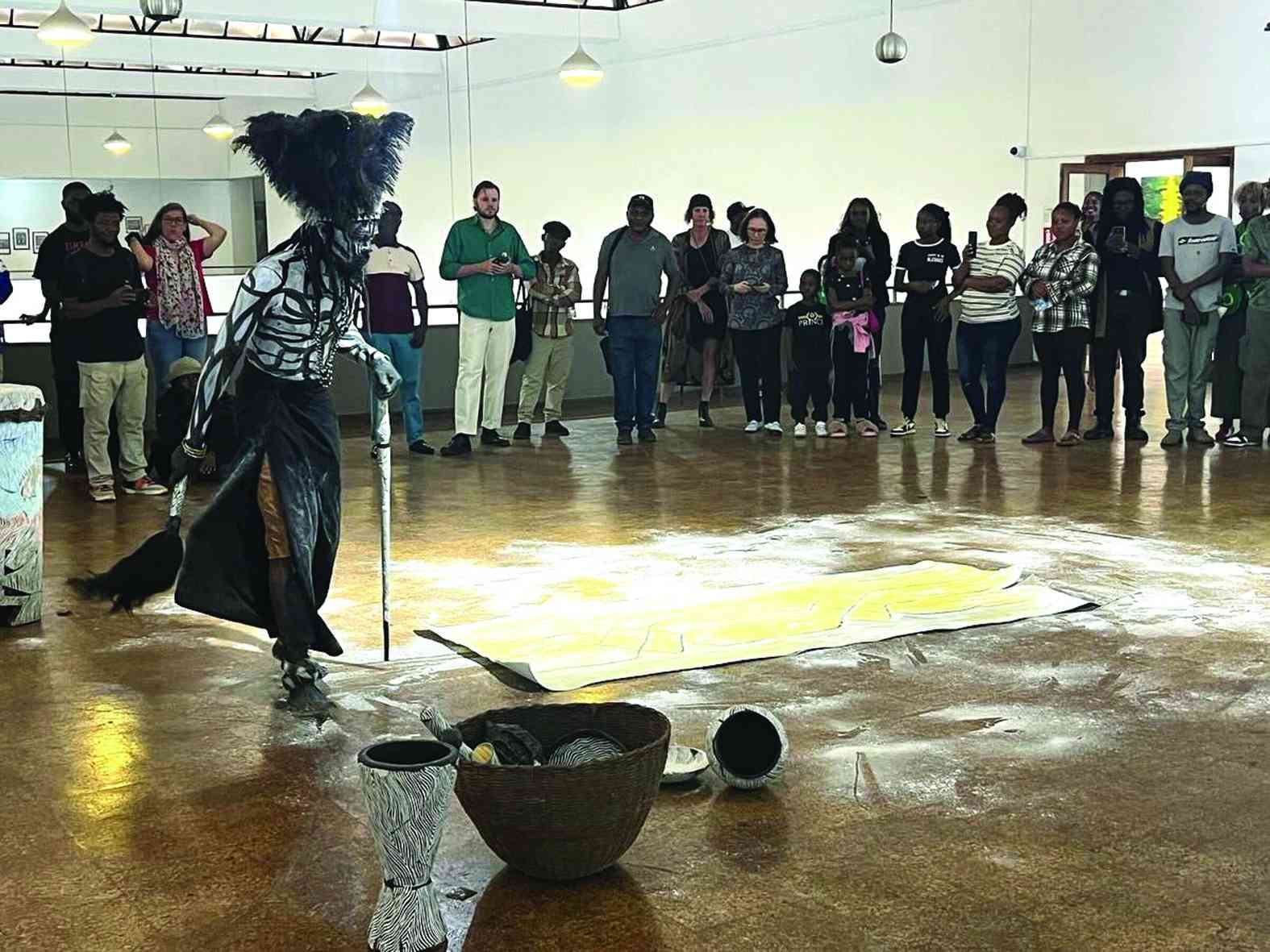
The artist, who was absent during the official proceedings, later appeared in costume and delivered a riveting performance after which the exhibition is named. Where it entered unannounced like a strange being materialising from nowhere.
As if from nowhere, a bearded man with long twisted hair, a black cloth associated with spirit mediums wrapped around his waist, entered the unsuspecting crowd, most of whom were looking upwards at the walls.
His bare upper body was painted black with the white stripes of a zebra going across his skin.
The barefoot man wore traditional feathered headgear and carried a staff, while holding a large bushel. His footsteps were accompanied by the soft rattle of magazhu (ankle shakers) fastened to his legs as he moved about like one unconstrained by time and space.
After traversing the space a few times, the character puts his bushel down.
With slow, deliberate movements, he spreads a mat on the ground and proceeds to take out culturally symbolic objects from his container, which include a mbira instrument, hosho, nhekwe, bakatwa, pfuko, mukombe, mbiya, hari, chuma, duri, mutswi and a fly whisk. The functional domestic appliances play an important role in traditional ceremonies.
“My performance, Zvatiri, was a transformative ritual of cultural reclamation . . .” says the artist.
“I installed padare and invoked the mhondoro (ancestral spirit) to reclaim and reassert our indigenous traditions, deliberately decolonising the space by removing imposed Christian symbols and reinstating the sacred energies of our ancestors.”
Mandangu has called this approach and its growing trend among young artists the “post-millennial spiritual patriotism”.
Commenting on another artwork, Nyahunzvi says: “Mhondoro spirit is a revered ancestral spirit, believed to be a guardian of the land, community and traditions. Mhondoro spirits are typically spirits of deceased chiefs, leaders or respected elders who’ve earned a high status in the spiritual realm.”
The National Gallery School of Visual Arts and Design alumni’s thematic position can be amplified by recent statements made by American journalist and college professor, Stacey Patton, who wrote, “. . . empires translate God into their own language, then teach people that version as original. . . That’s how power works. You conquer land. You control education. You control printing. You control the church. Then you hand people a translated book and tell them this is the truth and how it has always been.”
The performance puts Nyahunzvi on the offensive towards dismantling the colonial narrative.
After the hostile showdown, Nyahunzvi’s powerful oil and paper collage artworks on canvas become like giant footnotes at the site of a spiritual battle — a battle that can only be won in the minds and hearts of the people.