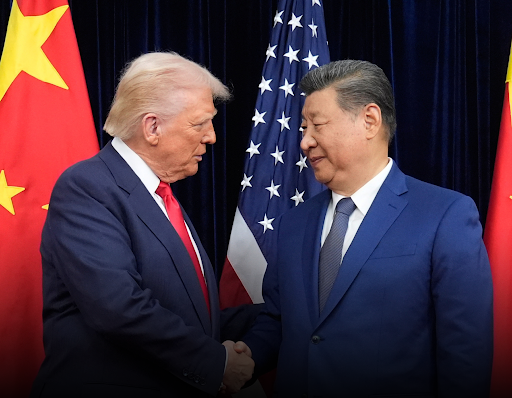
For decades, the United States has been widely regarded as the world's dominant power, celebrated for its democratic institutions, technological innovation, economic strength and leadership in global governance. China, by contrast, has traditionally been viewed as a rapidly rising economic power whose international influence has expanded steadily over the past several decades.
Recent findings from the Pew Research Center, however, suggest that global perceptions may be evolving. According to a survey conducted across 36 countries, China now enjoys more favorable public opinion than the United States in a majority of the countries surveyed. While public opinion varies significantly by region, the findings point to an important shift in how many societies assess global influence and international partnerships.
Rather than signalling a complete reversal of the international order, the survey reflects changing attitudes toward the qualities many countries increasingly value in major powers—economic cooperation, policy consistency and long-term development partnerships.
Economic engagement shapes perceptions
One of the principal factors behind China's growing international appeal is its extensive economic engagement around the world. As the world's second-largest economy, China has become a major trading partner for countries across Asia, Africa, Latin America and the Middle East.
Through trade, investment and infrastructure development, China has financed and constructed roads, railways, ports, power stations and industrial facilities in many developing countries. These projects have contributed to employment creation, improved connectivity and expanded productive capacity in several economies.
For many governments and communities, these visible development initiatives have strengthened China's image as a practical partner focused on economic growth and infrastructure development.
China's rapid advances in technology have also contributed to changing global perceptions. Beyond its traditional role as a manufacturing hub, the country has emerged as a significant player in sectors such as telecommunications, artificial intelligence, renewable energy and electric vehicles, reinforcing its reputation as an increasingly important source of technological innovation.
- Education crisis mirrors national problem
- USD fees: Govt policy failure hurting parents
- Zim has 2nd highest rising food prices: WB
- US raises red flag on abuse of journos in Zim
Keep Reading
Domestic challenges and America's global image
While China's international profile has strengthened in many regions, the United States has faced growing challenges that have affected its global image.
Deep political polarization, frequent changes in policy between administrations and domestic governance disputes have raised questions among some international observers about the consistency and predictability of U.S. foreign policy.
Trade disputes, tensions with long-standing allies and continued involvement in international conflicts have also influenced global perceptions of American leadership. In several countries, these developments have contributed to declining confidence in the United States as a stable and reliable international partner.
The Pew survey suggests that respondents in many of the countries surveyed express greater confidence in China's policy continuity than in U.S. political leadership. Whether this trend persists will largely depend on future domestic developments in both countries.
Regional differences remain significant
Despite these findings, global opinion remains far from uniform.
Countries such as India, Japan, South Korea and the Philippines continue to hold more favorable views of the United States. Historical relationships, security concerns, strategic alliances and regional geopolitical dynamics continue to shape public opinion across Asia.
These differences illustrate that international influence is increasingly multidimensional. Military strength remains important, but economic cooperation, technological innovation, diplomatic engagement, development assistance and investment have become equally significant indicators of global leadership.
As countries pursue their own development priorities, many increasingly assess international partnerships based on practical outcomes rather than ideological alignment alone.
China's growing appeal in the Global South
The changing trend is particularly relevant for developing countries, especially across Africa.
China has become one of Africa's largest economic partners, with cooperation spanning infrastructure, mining, agriculture, energy, manufacturing, education and healthcare. Chinese investment has played an important role in supporting industrial development and infrastructure expansion across numerous African countries.
Although challenges remain and many projects continue to attract debate regarding financing, transparency and long-term sustainability, many African governments view cooperation with China as having contributed meaningfully to national development objectives.
Zimbabwe offers an example of this long-standing relationship. Over several decades, cooperation between Zimbabwe and China has expanded across multiple sectors, strengthening economic ties while deepening diplomatic relations.
As more developing countries prioritize industrialisation, infrastructure and economic transformation, demand for development-oriented international partnerships is likely to continue growing.
Competition and cooperation in global governance
Despite shifting public perceptions, both China and the United States remain indispensable actors in global governance.
Addressing challenges such as climate change, global health, food security, poverty reduction and international peace requires cooperation among major powers. Strategic competition between Washington and Beijing will undoubtedly continue, but collaboration in areas of shared interest remains essential for global stability.
Most countries, particularly in the developing world, seek constructive relationships with both powers rather than choosing sides. Their primary objective is to safeguard national interests while expanding opportunities for economic growth and development.
The Real Measure of Global Influence
The Pew survey should not be interpreted as signalling the end of American influence or the unquestioned triumph of China. Public opinion is dynamic and continues to evolve alongside economic performance, geopolitical developments and domestic political change.
What the survey does suggest is that many countries increasingly judge major powers by their ability to deliver practical benefits, maintain policy credibility and contribute to shared prosperity rather than relying solely on historical prestige or military power.
China's continued economic growth, expanding technological capabilities and development-focused international engagement have strengthened its global standing in many parts of the world. At the same time, domestic political divisions and policy uncertainty have affected perceptions of the United States in several countries.
Ultimately, the future balance of global influence will depend not simply on economic or military strength, but on which nations can consistently build trust, foster mutually beneficial partnerships and contribute meaningfully to addressing the world's shared challenges.
Mafa Kwanisai Mafa is a Pan-Africanist political commentator based in Gweru, Zimbabwe. He regularly contributes analytical commentary to several media platforms.