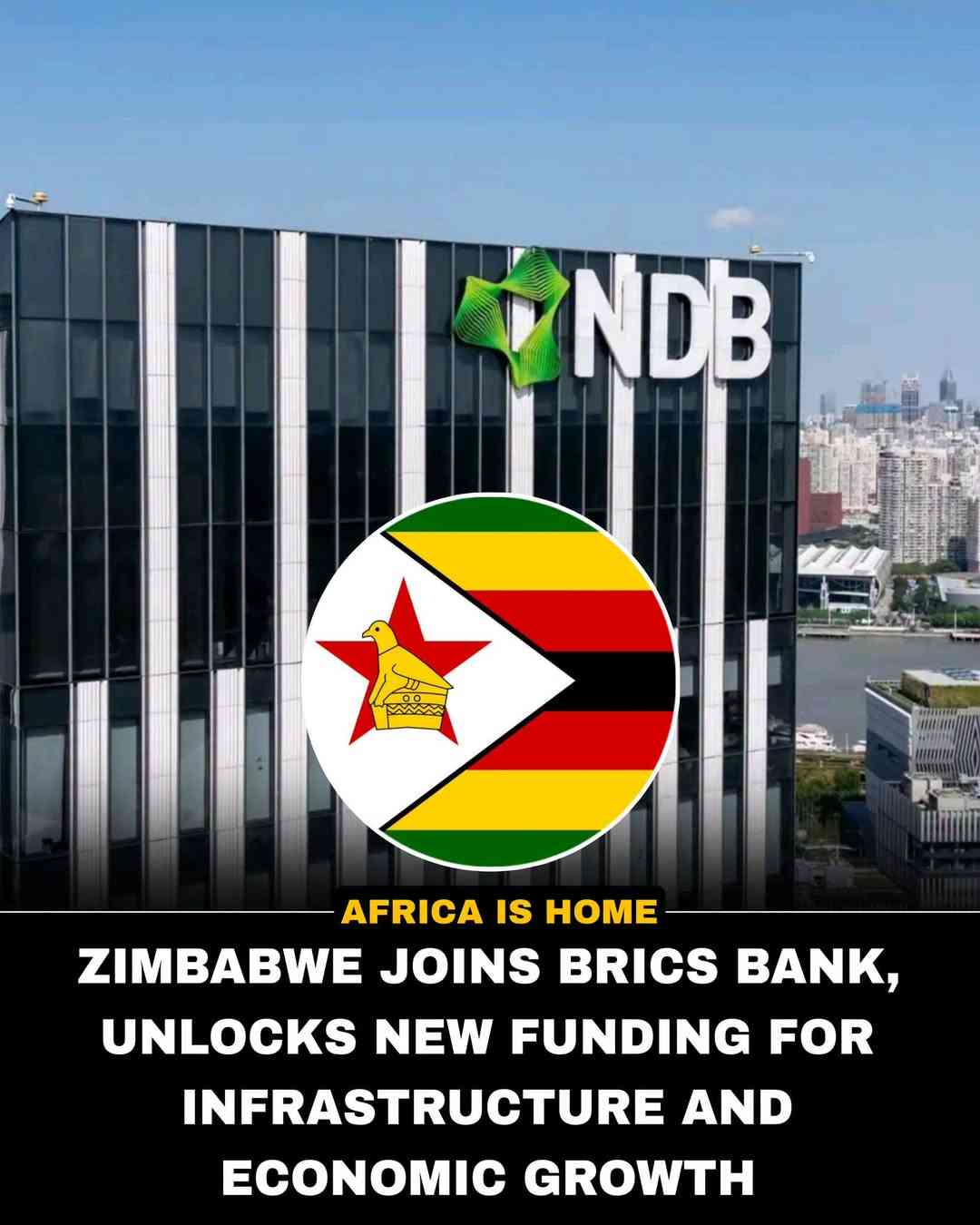
Zimbabwe’s admission as a borrowing member of the BRICS-backed New Development Bank (NDB) is a significant diplomatic and financial milestone, but it is neither a bailout nor an instant solution to the country’s long-standing debt and financing constraints.
The membership gives Zimbabwe something it has lacked for years: access to another multilateral lender capable of financing large infrastructure projects. Whether that translates into roads, power plants, dams and industrial parks will depend less on the admission itself than on the government’s ability to prepare bankable projects, manage debt prudently and restore investor confidence.
What membership actually delivers
The immediate benefit is eligibility.
Zimbabwe can now apply for NDB financing for projects aligned with national priorities such as energy generation, transport infrastructure, industrialisation, water systems and climate resilience.
Unlike grants, however, NDB financing is not automatic. Government must first ratify the membership agreement, subscribe its US$63 million shareholding—US$12.6 million in paid-in capital and US$50.4 million in callable capital—and then submit individual projects for appraisal and approval.
Every project must still pass technical, financial and environmental due diligence before funding is released.
In other words, Zimbabwe has gained access to a new source of capital—not capital itself.
- In the groove: Major League disappointed Harare fans
- In the groove: Major League disappointed Harare fans
- Apostolic sect leader mobilises for ED
- ZHF set to host Zone 6 international handball tourney
Keep Reading
Why this matters
For more than two decades, Zimbabwe has faced severe financing constraints because of external debt arrears and its inability to borrow from the World Bank, African Development Bank and the International Monetary Fund under normal lending windows.
As of recent estimates, Zimbabwe’s external public debt exceeds US$21 billion, with a significant portion comprising arrears owed to multilateral and bilateral creditors.
Those arrears prevent access to new concessional financing from the World Bank and IMF until they are cleared.
The NDB offers Zimbabwe another avenue to finance development projects while the debt clearance process continues.
Does this replace the IMF or World Bank?
No.
Perhaps the biggest misconception is that joining the BRICS bank means Zimbabwe no longer needs the Bretton Woods institutions.
It does.
The IMF performs functions that the NDB does not, including macroeconomic surveillance, balance-of-payments support and policy advice during economic crises.
Similarly, the World Bank provides concessional financing, technical assistance, social sector support and institutional development programmes that extend well beyond infrastructure lending.
The NDB complements—not replaces—those institutions.
Zimbabwe’s ongoing debt clearance and arrears resolution programme therefore remains critical if the country hopes to regain full access to global capital markets.
A different type of lender
Where the NDB differs is in its approach.
The bank was established by the BRICS countries to finance infrastructure and sustainable development projects in emerging economies, with less emphasis on the extensive policy conditionalities traditionally associated with IMF and World Bank lending.
That makes it particularly attractive for countries facing geopolitical tensions or prolonged debt-related financing constraints.
However, fewer political conditions do not mean fewer financial disciplines.
The NDB still expects borrowers to demonstrate project viability, repayment capacity, sound governance and transparent procurement.
Could Zimbabwe borrow in ZiG?
One development worth watching is the NDB’s growing preference for local-currency lending.
The bank has increasingly issued loans denominated in member countries’ domestic currencies to reduce exchange-rate risks and dependence on the US dollar.
If Zimbabwe eventually qualifies for similar arrangements, some future loans could potentially be structured partly in ZiG.
Whether such financing would be practical depends largely on confidence in Zimbabwe’s currency and the country’s macroeconomic stability.
Government has not indicated whether it would pursue local-currency borrowing.
What government must do next
Membership of the New Development Bank is only the first step. To translate that opportunity into economic growth,
Zimbabwe will need to present well-prepared, commercially viable projects capable of generating measurable economic returns. Infrastructure such as power stations, roads, railways, irrigation schemes and water projects must be backed by robust feasibility studies, clear procurement processes and sound governance if they are to meet the bank’s lending standards.
Government must also move quickly to ratify the membership agreement and pay its capital subscription, enabling it to begin formally applying for project financing.
At the same time, Zimbabwe cannot afford to abandon its broader economic reform agenda.
The country still needs to clear its debt arrears with the World Bank, IMF and other creditors to restore full access to international capital markets.
Maintaining macroeconomic stability through prudent fiscal management, low inflation, exchange rate stability and predictable economic policies will also be critical in giving lenders confidence that Zimbabwe can repay new loans.
Most importantly, any borrowing should be directed towards projects that increase productivity, exports and tax revenues, ensuring new debt finances economic growth rather than becoming an additional burden on already strained public finances.
Without these reforms, access to another lender alone is unlikely to transform the economy.
The real opportunity
For Zimbabwe, the NDB opens another financing window at a time when infrastructure deficits continue to constrain economic growth.
Reliable electricity, modern transport networks, irrigation systems, water infrastructure and industrial facilities all require long-term capital that domestic markets cannot easily provide.
If government secures financing for well-designed projects that stimulate exports, improve productivity and create jobs, the economic benefits could extend well beyond the projects themselves.
If, however, borrowing finances low-return investments or politically driven projects, the country risks adding to an already heavy debt burden without generating sufficient growth.
The bottom line
Zimbabwe’s admission to the BRICS New Development Bank is an important strategic gain rather than an immediate financial windfall.
It gives the country another seat at the table of multilateral development finance and potentially broadens its funding options beyond traditional Western lenders.
But membership does not erase Zimbabwe’s debt arrears, replace the IMF or World Bank, or guarantee billions in new loans.
The real test begins now. The value of membership will ultimately be measured not by the announcement itself, but by whether Zimbabwe can convert access into productive investment, sustainable growth and stronger public finances.