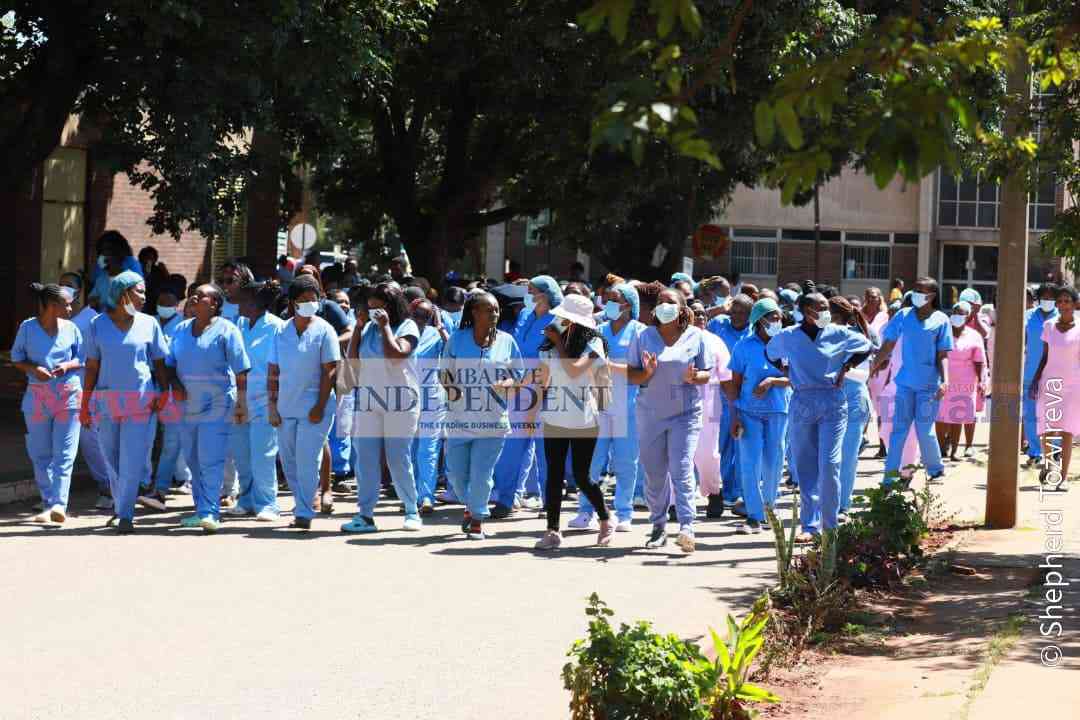
FOR too long, nurses have stood in the trenches of our public health system, carrying a burden far heavier than the recognition, pay, and support they receive.
They are the first to notice distress, the first to calm fear, the first to clean wounds, the first to stay when others have gone home, and often the last line between suffering and survival.
Yet their welfare has not been genuinely addressed. A health system cannot be built on rhetoric, Press statements and recurring promises of review while the very people who keep it alive struggle to afford transport to work, necessities at home and dignity at the workplace.
When the nursing profession is treated as an afterthought, the whole nation pays the price.
The recent strike by nurses is, therefore, not merely a labour dispute; it is a warning signal, loud and painful, that our public health delivery system is approaching a dangerous threshold.
The anguish of patients at Sally Mugabe Hospital, Parirenyatwa Hospital, United Bulawayo Hospitals and countless district facilities is not an abstract policy issue.
It became very real when my sick sister, who had spent the whole night vomiting and suffering from severe headaches, was left at the reception outpatient area for nearly two hours without even a greeting, let alone assistance.
That is not just poor service. It is a human failing. It is a breakdown of compassion, administration, and planning.
- Kadoma talent show to fundraise for the deprived
- Engage disgruntled health workers
- Nurses strike takes new twist
- Covid-19 has changed PR & communications industry
Keep Reading
It is the lived experience of many patients who arrive at public hospitals already frightened and vulnerable, and encounter silence, delay, and indifference.
What makes this situation more tragic is that these failures are entirely predictable. When nurses are underpaid, demoralised and overworked, service delivery inevitably collapses.
A nurse, who feels abandoned by the system, cannot be expected to serve with consistency, warmth, and energy under impossible conditions.
This does not excuse poor professionalism, because patients deserve courtesy regardless of institutional distress, but it does explain why frustration eventually spills into service withdrawal and low morale.
The result is a vicious cycle: poor remuneration leads to demotivation, demotivation leads to weak service, weak service deepens public anger and public anger then becomes the face of a problem that is, in fact, structural and administrative at its core.
The Health minister’s appeal for “constructive dialogue” is appropriate in principle, but dialogue without sincerity, timelines and action becomes little more than a ritual. Nurses have already heard promises before.
According to reports, there were expectations of a salary review and then what reportedly came was a modest increase, far below what had been anticipated.
That kind of gap between assurance and delivery damages trust. It tells health workers that their sacrifices can be exploited indefinitely.
When the government tells nurses to suspend industrial action and allow space for dialogue, it must understand that dialogue is only meaningful when it is backed by visible commitment, credible benchmarks and immediate relief measures.
Otherwise, it becomes a way of buying time while suffering continues.
This is why the broader national conversation must move beyond the narrow framing of “strike versus government” and ask a deeper question: what kind of society allows the health of its people to depend on the desperation of its nurses?
We must say clearly that health is not a luxury. It is a constitutional, moral and developmental imperative.
The right to health is widely recognised in major international and regional instruments. The Universal Declaration of Human Rights affirms the right to a standard of living adequate for health and well-being.
The International Covenant on Economic, Social and Cultural Rights recognises the right of everyone to the enjoyment of the highest attainable standard of physical and mental health.
The African Charter on Human and Peoples’ Rights places duties on States to protect the health of their people.
In Zimbabwe’s own legal framework, the Constitution guarantees the right to healthcare services, including reproductive healthcare and requires the State to take reasonable measures, within the limits of available resources, to achieve the progressive realisation of these rights.
These are not decorative words for legal textbooks. They are binding expressions of national duty and human dignity.
Yet legal commitment means little if the public health system is starved, neglected or undermined by poor prioritisation.
It is difficult to speak credibly about the right to health while billions leak through corruption, illicit financial flows, inflated procurement, patronage and wasteful expenditure.
Every dollar lost to corruption is a stolen syringe, a missing drug, a broken bed, an unavailable ambulance, a demotivated nurse and a patient left waiting in pain.
We cannot continue to tolerate a reality in which critical public services are underfunded while enormous sums vanish into opaque networks of self-enrichment.
A nation that cannot protect the integrity of its health budget cannot pretend that it is serious about the dignity of its citizens.
This is not merely an economic issue; it is a moral indictment.
The response required must, therefore, be broad, decisive and honest. First, nurses’ salaries must be reviewed urgently and transparently in line with the cost of living, not based on vague promises or token adjustments.
If the State genuinely values the profession, then compensation must be structured to reflect the weight of responsibility nurses carry, the sacrifices they make and the inflationary pressures they face.
Salary reform should not be a one-off announcement, but part of a predictable mechanism that prevents a recurrence of this crisis.
Second, working conditions must be addressed with equal seriousness. No nurse should be expected to perform effectively in wards lacking essential medicines, adequate equipment, protective gear, functioning water systems and basic staffing levels. A humane workplace is not a privilege; it is a prerequisite for care.
Third, the government must rebuild trust through real social dialogue, not staged consultations.
The Health Apex Council, the Health Services Commission, nurse representatives, hospital administrators and relevant Treasury officials should meet under a framework that produces deadlines, written commitments and publicly monitored implementation.
Workers need more than assurances; they need evidence. The public needs more than announcements; it needs accountability.
If agreements are reached, they should be published in summary form so that citizens can see what has been promised and by when. Secrecy has too often shielded failure.
Fourth, there must be immediate emergency measures to protect patients during labour disputes.
Hospitals should have contingency staffing plans, mediation protocols and minimum service safeguards to ensure that emergency and critical care are not entirely disrupted. No mother in pain, no child in distress, no elderly patient in crisis should be abandoned at the reception desk because the system has no operational plan.
Health facilities must retain a duty of care even in moments of conflict. The State, as the ultimate guarantor of public health, must ensure that industrial disputes do not become death sentences for the poor.
Fifth, the fight against corruption must be treated as a health intervention. Public financial management reforms, procurement transparency, audit enforcement and prosecution of those who steal from the State must be elevated from slogans to action.
If the government can recover even a fraction of the resources lost to illicit financial flows and waste, those funds should be visibly channelled to hospitals, drug supply chains, staff welfare and infrastructure renewal.
The public should be able to trace where health funds go and what they achieve. If we can track political promises with urgency, we should be able to track public money with even greater discipline.
Sixth, the country must invest in the dignity of health workers beyond wages. Nurses need safe accommodation in some locations, reliable transport support where necessary, opportunities for professional advancement, mental health services and recognition that goes beyond ceremonial speeches.
A demoralised workforce cannot deliver compassionate care at scale. We must stop treating health workers as expendable instruments and start viewing them as national assets whose well-being is inseparable from public well-being.
Finally, the public itself must learn to speak with compassion but also with firmness. Patients are right to be angry when services fail, but anger should be directed not only at the visible nurse at the reception desk.
The deeper failure lies in policy neglect, fiscal indiscipline and institutional inertia. We need a national ethic that says the health of citizens is sacred, the dignity of nurses is non-negotiable and the corruption that drains our hospitals is intolerable.
A country is judged not by its speeches but by how it treats the sick and those who care for them.
My own experience at a district hospital is, therefore, not just personal; it is representative of a larger wound.
A sick mother should not have to endure hours of uncertainty before seeing a caregiver. A nurse should not have to choose between survival at home and service at work.
A nation should not have to live with the shame of avoidable suffering in its public hospitals. If we are serious about building a just society, then we must prioritise health as we always claim to do.
We must be bold enough to confront corruption, disciplined enough to fund our hospitals properly and humane enough to treat nurses not as objects of routine complaint, but as indispensable guardians of national life.
If the dignity of a nation is partly measured by how it cares for the weak, then our hospitals must become places of healing, not despair. The present crisis should awaken us. We must do better. We must act better. And we must do so now.
- Lawrence Makamanzi is an independent researcher and analyst, passionately sharing his insights in a personal capacity.