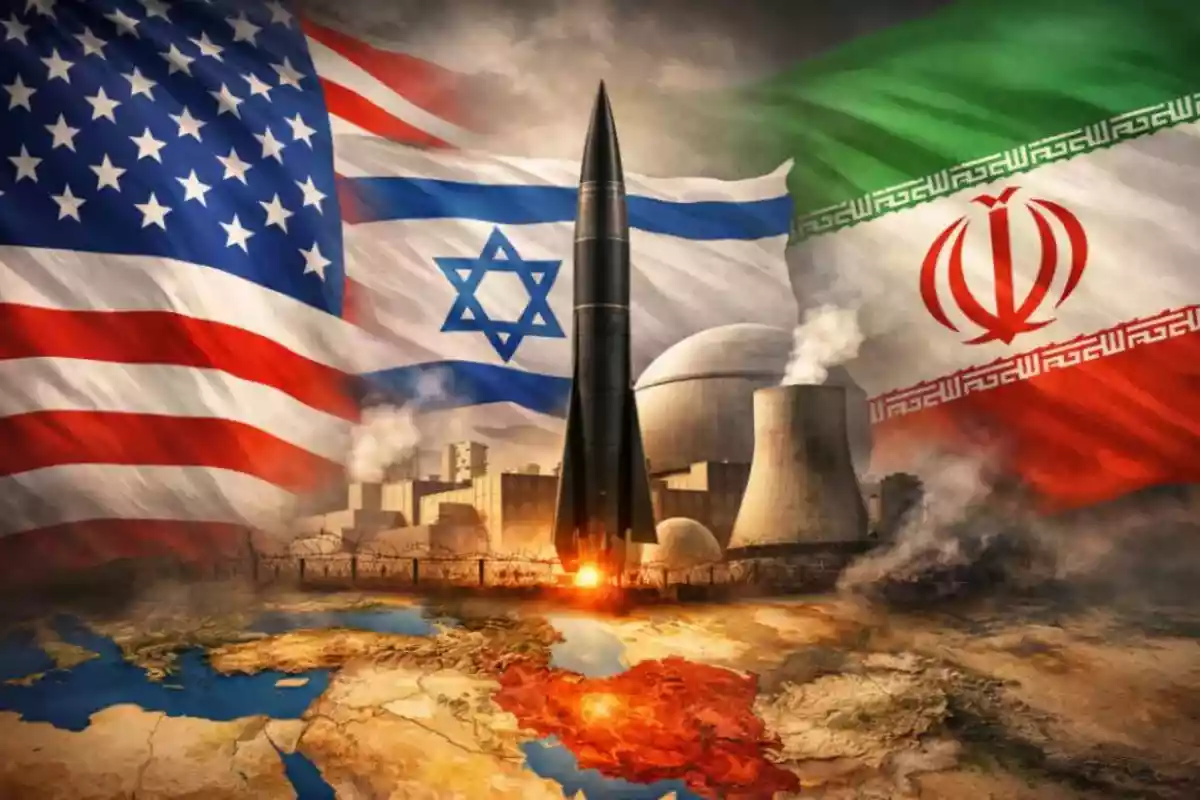
The US-Israel war against Iran has been called a war that should never have happened or a war of choice.
As the war escalates, Beijing has repeatedly called on the conflict protagonists to halt military operations, warning that continued conflict could trigger a "vicious cycle" of instability across the Middle East and damage global economic growth. But is there another path outside diplomacy to stop this unpopular war?
Four weeks into the war, the key protagonists have become inextricably sucked into violent escalation without any clear off-ramps, raising the spectre of nuclear war, or post-war regional and global nuclear proliferation beyond limit.
The war has rattled global markets, regional peace and stability, and is directly affecting international energy, finance, trade, and shipping—all shared interests of all countries in the world.
The consequent energy insecurity has triggered widespread global economic ripple effects affecting the livelihoods of ordinary people, risking political stability in other parts of the world.
According to the International Energy Agency executive director, Fatih Birol, the war has caused the greatest global energy security threat in history since the oil shocks of 1973 and 1979.
Birol said that even if the conflict ends, restarting damaged or shattered oil and gas fields will take significant time, ranging from six months for some sites to be operational, while others may take longer.
He further noted that people may understand this war is a major challenge, but they may not fully appreciate the depth and consequences of the situation.
- A boom in renewable energy has blunted the global rise in emissions
- A boom in renewable energy has blunted the global rise in emissions
- Reflecting on the export ban for raw lithium
- Zim to supply 20% of global lithium
Keep Reading
Before the US and Israel attacked Iran on February 28, intense diplomatic processes seemed set to unlock the major issues between the parties, allowing for political solutions.
In an article titled, America’s friends must help extricate it from an unlawful war: The superpower has lost control of its foreign policy, published in The Economist, Badr Albusaidi, Oman’s chief diplomat and Foreign minister, slammed the US-Israeli "unlawful war," asserting that the war had jeopardised negotiations that were progressing toward a possible deal.
Albusaidi writes, "Twice in nine months the United States and Iran have been on the verge of a real deal on the most difficult issue that divides them: Iran’s nuclear-energy programme and American fears that it could be a weapons programme."
He further says, "So it was a shock but not a surprise when on February 28th - just a few hours after the latest and most substantive talks—Israel and America again launched an unlawful military strike against the peace that had briefly appeared really possible."
Albusaidi led negotiations between Washington and Tehran in the weeks before the war broke out, hosting indirect talks between their officials in Muscat and later Geneva. As Iranians argue, the US has now attacked Iran twice under the guise of negotiations, sowing deep mistrust and making a return to diplomacy a major challenge, although still possible.
A report in the Guardian, citing Britain’s national security adviser, Jonathan Powell, who attended the final talks between the US and Iran, suggests that the offer made by Tehran on its nuclear programme was significant enough to prevent a rush to war, raising prospects that a diplomatic solution that could have avoided the ongoing war was possible. The Guardian article says Jonathan Powell "believed the path remained open to a negotiated solution to the long-running issue of how Iran could reassure the US that it was not seeking a nuclear weapon," and “Iran was prepared for the deal to be permanent."
China’s call for the immediate cessation of conflict to allow diplomacy and mediation within a multilateral framework to take place makes compelling sense. Beijing’s response is marked by its consistency in rejecting coercive abuse of power and the need to foster and maintain friendly relations among nations and different civilisations, respect for international law, and the UN Charter.
China has consistently emphasised the need to resolve conflicts through dialogue and mediation. The Sino-Brazilian peace proposal on the Russo-Ukrainian war signifies efforts by China to collectively rally the support of the Global South and the international community to work together in maintaining world peace.
China's mediation between Iran and Saudi Arabia in 2023 contributed to a major diplomatic breakthrough, which paved the way for the two regional rivals to restore diplomatic relations after years of hostility. The deal, reached during talks in Beijing, included commitments to reopen embassies, respect sovereignty, and avoid interference in each other's internal affairs, marking a shift from conflict to stable relations.
Amid escalation in the US-Israel war against Iran, China has called for a return to diplomacy and dialogue. During a news conference held on March 8 in Beijing, China’s Foreign minister, Wang Yi, stated that the hegemonic return to the "law of the jungle" and unilateral coercive use of power make the world more dangerous.
He warned against regime change machinations in Iran and called the conflict parties to return to diplomacy and dialogue, emphasising that the principles of respecting national sovereignty, rejecting the abuse of force, adhering to non-interference in internal affairs, and promoting the political settlement of hotspot issues should be observed. Wang called for respect for the sovereignty of Iran and other regional nations, saying Middle Eastern affairs should be determined by regional countries, not outside forces.
Furthermore, Wang highlighted that the US-Israel war with Iran is an “unjust war” that “should never have happened,” advocating for an immediate ceasefire, dialogue, and diplomatic resolution. As it stands, the war will not solve the major issues of concern between the US, Israel, and Iran. Conversely, it has triggered massive humanitarian crises in an extremely fragile region and will deepen hatred among Middle Eastern nations. The war has sucked in all the Gulf States—Saudi Arabia, Kuwait, Bahrain, Qatar, the United Arab Emirates, and Oman—as well as Syria, Lebanon and Gaza.
China's entire foreign policy identity and diplomacy is built on the Five Principles of Peaceful Coexistence, a framework that provides a strong foundation for global peace, international solidarity, cooperation, and "win-win" partnerships, particularly in Africa and Asia. President Xi Jinping has described them as the "cornerstone" of China's foreign policy, linking them with the modern initiative of "building a community with a shared future for mankind."
The five principles are written into China's Constitution, and they provide a homegrown, peaceful, non-interventionist approach to international relations rooted in mutual respect, diplomacy and dialogue. The Five Principles of Peaceful Coexistence serve as a guiding framework that promotes solidarity, cooperation and mutual respect among countries, fostering peaceful relations between China, the Global South and the rest of the international community.
Their emphasis on mutual respect for sovereignty and territorial integrity, mutual non-aggression, non-interference in each other's internal affairs, equality and mutual benefit, and peaceful coexistence, which anchors China's diplomacy in the New Era, could provide a model rooted in diplomacy for long-term peace building in the Middle East and other places.
Gideon H Chitanga, PhD is a politics and international relations analyst