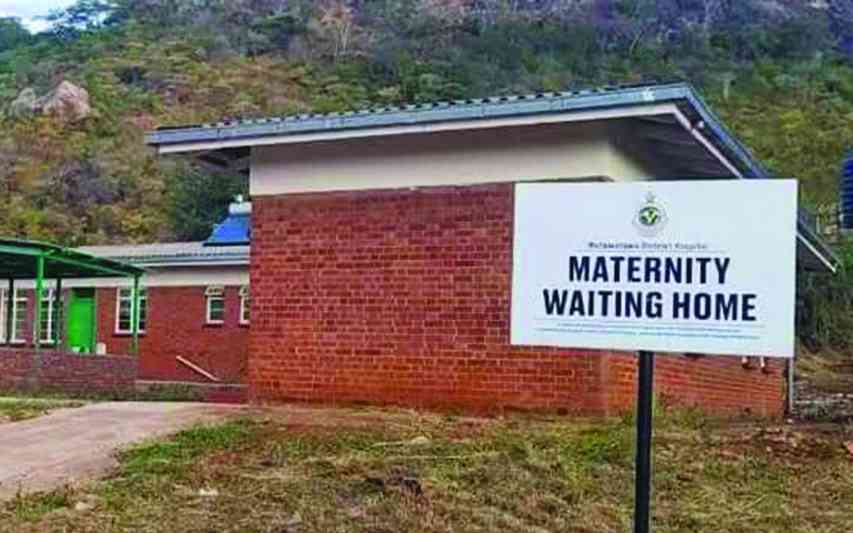
EVIDENCE Chikwishe remembers the fear in her mother's eyes when she gave birth at just 15 years old.
"I was advised that I needed to stay at the hospital's waiting mothers' shelter so that I could get timely check-ups and prepare for a safe delivery," says Chikwishe, now 33, from Chisavanye village in Chipinge.
That advice saved her life and the lives of her six children.
All her deliveries have been safe a remarkable feat given that she lives far from St Peter's Mission Hospital.
But she has learned a critical lesson many rural Zimbabwean women learned too late: stay close to medical help before complications strike.
“I don't have challenges with the nurses here,” she says.
“They remind me to come and stay closer to the hospital so that I don't face delays.
“We live far from the hospital, leaving no room for emergency medical care should the need arise.
“One may suffer excessive blood loss and lose the child or even their own life.
"I understand the importance of staying close to the hospital because the nurses take quick action. That is the reason why all my children are alive and were delivered safely."
Years ago, Zimbabwe's maternal mortality picture was dire.
In 2015, the country recorded 651 deaths per 100 000 live births, meaning hundreds of women were dying from preventable causes such as postpartum haemorrhage and eclampsia.
Today, that number has dropped to 212 deaths per 100 000 live births, according to the latest 2023-24 Zimbabwe Demographic and Health Survey.
This progress has been driven by a combination of low-tech solutions such as waiting mothers' shelters and high-impact medical training, backed by more than US$180 million in international funding since 2020.
Stephen Mbiri, medical superintendent at St Peter's Mission Hospital, says demand for the shelters has surged.
"Our waiting mothers' shelter normally has a capacity of 20 beds, but over the past two years we have been having an average of 35 women at any given time," he said.
"It is because of improved healthcare. Most of them now appreciate the importance of staying at the hospital just before giving birth."
Home deliveries, once common in rural areas lacking transport and health facilities, have now declined significantly.
"We are emphasising safer delivery methods at health institutions," Mbiri added.
Key interventions include scaling up emergency obstetric and neonatal care training for more than 3 700 staff, implementing results-based financing to reward quality care, expanding maternity waiting homes and strengthening maternal and perinatal death surveillance and response systems.
Perhaps no place tells the success story better than Hauna District Hospital in Mutasa district.
Since 2022, the hospital has safely delivered more than 4 000 babies and not a single mother has died.
Colletta Ngende from Chiko village knows she nearly became a statistic.
Arriving at Hauna with foetal distress, she needed an emergency Caesarean section.
"I arrived here at 5am and at 7am I was taken to theatre," she said.
"I am being given all the medicines needed for my healing."
In the past, she may have waited days. Her two-hour turnaround is now the norm.
A Caesarean section takes about 45 to 60 minutes.
Common reasons include labour that fails to progress, breech position, foetal distress or multiple births. It can be planned or, as in Ngende's case, an emergency.
Hospital matron Tendai Serere credits the results to getting the basics right.
"We receive many pregnant women who deliver here. In the first three months from January to March this year, we delivered 446 babies and all of them survived,” Serere said.
“We have not had any woman lose her life during childbirth since 2022. We have a skilled workforce, including trained midwives and nurses.”
The hospital serves a catchment area of more than 50 clinics and health posts, supported by strengthened referral systems designed to minimise delays in emergency obstetric care.
Expectant mothers with complications are now encouraged to stay at the waiting shelter from as early as 33 weeks of pregnancy.
This transformation is closely linked to Zimbabwe's broader health systems strengthening under the COVID-19 Response Mechanism a project led by the Health and Child Care ministry, with financial support from the Global Fund and implemented by the United Nations Development Programme.
Since 2020, Zimbabwe has received more than US$180 million to support both the COVID-19 response and long-term health system improvements.
The results measured in mothers and babies alive are beginning to speak for themselves.