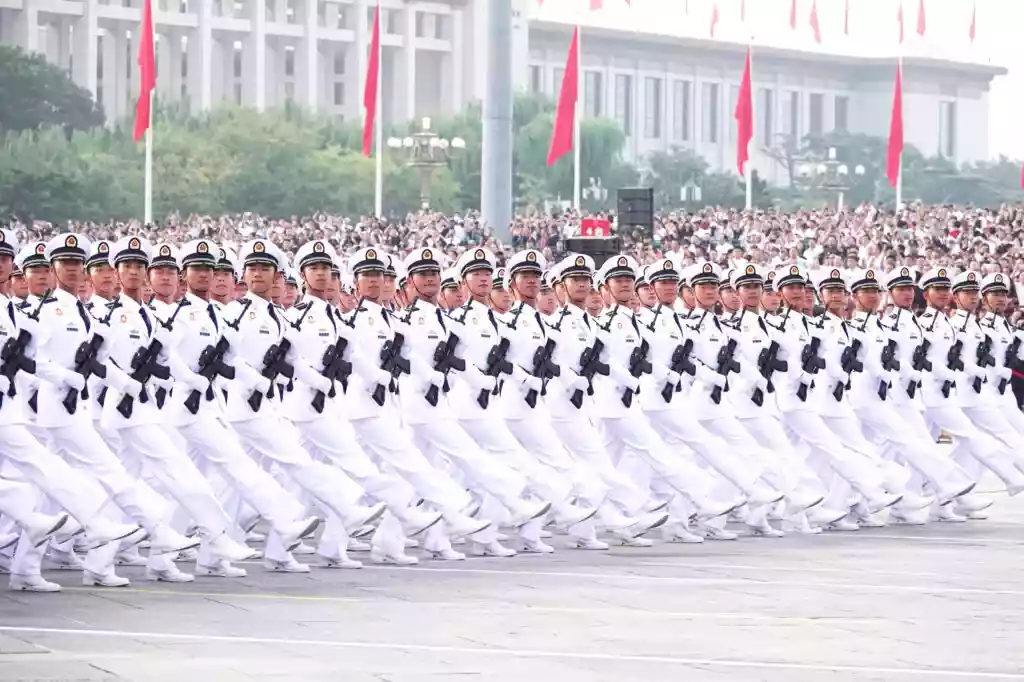
The final days of 2025 saw Taiwan surrounded by Chinese warships, aircraft and coast guard vessels in what the Chinese Ministry of Defence described as a serious warning to ‘Taiwan independence’ separatist forces and foreign interference. ‘Justice Mission 2025’, the sixth major military exercise to simulate a blockade of Taiwan since 2022, came closer to the island’s shores than previous drills, reflecting China’s strategy of creeping escalation.
In 2025, Chinese incursions into Taiwan’s air defence identification zone reached their largest number yet — more than 3700 — coupled with record-high cyberattacks. The year was further marked by continued allegations of espionage and cutting of undersea cables, reports of rising disinformation and the first instance of Chinese law enforcement opening an investigation into a sitting Taiwanese lawmaker for ‘criminal activities aimed at splitting the nation’.
Reunification with Taiwan is deemed an essential component of Chinese President Xi Jinping’s vision of ‘national rejuvenation’, so it is targeted more frequently and with greater intensity than anywhere else in the Indo-Pacific. Yet it is far from the only victim of Chinese grey zone aggression.
The Chinese coast guard set a new record of 335 consecutive days spent in the waters around the Japanese-administered Senkaku Islands in 2025, shattering the previous year’s record of 215. Japan was further subject to military intimidation, punitive economic measures and information warfare after Japanese Prime Minister Sanae Takaichi remarked that an invasion of Taiwan would threaten Japan’s survival and might force it to act in self-defence.
In the South China Sea, China continued to gradually turn up the level of aggression against the Philippines, resulting in a dramatic collision between two Chinese vessels in August. Similarly, Chinese aircraft continued to challenge Australian and Philippine air patrols using unsafe manoeuvres and other dangerous tactics. There were also multiple standoffs between the Chinese coast guard and South Korean vessels in the Yellow Sea, where China has been unilaterally deploying maritime infrastructure and declaring ‘no-sail zones’.
Further afield, the People’s Liberation Army Navy conducted shock, live-fire exercises in the Tasman Sea, in an unprecedented display of power projection that rattled Australia and New Zealand. Elsewhere, China continued the quiet build-up of dual-use infrastructure along its border with India, and in strategic locations in the South Pacific.
This is not simply ‘business as usual’ in the Indo-Pacific. China has been increasingly assertive for many years now. But as each year goes by, and boundaries are pushed a little further, the region is being incrementally reshaped in the process. This is occurring despite repeated condemnations and efforts to expose and defend against Chinese expansionism. In short, deterrence in the grey zone is failing.
Indo-Pacific countries must begin by explicitly recognising that their challenges are not isolated problems, but part of a broader pattern of cross-domain Chinese aggression. The region must also be far more willing to call out China for its actions and offer diplomatic, if not material, support to other victims of Chinese bullying and subversion.
- The brains behind Matavire’s immortalisation
- Red Cross work remembered
- All set for inaugural job fair
- Community trailblazers: Dr Guramatunhu: A hard-driving achiever yearning for better Zim
Keep Reading
All too often — as in the ongoing spat between China and Japan — countries must weather their respective storms alone. Despite the mushrooming patchwork of minilateral initiatives in recent years, responses have tended to be reactionary, fragmented and risk averse. And they have ultimately failed to change China’s behaviour.
If the United States and its partners and allies across the region hope to change China’s cost-benefit calculus in the grey zone, they will have to take a more decisive stand, and they will have to do so together.
Encouragingly, momentum is building in this direction. Japanese Defence Minister Shinjiro Koizumi has called on ‘like-minded’ Indo-Pacific nations to enhance defence collaboration and strengthen deterrence in the face of routinised military coercion and what he referred to as the ‘weaponisation of everything’. In this vision, existing networks would be connected so ‘when some nations face harassment or coercion, the region as a whole will be able to respond collectively’.
This idea presents a more near-term, workable alternative that better aligns with current regional realities than a formal ‘Pacific Defense Pact’. It is also consistent with the US Strategy to Strengthen Multilateral Defense in the Indo-Pacific, which aims to bolster security cooperation with allies and partners, while stopping short of a formal alliance.
Enhanced military cooperation is important, but it is also unlikely to deter China’s grey zone aggression by itself. It is critical that these new forms of cooperation employ the full spectrum of national power in a coordinated fashion. Military cooperation is likely to be more effective when combined with diplomatic, economic and informational measures.
More fundamentally, this emerging network of multilayered deterrence must be grounded in a shared, common operating picture and an accompanying counter grey zone strategy. This would be greatly aided by the establishment of a multi-national Indo-Pacific Centre of Excellence for Countering Hybrid Threats, not unlike the NATO–EU institution that exists in Europe.
Efforts to deter Chinese grey zone aggression must also assume a more proactive posture. Though this may require the use of potentially escalatory tactics and a greater appetite for risk, only real costs are likely to change China’s calculus.
Winning back the initiative and establishing deterrence in the grey zone will be no easy task. But in the absence of a more strategic, coordinated and robust approach to Chinese grey zone aggression, China will continue to incrementally advance its strategic and territorial aims at the Indo-Pacific’s peril.
Sam Mullins is Professor at the Daniel K. Inouye Asia-Pacific Center for Security Studies, US Department of War.
The opinions expressed in this article are the author’s, and do not necessarily represent the official position of the Daniel K. Inouye Asia-Pacific Center for Security Studies or the US Department of War.