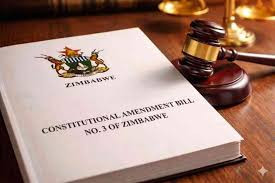
HARARE, May 29 (NewsDay Live) — Human rights activist Youngerson Matete has approached the High Court seeking to halt the enactment of the Constitutional Amendment Bill No. 3 (CAB3), arguing that key provisions can only be amended through a national referendum.
In an application for a declaratory order, Matete cited the Parliament of Zimbabwe, President Emmerson Mnangagwa, Justice minister Ziyambi Ziyambi, the Zimbabwe Electoral Commission (ZEC) and the Attorney-General as respondents.
Matete argues that clauses 4, 9 and 10 of the Constitution of Zimbabwe Amendment (No. 3) Bill fall within provisions protected under Section 328 of the Constitution and therefore cannot be amended without the approval of voters through a referendum.
He is seeking a declaration that any attempt to enact, promulgate or implement the contested clauses without first obtaining approval through a national referendum would be unconstitutional and invalid.
The application also seeks an order barring Parliament, the President and the Justice minister from taking any further steps toward the enactment or implementation of the clauses unless they are first approved by voters in a referendum.
Matete further wants the court to direct ZEC to conduct a referendum on the proposed constitutional amendments if Parliament passes the Bill.
The Constitutional Amendment (No. 3) Bill, 2026 (H.B. 1 of 2026), was gazetted on February 16, 2026.
Among its most controversial provisions are proposals to extend the terms of the President, Parliament and local authorities from five years to seven years and to replace the direct election of the President with a parliamentary electoral system.
- Mr President, you missed the opportunity to be the veritable voice of conscience
- ED to commission new-look border post
- Zanu PF ready for congress
- Zanu PF ready for congress
Keep Reading
The Bill also proposes transferring voter registration functions from ZEC to the Registrar-General’s Office, creating a separate Zimbabwe Electoral Delimitation Commission, abolishing the Zimbabwe Gender Commission by transferring its functions to the Zimbabwe Human Rights Commission, and increasing the number of appointed senators.
Matete said public debate over the Bill had revealed deep divisions on whether some of the proposed amendments require approval through a referendum.
He cited public statements attributed to Ziyambi and former deputy Justice minister Munyaradzi Mangwana suggesting that a referendum was not necessary.
Matete also referred to submissions made to Parliament by the Zimbabwe Catholic Bishops Conference on May 12, 2026, which raised concerns over protecting constitutional safeguards, including term-limit provisions, from amendment without direct public approval.
“My interest is neither abstract, academic nor hypothetical,” Matete said in court papers.
“It is a real, legally recognisable and constitutionally protected interest arising from my status as a citizen of Zimbabwe, a registered voter and a beneficiary of the constitutional order established under the Constitution.”
He said he had a direct interest in ensuring constitutional amendment procedures were conducted strictly in line with the Constitution and that entrenched provisions were not altered unlawfully.
“The proposed constitutional amendment process directly affects my constitutional rights and interests, including my right to constitutional governance founded upon the supremacy of the Constitution and my political rights to participate in constitutionally mandated democratic processes,” he said.
Matete argued that the case raises a “real, live and justiciable constitutional controversy” over the interpretation and application of Section 328.
“The Bill has already been gazetted and legislative processes towards its enactment are underway. Public statements by senior government officials and politicians further demonstrate a clear intention to proceed without submitting the proposed amendments to a referendum,” he submitted.
He contended that proceeding without a referendum would undermine constitutional supremacy, democratic participation, the rule of law and the sovereignty of Zimbabwean citizens.
“Section 328 exists to ensure that fundamental constitutional safeguards cannot be altered solely through parliamentary processes without the direct participation and approval of the electorate,” Matete argued.
He said failure to hold a referendum would unlawfully deprive Zimbabweans of their constitutional right to participate directly in decisions affecting entrenched constitutional provisions.
The matter is pending before the High Court.