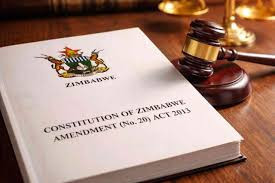
Zimbabwe’s 2013 Constitution, once celebrated as the country’s democratic breakthrough, now stands at risk of gradual dismantling through proposed amendments, selective implementation and political manipulation. Yet the most troubling question is not only what the ruling elite are doing to the Constitution, but why citizens, institutions and opposition forces appear unable or unwilling to mount sustained resistance against its erosion.
When the Constitution of Zimbabwe Amendment (No. 20) Act came into force in 2013, it was hailed as a historic national achievement. It emerged from years of consultation, political negotiation and public participation. Zimbabweans overwhelmingly endorsed it in a referendum because it promised limits on executive power, stronger civil liberties, judicial independence, devolution, transparency and institutional accountability.
At the time, it was marketed as “the people’s constitution.”
More than a decade later, many of its most important provisions remain partially implemented, delayed or deliberately ignored. Now, instead of demanding full implementation, political energy is increasingly focused on altering the very document that citizens once defended with pride.
This raises a disturbing national contradiction.
Why are Zimbabweans not demanding the protection of their own Constitution before it is fundamentally weakened? Why has constitutionalism become secondary to political survival, factional interests and economic desperation?
Part of the answer is uncomfortable but necessary to confront: the silence is not entirely voluntary. In many respects, it is forced.
Years of political intimidation, arrests, violence, surveillance and economic vulnerability have created a climate where open resistance carries real personal consequences. Citizens are not merely passive observers; many operate within an environment where dissent can lead to harassment, exclusion, arrest, assault or loss of livelihood. Fear has become embedded within public life.
- Biti concludes ConCourt application
- AFM church leader in court for fraud
- Biti alleges ‘powerful forces’ after him
- Biti reported to Law Society
Keep Reading
Zimbabwe’s deeper crisis has never been the absence of ideas or legal frameworks. The country possesses some of Africa’s finest constitutional lawyers, academics, policy experts and intellectuals. The real crisis is the normalization of non-implementation and the collapse of sustained citizen pressure under increasingly restrictive political conditions.
A constitution has value only when institutions and citizens insist that it must be obeyed.
Instead, Zimbabwe has become a nation that celebrates progressive laws during launch ceremonies while tolerating their violation in practice. Parliamentarians swear to defend the Constitution, yet many rarely confront unconstitutional conduct with seriousness or consistency. Sections of civil society raise concerns intermittently, but broad national mobilisation has remained weak and fragmented. Even the legal fraternity, traditionally expected to defend constitutional order, has often responded selectively.
Most alarming is the constrained public silence.
Citizens who overwhelmingly voted for the Constitution in 2013 have not collectively insisted on the implementation of every clause. Economic hardship, political fatigue and fear have gradually weakened organised resistance. For many Zimbabweans, daily survival now overshadows constitutional activism.
But history shows that authoritarian consolidation often succeeds not only because of state power, but because societies are gradually conditioned into silence through intimidation and exhaustion until institutional erosion becomes normalized.
In this context, the beatings, arrests and persecution of constitutional lawyers and opposition figures such as Lovemore Madhuku and Tendai Biti appear less like isolated political incidents and more like warning signals of a broader struggle over constitutionalism itself. When individuals who publicly challenge state excesses are criminalised, assaulted or intimidated, it sends a wider message to society about the risks of confronting power.
The pattern matters.
Constitutions are rarely destroyed overnight. More often, they are weakened gradually through selective amendments, ignored provisions, institutional intimidation and public exhaustion. Citizens adapt slowly until abnormality becomes normal.
Zimbabwe now risks entering that phase.
The tragedy of Zimbabwe is therefore not merely incompetence or poor governance. It is the growing national acceptance, often under pressure and fear, that laws may exist without enforcement, that constitutional guarantees may be suspended without consequence and that democratic safeguards are negotiable depending on political convenience.
Countries do not develop because they draft beautiful constitutions. They develop because institutions, courts, Parliament, civil society and ordinary citizens insist that constitutional rules apply equally to everyone, especially those in power.
The 2013 Constitution was supposed to represent a turning point away from centralized power and arbitrary governance. Whether it remains a living democratic instrument or becomes another symbolic national document sitting on a shelf now depends on the willingness and ability of Zimbabweans themselves to defend it before its core principles are permanently diluted.
The greatest threat to the Constitution may no longer be amendment proposals alone.
It may be the forced silence surrounding them.