
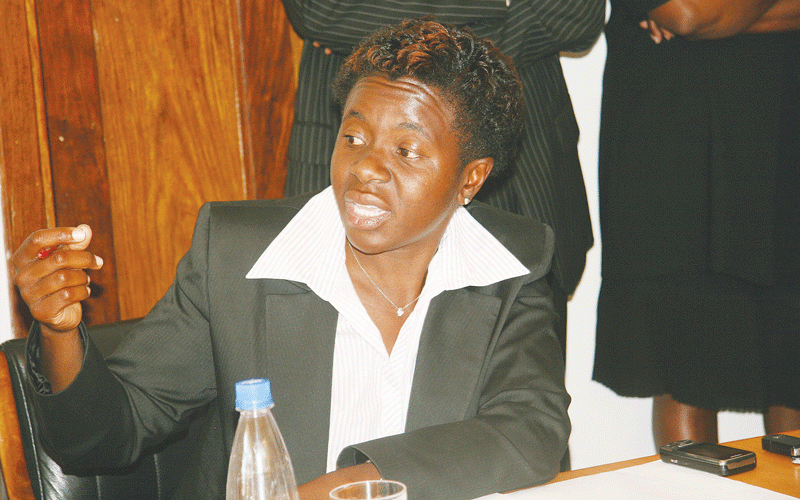
SOME departures happen loudly with speeches, applause, bouquets and cameras. Others happen in silence, in corridors heavy with fear, where goodbye is whispered rather than spoken loudly.
Jessie Majome’s exit from the Zimbabwe Human Rights Commission was the latter.
Her removal as chairperson by President Emmerson Mnangagwa came soon after the commission released a damning report on Constitutional Amendment No 3 Bill. The timing was impossible to ignore.
On a Tuesday, April 7, she addressed the Press on a report that challenged power.
By Friday of that week, Majome was reassigned to the Public Service Commission. Many Zimbabweans predicted it the moment she spoke.
They were sadly correct.
The commission’s report quickly went viral, particularly among citizens who had been denied an opportunity to speak at the Parliamentary public hearings, many of whom said it accurately captured their concerns and experiences.
Like many of my generation, I first knew Jessie Majome through newspaper pages long before I knew her in person.
- Mr President, you missed the opportunity to be the veritable voice of conscience
- ED to commission new-look border post
- Zanu PF ready for congress
- Zanu PF ready for congress
Keep Reading
In the late 2000s, she was one of the most outspoken opposition legislators in Parliament, sharp, fearless and articulate.
To young readers, she seemed larger than life: one of those rare public figures who appeared to speak with conviction rather than convenience.
Years later, when I began covering her work more closely, I discovered something newspapers alone could not fully capture.
I saw it in Mbare Matapi Flats during a fact-finding mission by the Zimbabwe Human Rights Commission.
The buildings were crumbling, the corridors dark, the stench of sewage overwhelming. Many people kept their distance, wary of collapsing structures and filth underfoot. Majome did not.
She walked through the same corridors residents used everyday.
She stepped where sewage flowed.
She listened to desperate voices competing to be heard. She did not delegate suffering to subordinates or receive reports from a safe distance.
She wanted to see, smell and hear for herself how people lived.
In that moment, the politician I had once read about became clearer to me: beneath the public image was a person animated by a genuine instinct for justice.
That is why the scene of her departure days later carried such emotional weight.
When I called her on the Monday morning after her dismissal, she told me she will be at the commission offices packing her belongings.
My call to her that morning was not for a headline, but a courtesy gesture to check on her well-being.
I went there, hoping to capture just one final image of her leaving the institution she served with visible passion.
I waited outside for hours.
When she finally arrived, she apologised for keeping me waiting.
She was cheerful, remarkably so.
There was no bitterness in her tone.
No performance of outrage.
No self-pity.
She simply invited me inside.
What I found in the corridors was a silence louder than words.
The atmosphere was subdued, as though grief had been instructed to keep quiet. Staff members approached her one by one, discreetly, glancing around before offering their goodbyes.
It was the kind of behaviour seen when affection becomes risky, when respect must be hidden because open association may be misunderstood and punished.
Some wanted to embrace her but settled for hurried words.
Some wanted to linger, but kept moving.
Some wanted to mourn, but wore professional faces.
One man, struggling to hold back tears, told her the place will never be the same again.
It did not sound like flattery.
It sounded like the truth.
Inside her office, she packed items that told the story of service more honestly than any official statement could.
The Constitution went into a box, carefully, tenderly.
It seemed less like a book and more like something she personally cherished.
Wall hangings came down one by one, each carrying a memory visible in her expressions before she spoke it aloud.
Then there was a postcard from 2024, sent when she was appointed.
A friend warned her that the role at the Zimbabwe Human Rights Commission will be “challenging and rewarding”.
She smiled as she read it.
There was wisdom in that message: some appointments are rewarding precisely because they become challenging.
As we chatted, while she was packing, I asked how she was coping with the flood of information and speculation circulating on social media about her removal.
She told me she had long stepped away from those platforms.
The toxicity, from the backlash over her appointment to the Zimbabwe Anti-Corruption Commission and later criticism during her time at the Zimbabwe Human Rights Commission, had convinced her not to worry herself with noise that she said only dragged her backwards.
When the packing was finished, two staff members helped to carry her belongings outside. Others watched from behind doors and windows.
They peeped through glass and narrow openings like witnesses to something they could not publicly acknowledge.
No speeches.
No formal farewell.
No ceremony.
Just silent eyes following a woman out of the building.
At the main entrance, as she stepped away, Majome said boldly: “It is done. It is well".
Those words stayed with me.
They were not the words of defeat.
They were the words of someone who had already made peace with the cost of principle.
Institutions often reveal themselves not only by whom they appoint, but by how they part with those who serve them honestly.
On that day, the Zimbabwe Human Rights Commission lost more than a chairperson. It lost a visible symbol of courage.
And in those quiet corridors, many people knew it.
They just could not say so loudly.
But outside, anger roared.
Across Zimbabwe, Majome’s removal sparked outrage and ordinary citizens, refusing to accept the decision as routine administrative reshuffling, approached the courts to challenge Mnangagwa’s action.






