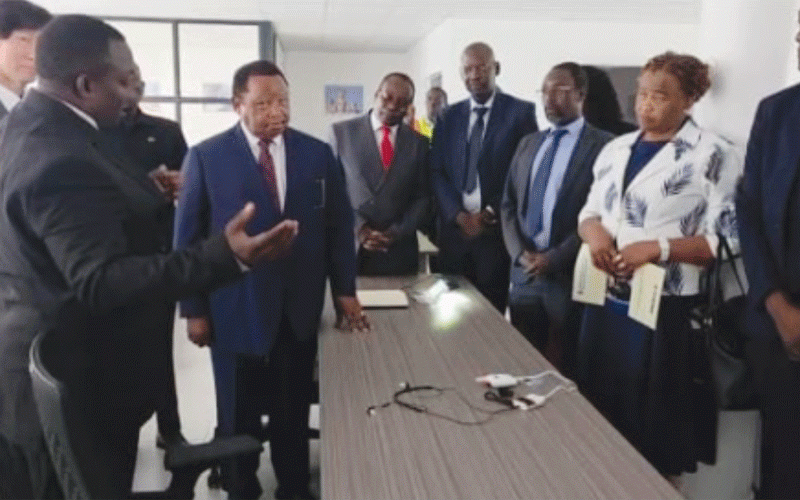
The government has commissioned a National Information Access Centre at the Zimbabwe Open University (ZOU), a digital hub expected to strengthen innovation, digital literacy and artificial intelligence (AI) training for students and young professionals.
Speaking at the launch in Harare last Friday, Higher and Tertiary Education, Innovation, Science and Technology Development minister Frederick Shava said the centre would enhance access to global research, support digital skills development and position Zimbabwe as an emerging player in AI education.
He said the centre stood as a national digital empowerment hub supporting innovation, inclusive education and global academic collaboration.
“Through its modern ICT Training Rooms, the centre equips young people with digital literacy, artificial intelligence (AI) fundamentals and industry aligned certifications building confidence and readiness for emerging technology careers,” Shava said.
According to Shava, the facility was established through a bilateral partnership between Zimbabwe and South Korea under Official Development Assistance, with an investment of US$350 000.
“A project made possible by a bilateral agreement between the governments of Zimbabwe and the Republic of South Korea,” he said.
“This initiative was established through Official Development Assistance with a dedicated investment of US$350 000 to establish Zimbabwe’s National Information Access Centre.”
Shava said the centre aligned with government’s Heritage-Based Education 5.0 model, which emphasised teaching, research, community engagement, innovation and industrialisation.
- Public relations: How artificial intelligence is changing the face of PR
- Queen Lozikeyi singer preaches peace
- Public relations: How artificial intelligence is changing the face of PR
- Business opinion: Branding through Artificial Intelligence
Keep Reading
He said the philosophy introduced in 2017 was an endeavour to have relevant education that delivered innovation and industrialisation that produced goods and services for society.
“To this end, one of the key enablers in the implementation of Heritage Education 5.0 is the physical/digital infrastructure arm,” he said.
The facility includes modern ICT training rooms, a digital library, a video conferencing suite and a digital content creation studio aimed at supporting virtual learning, research collaboration and media production.
“The video conference room expands global connectivity, enabling virtual learning, international seminars and accessible communication for all learners.
“The digital content creation studio strengthens ZOU’s digital presence by supporting lecture recording, media production and creative industry skill development.
“Once more, this strengthens the implementation of Education 5.0 pillars of teaching, research, community engagement, innovation and industrialisation.”
Shava said the centre was equipped with an NVIDIA Graphics Processing Unit-powered AI server that would enable practical artificial intelligence training, advanced data analytics and youth technology entrepreneurship.
“With the addition of an NVIDIA Graphics Processing Unit (GPU) powered AI server, the centre now positions Zimbabwe as a first mover in AI education and innovation,” he said.
“This infrastructure enables practical AI training, advanced analytics and support for youth tech-entrepreneurship, transforming the Information Access Centre to a national Centre of Excellence for Digital Skills and AI Innovation.
“It becomes a bridge: between local challenges and global solutions; between policy and implementation; between knowledge and production.”
The strategic investment in education and information and communication technologies will help to accelerate the country’s transition towards a competitive digital economy, he said.
“I am informed that the National Information Access Centre advances inclusive skills development, drives digital transformation and accelerates Zimbabwe’s progress towards a competitive digital economy aligned with Vision 2030,” Shava said.