ZIM Sculpture Gallery is on a mission to foster greater appreciation for underrepresented communities.
With its head office in Richmond Hill, Ontario, and a gallery in Picton in Prince Edward County, it has become Canada’s foremost purveyor of magnificent Shona stone sculptures from Zimbabwe.
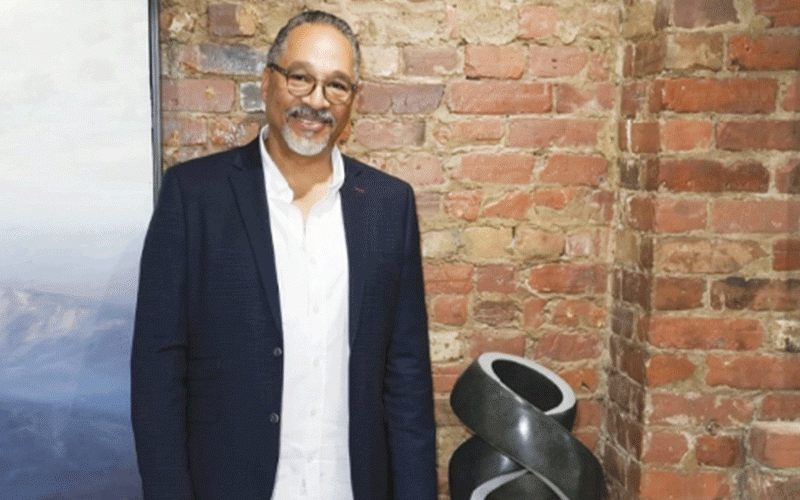
Gallery owner Wayne Gallimore represents two of Zimbabwe’s major artist communities, as well as independent artists.
In a wide-ranging email interview with the Toronto Spark, Gallimore shared his insights into the history, artistry and growing international appeal of Shona sculpture.
How did you become interested in Shona sculpture?
My interest in Shona sculpture, now often referred to as Zimbabwean stone sculpture, grew out of a lifelong relationship with art.
That relationship began at home in Jamaica, where my parents had a modest but meaningful art collection, and continued through my own work as a collector, gallerist, and former Director on the Boards of the National Gallery of Jamaica and the Museum of History and Ethnography.
The spark that became a deep and lasting commitment came on Father’s Day in 2023, when I encountered Shona sculpture at Fran Fearnley’s Zim Art Rice Lake Gallery in Ontario, just four months before she retired and closed the gallery.
- Letter from America: We must rid ourselves of Eurocentriceducation. Which One?
- Letter from America: We must rid ourselves of Eurocentriceducation. Which One?
- Where does agriculture begin and end?
- Mukundi project inspires through spoken word
Keep Reading
The artistry was immediately soul-stirring.
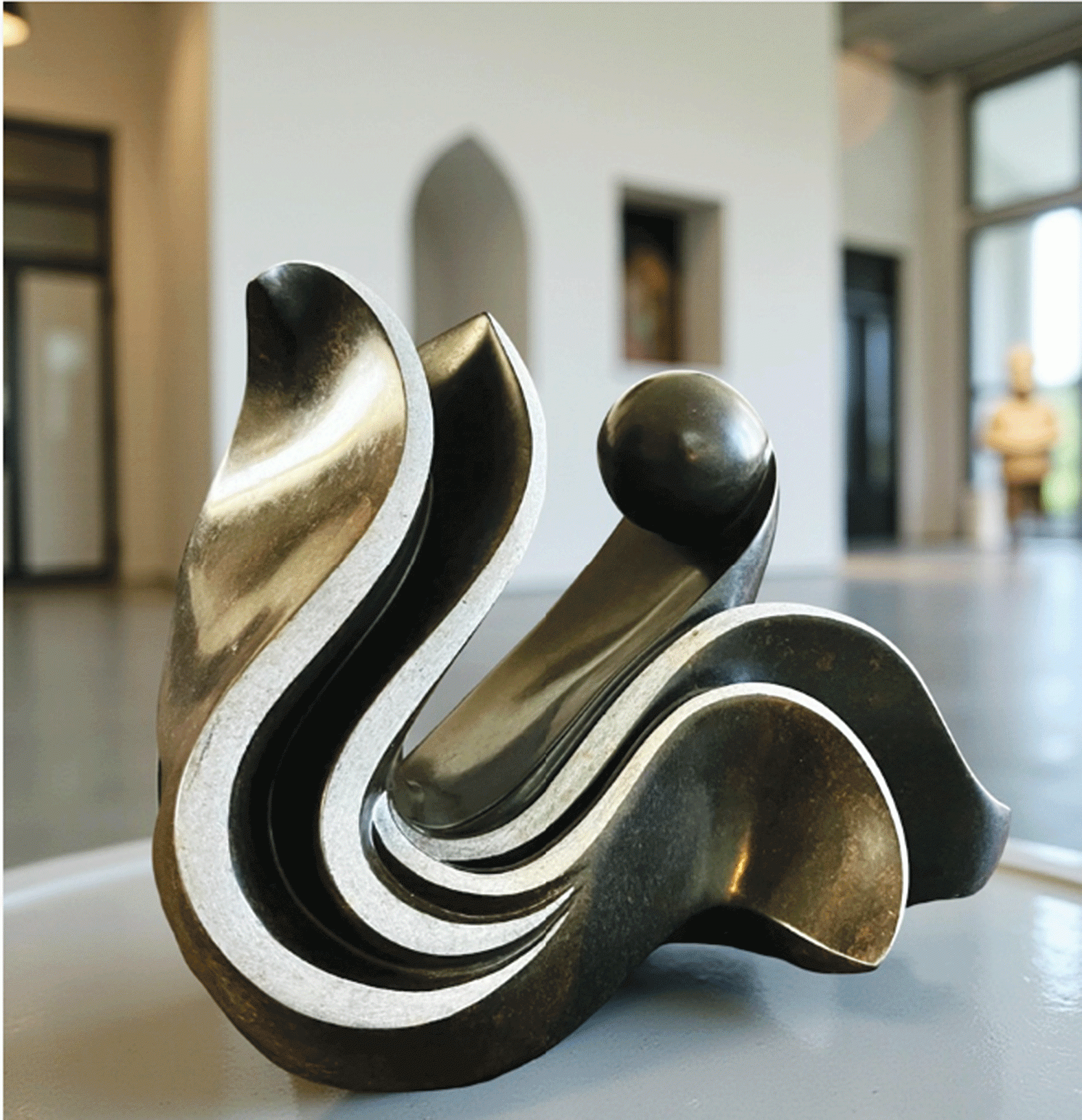
These unique and exquisite, hand-carved stone sculptures were richly textured, beautifully polished, and harmoniously balanced, shimmering in an extraordinary range of colours.
More than that, they carried stories; stories rooted in ancestral Shona traditions and expressed through the contemporary lives and experiences of the artists.
I knew instantly that this extraordinary yet underrepresented art movement deserved far greater visibility in Canada and across the Americas.
It became my mission to continue Fran’s pioneering work of championing this art form.
With her collaboration, I founded ZIM Sculpture Gallery that summer, building on the foundation she had laid after introducing Zimbabwean stone sculpture to Canada.
This journey did not begin as a business decision; it began with being deeply moved.
I now travel regularly to Zimbabwe, spending time with artists in their studios and homes, meeting their families, selecting works, and walking the very landscapes where the movement was born.
Today, Shona sculpture is not something I simply exhibit, it has become a central part of my life’s work: building cultural bridges between Zimbabwe and Canada through art, while helping audiences diversify their appreciation of art and enrich their collections.
We have also exported works to Jamaica and the United States.
How did this art form originally develop?
Zimbabwe quite literally means “house of stone” in the Shona language, a name that reflects the country’s astonishing geological richness, which has nurtured one of Africa’s most remarkable sculptural movements.
Stone craftsmanship has deep roots in the Shona culture, most notably seen at Great Zimbabwe, a UNESCO World Heritage Site constructed around 1100 CE.
This ancient stone city was built by master stone masons using more than a million hand-hewn granite blocks, stacked with extraordinary precision and without mortar.
It boasts walls that are 11 metres high and six metres wide at the base, superbly tapering to the top.
Other parts of the settlement seamlessly combine dry-stone construction with natural rock formations, blending function and aesthetics.
Archaeological finds at the site include eight carved soapstone birds that are most famously known as the Zimbabwe Birds.
They represent the African fish eagle, locally called Chapungu, and are thought to be the first totem or sacred carvings symbolizing the early Shona people’s identity.
The Zimbabwe Birds now appear on the nation’s flag and coat of arms symbolising national identity, and are the only known examples of fine-art stone carving in Zimbabwe, prior to the 20th century.
Over time, much of the stone-working tradition became dormant until 1957, when Joram Mariga, a wood carver supervising a road crew, noticed a beautiful piece of soapstone.
Curious, he took out his penknife and discovered it could be carved.
That moment marked the reawakening of ancient skills and the birth of one of Africa’s greatest modern art movements.
Mariga, now widely regarded as the “father of Shona sculpture”, was not only a prolific artist, but also a mentor and driving force behind this movement, particularly in rural areas.
His work caught the attention of Frank McEwen, the first director of what is now the National Gallery of Zimbabwe.
McEwen was deeply impressed by Mariga’s creativity, which had developed independently of Western influence.
Rather than instructing the “first generation” stone sculptors, McEwen encouraged them to draw from their own culture, mythology, spirituality and environment.
Artists were given tools and stone.
McEwen urged them to look inward, to express what he called their “tribal subconscious”.
As he famously described it, their work revealed “the images they bore in their souls”.
Artists learned from one another, mentoring through observation and shared practice.
This tradition continues today. While the Shona are the dominant ethnic group in Zimbabwe, representing over eighty percent of the population, local sculptors from other ethnic communities also learned and practiced “Shona sculpture”.
Hence the more encompassing term Zimbabwean stone sculpture was introduced.
Thanks to McEwen’s international reputation, including his connections to artists such as Picasso and Matisse, the movement quickly gained global recognition.
Major exhibitions in the 1960s and 1970s at institutions such as the Museum of Modern Art in New York, the Rodin Museum in Paris, and the Institute for Contemporary Arts in London were met with critical acclaim.
Over time, artists moved from softer soapstone to harder, more durable stones such as serpentine, allowing for greater ambition, intricacy, and longevity.
Unlike many African art forms shaped by external demand, Shona sculpture emerged as a wholly indigenous modern expression, rooted in ancestral belief, the natural world, and human relationships.
Today, these works stand as both deeply cultural and universally resonant expressions of humanity.
What makes Shona sculpture so special?
Authentic Shona sculpture is hand-carved, most often from a single piece of stone.
A sculptor once responded to a question about why he spent two weeks shaping stone by hand instead of using power tools in just hours.
He replied: “Perhaps so, but after two weeks, the stone and I are communicating. We are beginning to understand each other.”
Sculptors often travel long distances to small artisanal quarries to personally select their stones.
They bring together artistic sensitivity, cultural depth, technical mastery, physical strength, tremendous dedication and patience, plus deep respect for the material.
The sculptors work outdoors in open-air studios where they feel a strong sense of harmony with nature.
The process is intuitive. Most sculptors do not sketch; instead, they “see” the finished form within the stone.
Natural shapes, lines, colours and fractures guide the work, telling the artist what to create, leave untouched, what to polish, and what to texture.
This relationship between artist and stone is almost meditative.
Shona sculptors are also storytellers.
Through expressive faces, symbolic forms, and fluid movement, they embed emotion into stone.
They continually evolve the art form, reinterpreting traditional themes, experimenting with abstraction, and developing distinctive personal styles while never losing their cultural grounding.
Walter Mariga, who learned sculpting from his father JoramMariga, recently told me: “While going forward, it is most important that the art movement retains its ‘Shona-ness’.”
There is also a remarkable sense of brotherhood among the artists.
Knowledge is passed through mentorship, apprenticeship, and communal studio life.
Despite economic challenges and difficult working conditions, sculptors remain deeply committed to their craft. True Shona artists carve what they feel, not what the market dictates.
That sincerity is what continues to draw collectors, museums, and art lovers worldwide.
Why is Shona stone sculpture gaining attention in the modern era?
Shona stone sculpture is gaining renewed attention because people today are seeking art that is honest, meaningful and culturally grounded.
As audiences push back against mass-produced, trend-driven art, the authenticity, distinctiveness and craftsmanship of Shona sculpture stand out.
The themes of family, relationships, love, identity, spirituality, resilience and connection to nature speak directly to modern concerns.
At the same time, global conversations around diversity and representation have opened space for African voices to be recognised not as “outsiders”, but as major contributors to contemporary art.
Shona sculpture bridges ancient wisdom and modern expression while remaining rooted in a vibrant African culture and heritage.
It offers something many feel is missing today: depth, authenticity, and a genuine relationship between artist, material, and story.
What prompted you to open ZIM Sculpture Gallery in Picton, Prince Edward County?
Opening ZIM Sculpture Gallery in Picton felt like a natural extension of my passion for Shona sculpture and my commitment to promoting an extraordinary yet underrepresented art movement in Canada.
Prince Edward County offered the ideal setting — creative, beautiful, and rich in cultural tourism.
The arts-focused community, combined with the rustic-meets-modern indoor and outdoor exhibition spaces at Wild Lot Farm Distillery, created an inspiring environment to showcase these works.
I wanted Canadians to encounter Zimbabwean world-class sculpture in a place already open to discovery, and Picton provided the perfect home for a gallery with a global vision.
What can people see if they visit your gallery?
ZIM Sculpture Gallery, located at Wild Lot Farm Distillery in Picton, offers an immersive experience where art, nature, and leisure converge.
Visitors encounter a curated selection of genuine Zimbabwean stone sculptures varying widely in size, colour, texture, style and subject matter.
The works explore themes of love, family, ancestry, spirituality, nature and the human experience.
Displayed both indoors and outdoors, the sculptures invite quiet reflection and emotional connection.
Visitors experience not only exceptional craftsmanship, but a living artistic tradition in ancient stones, from far away, telling stories that touch and unite us.
We also occasionally present collaborative and pop-up exhibitions at other venues, to provide opportunities for more people to experience this remarkable art form.
What advice do you have for anyone interested in purchasing a Shona sculpture?
Take time to engage with the work. Look closely.
Notice which piece speaks to you, whether through form, movement, texture, colour, the story it tells or emotion it evokes.
A personal connection is what turns a purchase into a lifelong relationship.
Consider how the sculpture will live with you, in your home, garden, or workplace.
Shona sculptures are not merely decorative objects; they are profoundly meaningful pieces that inspire reflection and conversation.
Authenticity matters. The market includes everything from museum-quality works to mass-produced copies.
Buying from a reputable gallery, curated by those who personally select the work directly from recognised artists in Zimbabwe, ensures authenticity and fair support for the sculptors.
Learning about the artist and cultural context deepens the experience and transforms your purchase into a more meaningful investment in world-class artistry and living heritage.
Is there anything else you would like to add?
Shona sculpture has a long history of international recognition, with prominent collectors including King Charles, Richard Attenborough, Denzel Washington, Oprah Winfrey, Maya Angelou, Céline Dion and Seymour Schulich.
At the last Venice Biennale, Shona sculpture stood out, marking a historic 60th appearance at the prestigious event.
Other major exhibitions have been held at institutions such as the British Museum, Oxford University’s Oriel College, the National Museum of Modern Art (Paris) and Kew Gardens (London).
Despite dire political and economic challenges in Zimbabwe, the movement continues through resilience, commitment, and global appreciation, connecting people across cultures through stories in stone.
Here are a few quotes about these sculptures from various sources:
“The real significance of this tribal art is that it shows us, locked within our own culture, that there are other ways of being human; there are alternative visions that have their own validity.” — David Attenborough
“These sculptures have an immediate impact beyond their place of origin… brilliantly adventurous and accomplished technically, they also seem curiously familiar because of the influence so-called ‘primitive’ art has had on Western modernism.” — Sunday Times, London
“Shona sculpture is perhaps the most important new art form to emerge from Africa in the 20th century.”— Newsweek
“Unlike art found in much of the rest of Africa, Shona sculpture has become a wholly indigenous modern art form created exclusively as a form of artistic expression.” —New York Times
“This tradition… is a genuinely indigenous art form; one that has its roots in ancestor worship and belief in the abiding presence of spirits. They are producing, some say, the finest stonework in the world.” — The Economist
“If the perfection of art is measured purely by emotional expressive power, then this art is beyond perfection.”— West Indian World
“They have pursued the inner life of the spirit with a consuming passion that has produced some of the finest art known to man.” —Basil Davidson, African Kingdoms
“The marvellous Shona sculpture from Zimbabwe not only speak for Africa, but they speak for all of us. They restore a dignity to art which it is in danger of losing.” — Art Review, London
“It is extraordinary to think that of the ten leading sculptor-carvers in the world, perhaps five come from one single African tribe, the Shona.” —Sunday Telegraph
“Though Shona sculpture is sometimes compared to the work of Picasso, Brancusi, Modigliani or other Western masters, we knew the Shona of the mountain highlands had never seen their work. Isolated from the West by geography and politics, the Shona looked within for inspiration within their own land and within their own spiritual legacy.” — Anthony and Laura Ponter, Spirits of Stone.