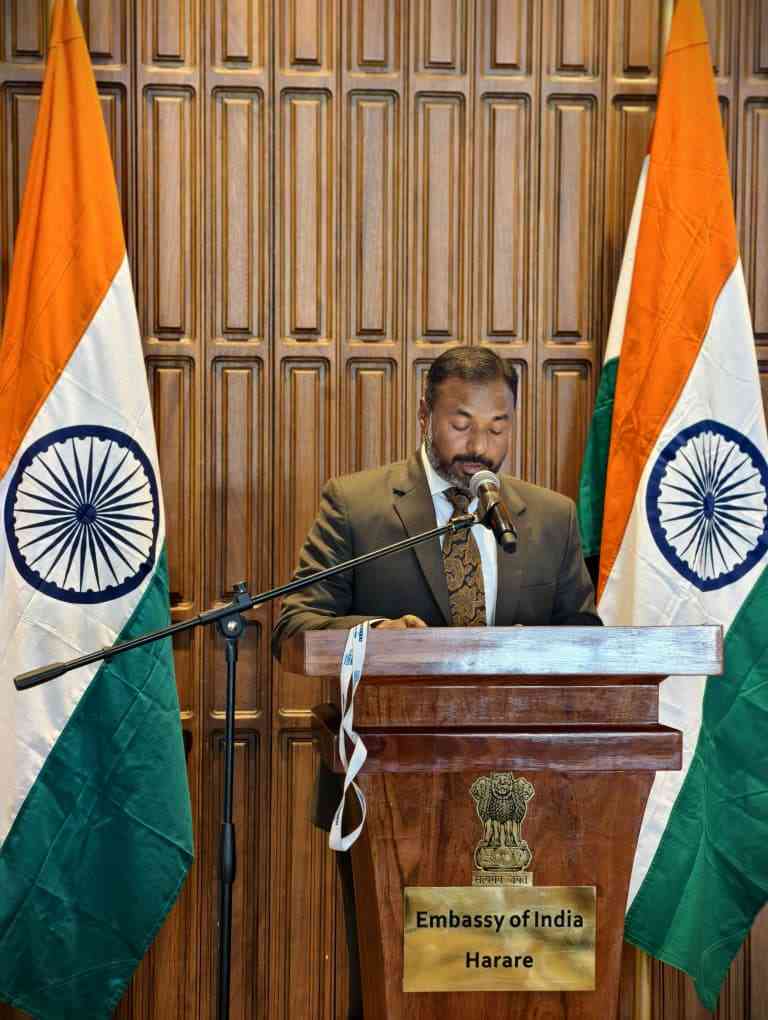
HARARE, Jun. 30 (NewsDay Live) – India has reaffirmed its commitment to strengthening bilateral relations with Zimbabwe, with renewed focus on investment, infrastructure development, education and people-to-people exchanges.
The Asian economic powerhouse has invested more than US$600 million in Zimbabwe across the mining, manufacturing and energy sectors and says it remains committed to supporting the country's development through expanded economic co-operation.
Indian companies have created more than 15,000 jobs in Zimbabwe. India is also one of Zimbabwe's key trading partners, exporting pharmaceuticals, machinery and engineering products while importing tobacco, diamonds and other minerals.
The two countries have maintained cordial diplomatic relations since Zimbabwe gained independence in 1980. India supported Zimbabwe's liberation struggle and has since expanded co-operation in trade, education, healthcare, infrastructure development and capacity building. Zimbabwe has also benefited from Indian scholarships, technical training and concessional lines of credit.
Speaking at a press briefing on the findings of India's sixth National Family Health Survey (NFHS-6), Indian Ambassador to Zimbabwe Brahma Kumar said New Delhi remained committed to deepening its longstanding partnership with Zimbabwe.
"Our focus will continue to be strengthening people-to-people connections through education," Kumar said.
"We are finding opportunities for Indian investment in capacity building and a number of development projects in Zimbabwe."
Kumar said Indian firms were also interested in participating in Zimbabwe's infrastructure rehabilitation programmes, particularly in the energy and railway sectors.
He said the proposed investment by Varun Beverages, announced last month, would exceed US$600 million over five years and would cover beverage production and clean energy projects.
"We are expecting that this will be signed as early as possible because everything has been been done. They need formal government approval and are ready to take over these power units for refurbishment," Kumar said.
"Indian companies can also play a major role in the railway sector. However, that will depend on the Government of Zimbabwe's priorities. There are also opportunities in manufacturing and engineering, and we remain open to participating in those projects."
Zimbabwe is seeking investment to modernise ageing infrastructure, particularly in power generation, transport and manufacturing, as part of efforts to accelerate economic growth and industrialisation.
Kumar said India's experience in improving its business environment could provide useful lessons as Zimbabwe pursues reforms to improve the ease of doing business.
Over the past decade, India has implemented reforms aimed at simplifying regulations, expanding digital governance, reducing compliance costs and improving market access. Those measures have strengthened investor confidence and helped make India one of the world's fastest-growing major economies. Zimbabwe is also implementing regulatory reforms, reviewing tax policies and streamlining business processes to attract investment.
Despite global economic uncertainty arising from the conflict in West Asia, Kumar said India's economic outlook remained strong. He said the Organisation for Economic Co-operation and Development projects India's economy to grow by 6.3% in the 2026-27 financial year and 6.4% in 2027-28, maintaining its position as the world's fastest-growing major economy.
"No country progresses without sound development on the domestic front, especially in terms of human development. The long-term path of development is determined by continued investment in human resources," Kumar said.
The ambassador said the briefing also highlighted findings from India's National Family Health Survey conducted in 2023-24 by the Ministry of Health and Family Welfare in partnership with the International Institute for Population Sciences in Mumbai.
The survey covered nearly 679,000 households in 715 districts and measured key indicators on population, health, nutrition and family welfare to guide policymaking.
According to Kumar, the survey recorded notable improvements in maternal and child health compared with the previous survey conducted between 2019 and 2021.
He said 95.9% of pregnant women received antenatal care, while the proportion accessing services during the first trimester rose from 70% to 76.2%.
The proportion of mothers receiving at least four antenatal visits increased from 58.5% to 65.2%.
Institutional deliveries rose from 88.6% to 90.6%, while births attended by skilled health personnel increased from 89.4% to 91.3%.
Postnatal care for newborns within two days of birth also improved from 79.1% to 85.3%, reflecting continued gains in maternal and child healthcare.