Africa has secured the election of all its eight candidates to the 36-member International Civil Aviation Organisation (ICAO) during the UN agency’s 42nd assembly held in Montreal, Canada.
The election grants the continent nearly a fourth of the total seats, demonstrating the international community’s continued confidence in Africa’s leadership and united commitment to shaping the global aviation agenda.
The eight African States—Angola, Egypt, Equatorial Guinea, Mali, Morocco, Nigeria, South Africa, and Uganda—were returned with decisive votes, reflecting global recognition of their effective service and influence in international aviation.
The ICAO Council, the governing body of the specialised United Nations agency, guides the evolution of aviation safety, security, environmental protection, and connectivity.
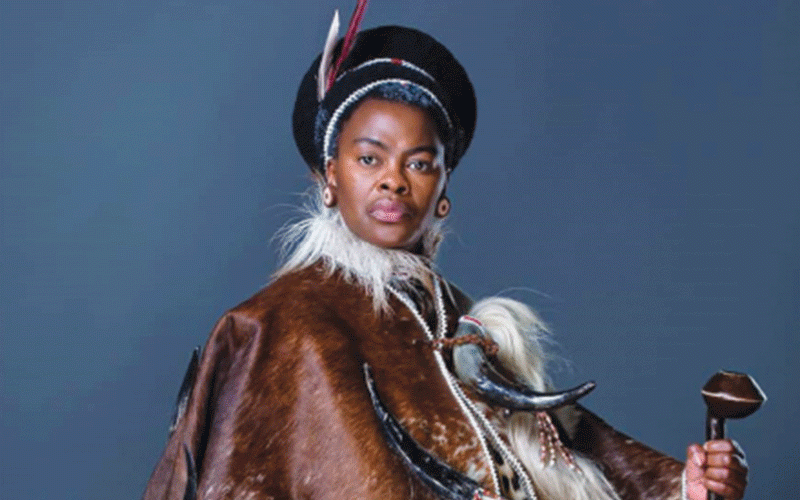
Lerato Mataboge, African Union Commissioner for Infrastructure and Energy, said the result, which affirmed the role of key African players, reflects global trust in Africa's expertise.
“This is a proud moment for Africa. It reflects the trust of the global community in Africa’s expertise and contributions. Our representatives will not only safeguard Africa’s aviation interests but will also continue shaping the global aviation system in ways that promote fairness, inclusivity, and sustainability,” she said.
Mataboge said the AU will continue working with Member States, the African Civil Aviation Commission (AFCAC), and partners to build a more connected and prosperous Africa in line with Agenda 2063: The Africa We Want.
During the last ICAO Council term, from 2022 to 2025, Africa was represented by Egypt, Nigeria, South Africa, Equatorial Guinea, Ethiopia, Ghana, Mauritania, and Zimbabwe.
- Councils defy govt fire tender directive
- Zim needs committed leaders to escape political, economic quicksands
- Bulls to charge into Zimbabwe gold stocks
- Byo author eyes SA award
Keep Reading
Experts say the recent election of eight African countries to the ICAO Council underscores the global recognition of Africa's effective service and leadership in international aviation, ensuring the continent's priorities remain at the forefront of global policy. With this enhanced representation, Africa is well-positioned to advance ICAO’s global priorities, including progress toward Net Zero by 2050, strengthening safety and security for all, and ensuring that no one is left behind.
At the continental level, this mandate will further accelerate the Single African Air Transport Market (SAATM), deepen integration, and drive inclusive growth in line with Agenda2063.
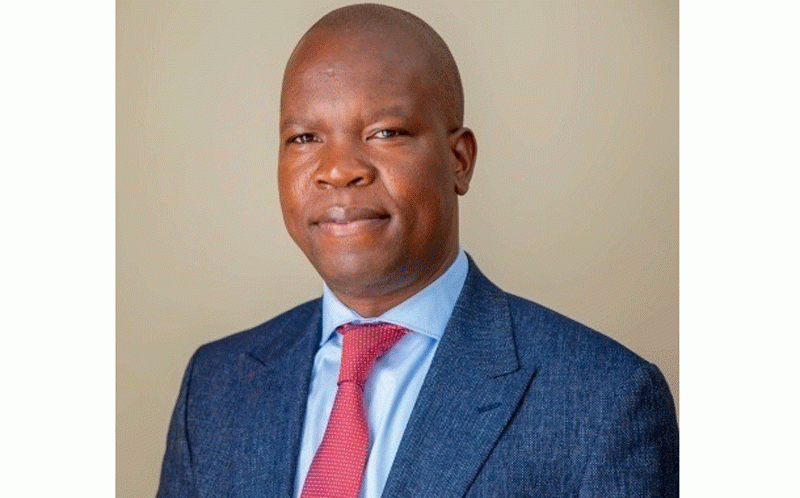
Florent Serge Dzota, AFCAC president, welcomed the outcome as a milestone for Africa’s civil aviation community.
“This renewed mandate is a victory for Africa’s aviation sector. It reaffirms that Africa’s leadership and contributions are valued by the global community. We look forward to supporting our Council members in ensuring Africa’s priorities are addressed at ICAO.”
Beyond securing the Council seats, Africa demonstrated a unified front by actively championing its priorities through a robust technical agenda, submitting 16 Working and Information Papers across key ICAO Commissions. This technical engagement was coordinated daily by the African Union, AFCAC, and the AFI Group to ensure a consistent, unified voice on all major issues.
Africa’s proposals focused on addressing the unique challenges and opportunities faced by developing States, weaving together priorities across safety, security, and sustainability. Africa placed strong emphasis on aviation safety and air navigation, submitting eight technical papers that called for the development of new Standards and Recommended Practices related to the use of Unmanned Aircraft Systems (UAS) for cost-effective ground checks of navigation aids. In addition, it underscored the importance of introducing a standardised global tool for monitoring and controlling obstacles around aerodromes, thereby ensuring safer operations.
The continent also advanced its proposals under the theme of security and facilitation by calling for the streamlining of aviation security systems within the framework of the Global Aviation Security Plan. Equally important, it urged the updating of international regulations to safely enable the use of UAS in transporting dangerous goods, including vaccines and critical medical supplies—particularly in health, emergency, and humanitarian operations.
Africa’s voice was also resolute in the environmental domain, as it strongly championed CORSIA (the Carbon Offsetting and Reduction Scheme for International Aviation) as the sole global Market-Based Measure (MBM) under ICAO. It cautioned against the introduction of duplicative or unilateral regional MBMs, which could undermine the growth and competitiveness of aviation in developing States, and instead pressed for global coherence in addressing aviation emissions.
Experts say Africa’s aviation family has demonstrated the strength of unity. Africa’s priorities will continue to be effectively represented at ICAO, advancing SAATM, strengthening safety and security, and driving sustainable aviation globally, they said.
With one of the world's fastest-growing aviation markets, Africa is now strategically positioned to advance its flagship initiative, the SAATM, which currently represents over 90% of intra-African traffic.