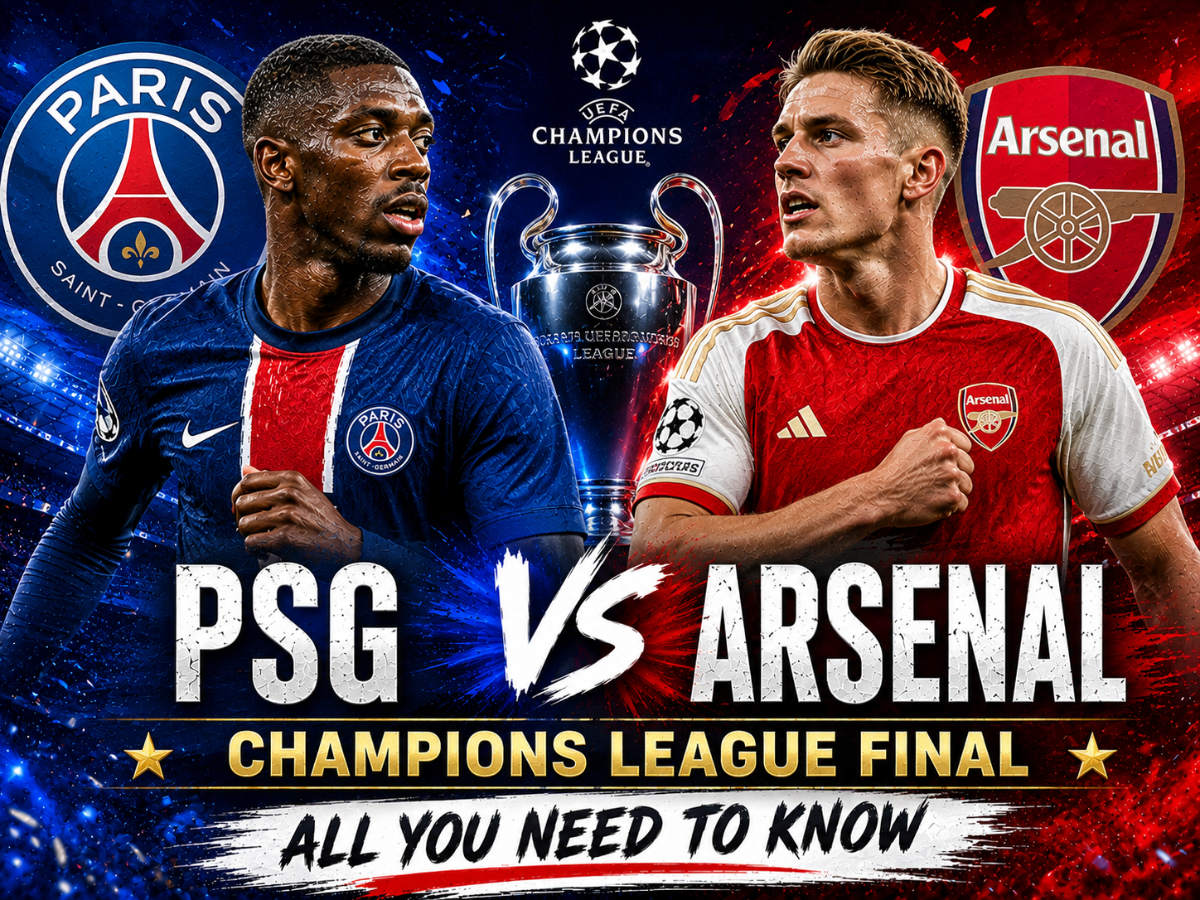
There is a particular cruelty to football's sense of timing. On 19 May, Arsenal were confirmed as Premier League champions for the first time in 22 years after Manchester City could only draw at Bournemouth.
After three consecutive runners-up finishes, including one where City pipped them to the title by a margin of just two points, the Gunners finally crossed the line.
Eleven days later, with the confetti barely swept from the streets of Islington, they walk out in Budapest for the most consequential 90 minutes in the club's modern history. One win separates Mikel Arteta's side from the first UEFA Champions League Cup in their 140-year existence.
Between them and that stands Paris Saint-Germain, defending champions, 44-goal attacking machine, and the team that eliminated Arsenal at this very stage last season.
This is not just a football match. It is a reckoning.
The Numbers Tell Two Different Stories
PSG beat Internazionale 5-0 to lift the trophy for the first time last year. They now have the chance to become only the second team to retain the Champions League in the competition's modern era, after Real Madrid, who won it three consecutive times between 2016 and 2018.
Their route to Budapest reads like a statement of intent. They racked up eight goals against Chelsea on aggregate in the round of 16, then six against Bayern Munich and four against Liverpool in the other knockout stages. In total, PSG have scored 44 Champions League goals this season. They scored the most goals in the knockout stage of any team, 23, while Arsenal scored six. The difference of 17 knockout goals between the two finalists is the biggest in UCL history between any two clubs meeting in the final.
- Mat South innovates to boost COVID-19 vaccine uptake
- Building narratives: Nurse pens anti-child marriages fiction novel
- Building narratives: Chindiya empowers girls through sports
- The Soccer Whiz: The renaissance of the twilight years!
Keep Reading
Arsenal's six knockout goals is itself a record worth pausing on. It is the fewest by any team to reach the final since Atletico Madrid in 2015-16, when they also scored just five. Yet those same Atletico sides, built on defensive suffocation, frequently pushed Real Madrid and Barcelona to their limits in finals and semi-finals. There is a philosophy at work here, not a deficiency.
Arsenal have conceded the fewest goals in the Premier League this season, only 26, and their backline of William Saliba and Gabriel Magalhaes, shielded by David Raya's club-record-equalling 19 league clean sheets, is arguably their most potent weapon. In 14 Champions League appearances this season, Arsenal have not lost a single match. No club in the history of the competition has gone 14 games unbeaten in a single season.
The contrast is stark and deliberate. PSG win by making the game unpredictable and chaotic. Arsenal win by making it narrow and controlled. Someone's model breaks in Budapest.
If Arsenal have a specific tactical headache entering the Puskás Aréna, it runs down PSG's left flank wearing the number 7 shirt.
Khvicha Kvaratskhelia has done something no player has ever done in the Champions League. He scored or assisted in seven consecutive knockout-stage appearances in a single season, the first player in the history of the competition to achieve that. His 10 goal involvements in this season's knockout phase is the highest of any player in the tournament. For context, across his 11 Champions League appearances this season, the 25-year-old Georgian has scored 7 goals and contributed 4 assists.
The manner of his scoring matters as much as the frequency. Against Chelsea in the quarter-final return leg in Paris, he scored twice and added an assist in a 5-2 victory, posting a near-perfect performance rating. Against Liverpool, he scored in both legs, contributing to the 4-0 aggregate victory that ended Arne Slot's European campaign. He saves his best performances for the biggest nights. Saturday night in Budapest does not come bigger.
Arsenal's defensive record suggests they are the right side to contain him. But containing Kvaratskhelia and stopping him are different problems. Even in games PSG have won comfortably, his involvement has come not through sustained pressure but through the single moment of quality that changes a match's trajectory. He is, in the language of defenders, the type of player who needs only one mistake to punish you.
The Ghost of Last Season
The two sides met in the semi-finals last season, with PSG winning 3-1 on aggregate en route to the title. For Arteta's players, that defeat lingers. They were eliminated at the same stage, having reached the same point the season before that. The question asked of this Arsenal group for three years running was whether they could close the final distance between very good and the best. The Premier League title answered one version of that question. Budapest answers the other.
What the head-to-head record does not settle, however, is what it means for a one-off final. The 3-1 aggregate was accumulated across two legs, with the ability to manage game states and absorb pressure. A single match, at a neutral venue, after Arsenal's best season in 22 years, in front of roughly 16,800 of their own supporters allocated from the Puskás Aréna's 67,000 capacity, is a different proposition. One-off finals have a habit of being decided by the team that controls anxiety better than the team that controls possession better.
The Opta supercomputer gives PSG a 56 percent probability of lifting the trophy, with Arsenal completing the double in 44 percent of scenarios. Those numbers reflect PSG's greater tournament experience, their attacking firepower, and their institutional knowledge of winning finals. But 44 percent is not irrelevant. It is, statistically, close enough that nobody writing the script for this match would be surprised by either result.
The Weight of History
For the record: Arsenal last won a European trophy in 1994. The Cup Winners' Cup final in Copenhagen, won 1-0 against Parma through an Alan Smith volley, remains their most recent continental prize. That was a George Graham side built entirely on defensive solidity, a "one nil to the Arsenal" philosophy that would not have seemed entirely foreign to a Mikel Arteta tactics board.
Arsenal's only Champions League final appearance came in 2006, when they lost 2-1 to Barcelona at the Stade de France. Between those two moments, 32 years of Champions League campaigns, early exits, near misses, and the institutional grief of watching Thierry Henry's generation fall at the final hurdle. Saturday is the first chance to close that chapter.
There is a personal dimension to Arteta's presence on the touchline that makes this moment unusual among UCL finals. He played for the club from 2011 to 2016. He is the first former Premier League player to win the top-flight title as a manager. He was in the building as a player when Arsenal last came close to genuine greatness. He took the manager's job in December 2019, when the club was eighth in the table, with no obvious route back to relevance. He is the fourth Spanish coach to reach a Champions League final with a non-Spanish club. When the final whistle blows in Budapest, whatever the result, it will be the most complete verdict on a six-year managerial project that has gradually, stubbornly, rebuilt one of English football's great institutions from its foundations up.
There is one more detail that history offers, perhaps the most atmospheric of all. The last time Arsenal and PSG met in a European knockout competition before last season was in the semi-finals of the 1994 Cup Winners' Cup. Arsenal went through 2-1 on aggregate in that tie and went on to win the trophy in Copenhagen. They meet now in a far bigger final, with PSG holding the recent advantage. Football occasionally enjoys symmetry.
PSG are the favourites for defensible reasons. Their attacking trio of Kvaratskhelia, Dembélé and Bradley Barcola has not encountered a backline as organised as Arsenal's in this competition, and that cuts both ways. Arsenal's defensive system, when functioning correctly, is built precisely to deny the kind of creative freedom that has carried PSG through every knockout round. If Arsenal can hold PSG scoreless through the first half, the weight of 44 goals scored across the season turns, momentarily, into pressure.
But if Kvaratskhelia finds space behind Riccardo Calafiori in the first twenty minutes, if Dembélé drifts inside and Arteta's midfield drops a yard too deep, the pattern can shift before Arsenal have had time to settle into the final they have been building toward for six years.
One of two things becomes true when the Killers' pre-match concert ends and the lights go up at the Puskás Aréna on Saturday evening. Either PSG become the first team to defend the Champions League in eight years, confirming Luis Enrique's project as the dominant force in European football. Or Arsenal seal a domestic and European double in the same summer they ended a 22-year title drought, and Mikel Arteta takes his place in the history of football's greatest managers.
There is no minor outcome available. The only version that exists is the one worth watching.