SOMEWHERE in Budiriro tonight, there is a family staring at an empty chair.
A young girl who should have returned from the shops is not coming home.
An elderly man who should be sitting with his family is gone.
A young man who should be planning for tomorrow is now being mourned.
None of them were supposed to die this week.
They did not die because of a natural disaster.
They did not die because of some unforeseeable accident.
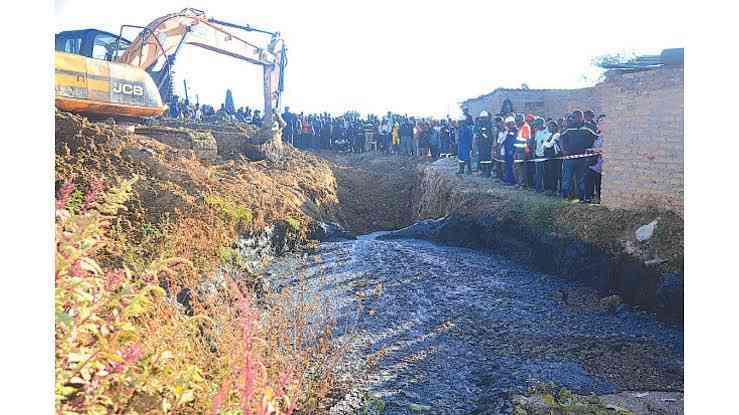
They died because an open excavation — three metres deep, seven metres long, unmarked, unfenced and unlit — was left in a residential area for months after a sewer rehabilitation project stalled.
- Byo armed robber in court
- Woman jailed 12 years for indecent assault
- Magistrate jailed 3 years for abuse of office
- Zim’s poor batting hands India series
Keep Reading
Three lives ended because something dangerous was left where people live, walk and raise their children.
The mayor has expressed regret. Residents are angry.
Social media is flooded with outrage. Investigations have been promised.
All of that is understandable.
But it is also familiar.
That is perhaps the most disturbing thing about what happened in Budiriro.
We have been here before.
In 2009, four boys drowned in an open pit in Budiriro 4.
Last year, two City of Harare employees lost their lives at the Firle Sewage Treatment Plant after reportedly being sent into a hazardous environment without adequate protection.
Different victims. Different circumstances.
The same pattern.
Something goes wrong.
Lives are lost.
Questions are asked.
Promises are made.
Then, slowly, attention moves on.
The danger disappears from the headlines long before it disappears from the ground.
Part of this is simply how outrage works.
It peaks fast, dominates a news cycle or two, and then the country’s attention shifts to the next emergency.
Institutions that have weathered this cycle before know its rhythm and know that waiting it out is, in practice, a strategy.
The pit, in the meantime, is still there.
That is why the deaths in Budiriro should force us to ask a difficult question: What changes after the anger fades?
Because anger, on its own, does not fence a trench.
It does not inspect hazardous sites.
It does not discipline those responsible for negligence.
It does not ensure that the next child walking home is safe.
The real test of accountability begins when the cameras leave.
Who was responsible for securing that excavation?
Who knew it had been left open?
What action will be taken?
Will there be consequences or merely condolences?
These questions matter because what happened in Budiriro was not simply an unfortunate accident.
It was a preventable failure.
And “accountability” should not remain an abstract word. ZimRights has already sketched out what it could look like in practice: a criminal investigation into those who left the site open, a city-wide inspection of every open trench, manhole and excavation in Harare, barricades and lighting installed where hazards remain, and compensation for the bereaved families without bureaucratic delay.
It is a reasonable, concrete list.
The test for the mayor’s regret is not whether it sounds sincere — it is whether it turns into a signature on a budget line that funds exactly this.
And yet, beneath the headlines, there is another story unfolding.
Residents have reportedly begun marking dangerous pits themselves using branches, stones, and whatever else they can find.
Think about that for a moment.
Ordinary citizens are now doing work that should never have fallen to them in the first place.
They are creating warning signs because they no longer trust the authorities to provide them.
That image — branches and stones placed beside deadly hazards — may be the most important image to emerge from this tragedy.
Not because it speaks to community spirit, although it certainly
does.
But because it reveals something deeper.
It reveals how little confidence many residents have left in the institutions meant to protect them.
When people begin performing basic public safety functions themselves, they are saying something without words.
They are saying that waiting for the authorities feels riskier than acting on their own.
That should concern every public official far more than a few days of angry headlines.
Trust is not lost all at once.
It erodes gradually, one disappointment at a time.
An uncollected pile of refuse.
A burst sewer left unattended.
A pothole that remains for years.
An open pit left exposed in a residential neighbourhood.
Eventually, residents stop expecting problems to be solved.
They start looking for ways to protect themselves from them.
That is where Budiriro seems to have arrived.
And that is why this moment cannot end with expressions of sympathy alone.
The families who have lost loved ones deserve answers.
Residents deserve to know that every dangerous excavation, trench and open manhole across the city is being identified and secured.
Those responsible for negligence must be held accountable.
And where harm has been caused, compensation should not become another battle families are forced to fight.
None of this will bring back those who have died.
But it may prevent another family from experiencing the same loss.
Because if nothing changes, we already know what happens next.
Another neighbourhood.
Another dangerous site that everyone knows about, but nobody fixes.
Another preventable death.
Another round of outrage.
And another promise that this time things will be different.
The people of Budiriro have every right to be enraged.
The question is whether that rage will be allowed to fade into the familiar cycle of apologies and inaction, or whether it will finally be connected to something more powerful: Consequence.
Without it, we will continue to bury victims and call it tragedy.
With it, we might finally start calling it what it is — negligence — and ensure that those responsible can no longer walk away from the hole they left behind.