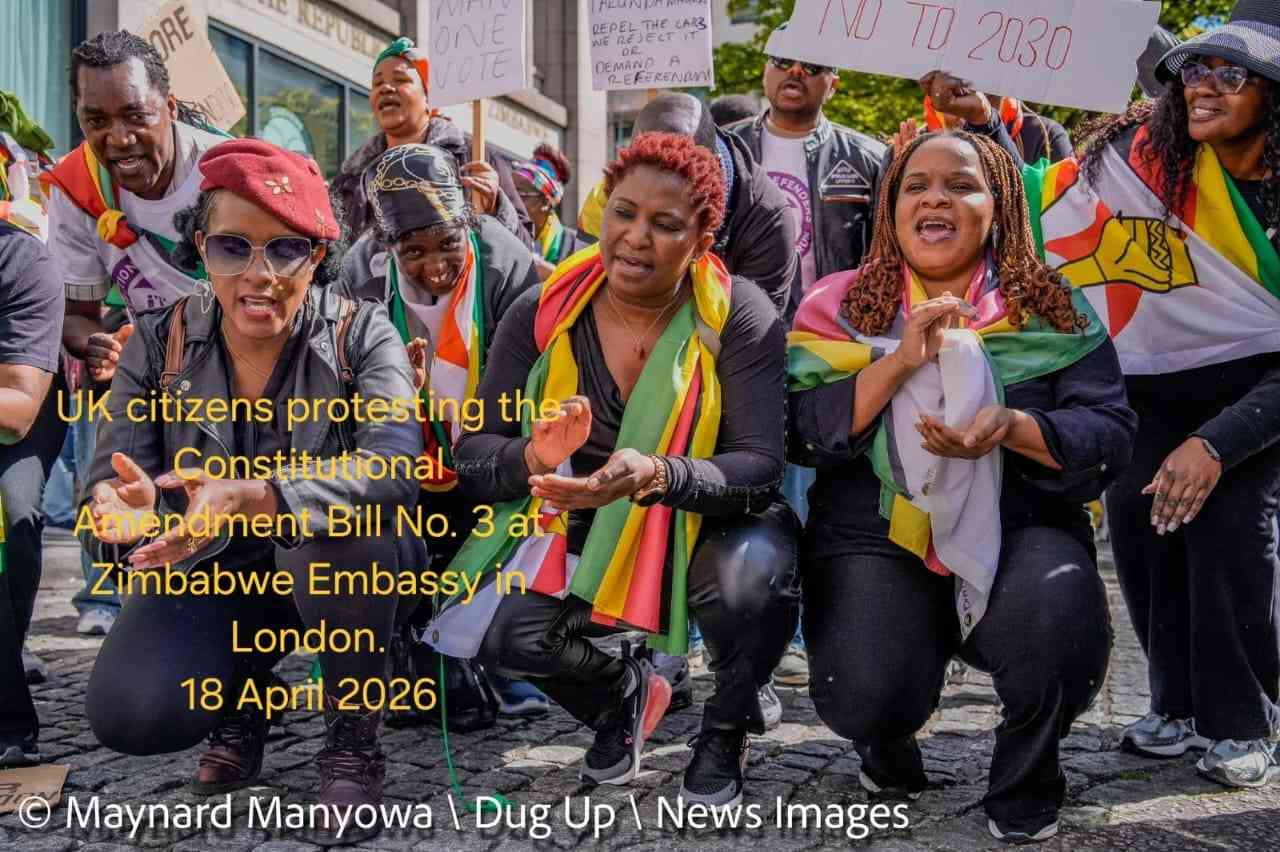
London, 18 April 2026 - The rain over Fitzroy Square was relentless, but it could not wash away the silence. At exactly twelve noon, three hundred Zimbabweans stood motionless outside the Zimbabwe Embassy. Every single one dressed in black. Not a chant. Not a drum. Not a single flag waved. They had come to mourn. The date was no accident. 18 April. Zimbabwe's Independence Day. The day the nation once celebrated the birth of majority rule, the triumph of one man, one vote. But on this Independence Day, 2026, there was nothing to celebrate, only a democracy to bury. Constitutional Amendment Bill No. 3 (CAB3) had done what decades of economic collapse could not. It had quietly, legally, killed the possibility of peaceful change.
Sarah Ncube had been in London since 2019. She held a sign that said simply: MY VOTE DIED. I WEAR BLACK. "I voted in 2018," she told me, her voice steady but raw. "I believed my voice mattered. Now? The President appoints ten Senators himself. He appoints the judges himself. He draws the boundaries himself. What exactly am I supposed to vote for every seven years?" She pointed to the embassy doors. "In there, they call this 'governance reform.' Out here, we call it by its real name: dictatorship with a stamp."
The protest had been organised by Zimbabweans in the UK under the banner of Change Radio. Among the organisers moving through the crowd, checking banners and coordinating with stewards, was Chenayi Mutambasere. She carried a clipboard in one hand and a black umbrella in the other, her phone buzzing constantly with WhatsApp updates from the channel she had helped build.
"The timing is everything," she said, pausing to speak with me. "18 April. Independence Day. The day we are supposed to remember the fight for one man, one vote. And what are they doing back home? They are killing that very principle. We chose this date so no one can pretend not to see the irony." She glanced at her phone. "We have people watching Parliament in Harare right now. The bill moves in May. Every day we wait, they tighten the noose." The most chilling testimony came not from a speaker, but from a woman who gave her name only as Mai T. She had arrived from Harare three weeks ago. Her brother, a member of the opposition, had been detained on 2 April during a public hearing in Mbare. The hearing, one of the supposed "public consultations" required before CAB3 could go to Parliament, had lasted eleven minutes. "They didn't ask for our views," Mai T said, adjusting the black shawl over her shoulders. "They told us what was happening. And when my brother stood up to ask a question, the police took him outside. We haven't seen him since. No charge. No lawyer. No phone call." She looked toward the embassy. "That is what CAB3 means. They are already silencing us. Now they want to make it legal."
Chenayi Mutambasere, passing by, stopped and placed a hand on Mai T's shoulder. "This is why we are here," she said quietly. "Not for politics. For people like her brother. For every voice that has been taken." The protest had been named a "blackout" for good reason. At 12:30, organisers asked everyone to turn their backs to the embassy for sixty seconds. Three hundred people rotated in near-perfect silence. A tourist from Manchester, walking his dog past the square, stopped and asked what was happening. "Someone died," a young man named Kudzai told him. "Who?" "Democracy. In Zimbabwe. Happened slowly. No one noticed until it was already dead." The bill's provisions are technical, but their effects are brutally simple. Clause 8 extends the presidential term to seven years. Clause 9 creates a new Delimitation Commission appointed entirely by the President—the same man who benefits from the boundaries drawn. Clause 6 gives the President ten direct seats in the Senate. Section 180 removes public interviews for judges, handing judicial appointments to executive discretion. Taken together, they form a quiet coup. No tanks. No midnight arrests of the president. Just a 90-day parliamentary process and a two-thirds majority. And then: no more elections that matter.
By 1 p.m., the crowd had swelled to nearly five hundred. Black umbrellas dotted the square like gravestones. A group of young activists unfurled a banner that read CAB3 = COUP. Police watched from a distance, hands behind their backs, uninterested.
Chenayi Mutambasere stepped onto a small platform, a wooden crate someone had found and addressed the crowd. Her voice was calm but carried the weight of someone who had spent months organising, messaging, waking up at odd hours to sync with activists back home.
"They think because we are in London, we have forgotten," she said. "They think because we have passports for this country, we no longer care. They are wrong. We carry Zimbabwe in our chests. And what is happening to Zimbabwe right now, this slow, legal strangulation of the people's voice is a crime against every African who ever bled for the vote."
- Zim needs committed leaders to escape political, economic quicksands
- Chicken Inn knockout Harare City
- Ziyambi’s Gukurahundi remarks revealing
- Ngezi stunned by 10-man Herentals in Chibuku Cup
Keep Reading
The rain softened, as if listening. "We wear black because something is dead. But we are here because we refuse to let it be buried quietly. Parliament votes in May. We have weeks. Use them." At 2 p.m., a delegation of three, including Chenayi Mutambasere, approached the embassy gates. A security guard emerged, listened to their request to deliver a formal letter of protest, and disappeared inside. Fifteen minutes later, he returned. "They are not receiving correspondence today," he said. "Because it's Independence Day?" Chenayi asked. "Because it's Saturday," the guard replied, and closed the gate. The delegation stood there for a full minute. Then Chenayi laughed a short, bitter sound and walked back to the crowd. "Ladies and gentlemen," she announced. "The embassy is closed. Apparently, the death of democracy does not qualify as an emergency."
A ripple of dark laughter moved through the mourners. The protest dispersed peacefully at 3 p.m., but not before a final act of witness. Each person placed a small black stone at the embassy gate, a Zimbabwean tradition for marking a grave. By the end, five hundred stones formed a dark, defiant pile. Chenayi Mutambasere knelt and added her stone last. Hers was smooth and river-worn, brought all the way from home. "This bill goes to Parliament in May," she said. "They have the votes. They will pass it. But they will never have our consent. That's the one thing they cannot amend."
As the crowd melted into the London streets, black umbrellas furling, black coats unbuttoned, one sound finally broke the silence: a single woman, standing across the square, singing a Shona mourning song. Her voice carried over the wet pavement, past the embassy gates, up toward the grey sky. "Hatifambi nedemo rakaita izvi." We will not walk with an axe that has done this thing. No one joined her. No one needed to. The song was for the dead. And in the rain, on Independence Day, Zimbabwe's democracy lay in a grave made of stones and silence and a bill no one voted for. Chenayi Mutambasere stood at the edge of the square, watching the last of the crowd disperse. Her phone buzzed again. A message from Harare: More arrests last night. Keep going. She typed back three words before slipping the phone into her pocket: We are not stopping.
Change Radio's WhatsApp channel continued sharing updates throughout the evening. By midnight, the message was simple: Parliament votes in May. The blackout is not over. It has only just begun.
Diana Machingauta is a Zimbabwean based in the Diaspora. She writes in her personal capacity.