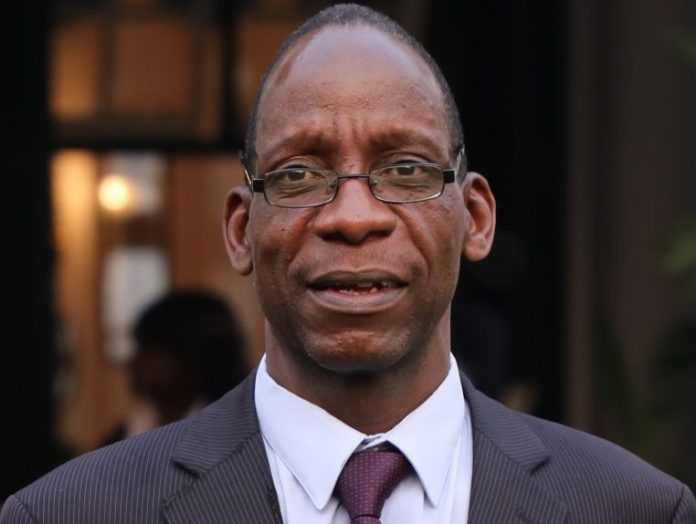
THE scene at a routine consultative meeting in Harare on March 1, 2026, transformed into a theatre of State-sanctioned violence when masked assailants stormed the offices of the National Constitutional Assembly.
Among the injured was Lovemore Madhuku, a prominent constitutional law expert and opposition leader, whose battered frame has become a grim symbol of a nation teetering on the edge of a new authoritarian era.
The attack, which left Madhuku with visible scars requiring urgent medical care, was not an isolated incident of criminality but a calibrated strike against those challenging a controversial constitutional amendment.
This latest escalation underscores a desperate struggle for the soul of Zimbabwe’s governance.
The ruling Zanu PF party is advancing the Constitution Amendment No 3 Bill, a legislative manoeuvre designed to extend presidential and parliamentary terms from five to seven years.
If successful, this measure allows President Emmerson Mnangagwa to remain in power until 2030, bypassing the two-term limit prescribed by the 2013 Constitution and centralising power by replacing direct presidential elections with a parliamentary selection process.
For a populace already grappling with economic volatility, the prospect of an indefinite Executive term is fuelling deep-seated anxieties about the future of democratic accountability.
The blueprint for Executive longevity
- AFM church leader in court for fraud
- Madhuku slammed over Sikhala rants
- Madhuku slammed over Sikhala rants
- Sikhala, Sithole denied bail for 5th time
Keep Reading
The proposed legislation is more than a mere shift in electoral cycles; it represents a fundamental reordering of Zimbabwe’s constitutional architecture.
Critics, including legal watchdogs and opposition figures, argue that the Bill is a direct assault on the democratic guardrails painstakingly established during the transitional period that led to the 2013 Constitution.
By proposing to eliminate direct popular voting for the presidency, the Zanu PF-dominated Legislature aims to consolidate control over the Executive office, insulating the presidency from the volatility of public opinion.
The push has been framed by ruling party officials, such as treasurer-general Patrick Chinamasa, as a means to achieve policy continuity and avoid the perpetual campaign cycle.
However, the opposition and civil society organisations view this as a transparent power grab.
The legal hurdles are significant, particularly given that section 328 of the current Constitution prevents sitting officeholders from benefiting from term-limit extensions.
To bypass this, the government would theoretically need to hold a national referendum, a prospect that has observers bracing for a volatile political showdown.
Term Extension: Presidential and parliamentary mandates would increase from five to seven years.
Electoral shift: Direct presidential elections would be replaced by parliamentary selection, reducing individual suffrage.
Executive power: The Bill grants the President power to appoint 10 additional senators and establish a Delimitation Commission.
Projected tenure: President Emmerson Mnangagwa, currently 83, would be eligible to remain in office until 2030.
A pattern of State-backed repression
The atmosphere of fear is not merely psychological; it is physical.
The assault on Madhuku is part of a broader, documented campaign of intimidation targeting those vocal against the amendment.
Jameson Timba, a senior opposition figure with the Citizens' Coalition for Change, reported that he and his colleagues have been under constant surveillance.
The appearance of an "X" painted on his home — a chilling precursor to State action — coincided with his attempts to organise opposition to the Bill at the Southern Africa Political Economy Series Trust offices.
Human Rights Watch and other international monitors have raised alarm over this systematic shutting down of dissenting voices.
The pattern reflects the enduring challenge of political transitions in southern Africa, where State machinery is frequently deployed to maintain incumbency.
For analysts, this is a continuation of a historical cycle of repression that has dogged Zimbabwe since independence, where the line between State security and party interests remains dangerously blurred.
The fragility of regional stability
The implications of this political standoff resonate far beyond Harare.
As Zimbabwe navigates its domestic crisis, regional neighbours are watching closely.
The economic stability of the Southern African Development Community (Sadc) is inextricably linked to the political health of its member States.
Kenya, though geographically distant, shares a profound commonality with Zimbabwe: both nations have navigated the tumultuous waters of post-colonial political reform, settler-colonial inheritances and the struggle to move beyond personality-driven politics to institution-based governance.
Economists at regional think-tanks note that political instability in Zimbabwe — manifesting as capital flight, currency depreciation and suppressed foreign direct investment — directly impacts the broader African growth narrative.
When the rule of law is perceived as tenuous, investor confidence across the region wobbles.
For policymakers in Nairobi, the Zimbabwean situation serves as a stark reminder of the fragile balance between national development and constitutional adherence.
The risk is that political grievances, if left unaddressed by democratic means, inevitably morph into economic crises that are harder to reverse than the laws themselves.
As Zimbabwe prepares for public hearings on the amendment, the nation remains in a state of high alert.
The fundamental question for the coming months is whether the constitutional order can survive the concentrated pressure of an Executive seeking to extend its shelf life.
The defiance of figures like Madhuku and Timba suggests that while the State may have the power to inflict injury, it is struggling to silence a society that views the 2013 Constitution as its most critical shield against arbitrary rule.
The battle for the supreme law of the land has only just begun. —Streamlinefeed