WE operate in data-driven business environments and Artificial Intelligence has taken the stage in controlling economies globally.
If a leader is to stay relevant and abreast, they should embrace artificial intelligence (AI).
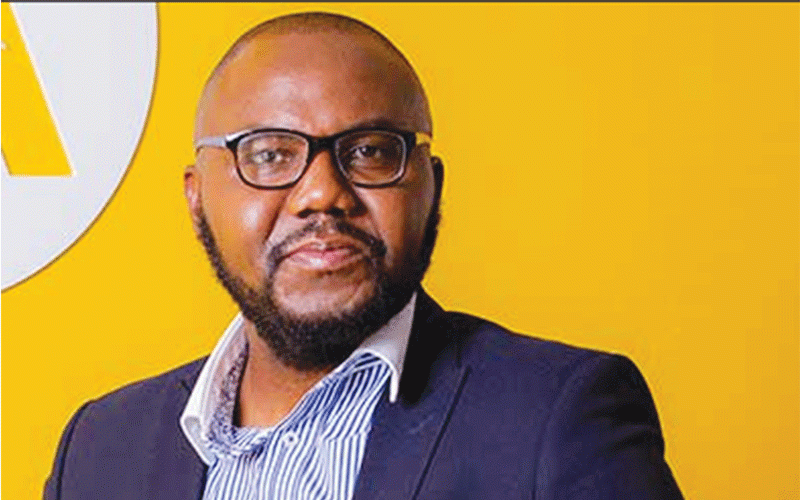
I (JN) engaged Dr Lance Mambondiani (LM), the former CEO of ABC Holdings Zimbabwe and managing director of BancABC Zimbabwe.
Prior to BancABC, he was CEO at Steward Bank, a subsidiary of telecoms company, Econet Wireless Zimbabwe.
He is a lawyer and banker with years of international experience at executive level.
He previously worked in Europe for various banking and financial institutions.
He is a much sought-after international speaker and turnaround strategist recognised internationally as a digital banking thought leader with an established track record in innovation and delivering financial results in challenging environments.
JN: What excites you about the role of AI shaping leadership today?
- Time running out for SA-based Zimbos
- Sally Mugabe renal unit disappears
- Epworth eyes town status
- Commodity price boom buoys GB
Keep Reading
LM: I think AI has come at a very critical moment worldwide.
AI is supposed to augment decision-making and allow leaders to make data-driven and quality decisions.
It also allows leaders to automate routine tasks and leverage human skills to ensure that decisions informed by those skills are relevant, efficient and time-saving.
So I think what excites me the most about AI is the fact that we are now making quality decisions based on available data.
So the danger might be that AI has computational power and decision-making power, so to speak.
Someone might ask, is AI here to replace us?
AI is not supposed to replace human beings; it's supposed to increase efficiency.
There are some things that are better left to machine learning or computing power because they are routine activities or exercises that we do not need to spend our time doing.
The human mind should be left to do creative thinking.
Not necessarily routine tasks like multiplying figures, which you can easily do through machine learning.
So I don’t particularly think that AI is here to replace human beings.
There is still a role for human beings, but what we need to learn is how to adapt to new technologies and new ways of doing things so that we are not spending time where we are not necessarily competent or where machines are more competent than we are.
JN: So as a follow-up to that, what can leaders do to maintain authenticity in a digitally driven world?
LM: Firstly, as far as I’m concerned, maintaining authenticity means leading out of yourself as a leader and ensuring that your leadership skills shape the organisation, its direction and its strategy.
Yes, you can use AI to enhance your strategy, but ultimately it falls on the leader to lead with authenticity and make sure that you are pouring yourself into the organisation and causing change.
I always like to say that the role of any leader in any position is to cause change.
If you are a leader and you’re not causing change, then you are not a leader; you are a manager.
Leadership is making something better than you found it.
So whether you are a father, a pastor in a church, or a CEO in an organisation, your role as a leader is to influence change and achieve that through the team you assemble to make sure that change happens.
JN: For those people not creating change, should we call them leaders?
LM: They are managers. If you’re not causing change — and I want to emphasise this — there are different types of leaders, as you know.
There are transformational leaders and there are maintaining leaders.
Some leaders can be in an organisation for 30 years just maintaining things — making sure the doors aren’t leaking, ensuring the day-to-day is maintained.
But transformational leaders are those who will pick things up.
You have Steve Jobs-type leaders — those who are there to cause a rift, a shift, a change, friction in an organisation, and ensure that they are providing a solution to a problem.
Leadership is about identifying a problem and assembling a team to provide a solution, and that solution has to be relevant to the market you serve.
JN: What’s the biggest mistake an organisation can make when adopting these new emerging technologies?
LM: I think it’s copying and pasting. Not every technology is relevant for a country or an organisation.
The biggest mistake people make is picking up these new technologies from abroad and thinking that AI tools are what their organisation needs.
Take blockchain, for example. You might hear that everybody wants to do blockchain or cryptocurrency, and then you try to force that into your organisation.
Maybe what your organisation needs is not a Rolls-Royce.
Don’t get a Rolls-Royce solution for what you might require is a Toyota 4x4 solution — something that, if borrowed from outside, is contextualised for your organisation and made relevant to the problem you want to solve.
You shouldn’t get technology first and then plug it into an organisation without solving a problem.
You should identify the problem you want to solve with technology and then get relevant technology that addresses and solves that problem. I’ve given this example many times.
One of the greatest technologies or developments that has ever happened in this country is USSD—the application that allows EcoCash to send money to people in rural areas. It’s not a blockchain.
We’re not a blockchain nation. Yes, blockchain is important, but what problems are you going to solve with blockchain for someone in Gwabalanda or in Mutare or in Binga?
What they need is a Toyota 4x4 solution — something that allows them to address the day-to-day challenges they face.
Say, receiving money or airtime while in rural areas.
To answer your question, the biggest challenge and problem that leaders face is adopting technologies that do not address local solutions.
JN: Can we then say Zimbabweans are blessed as we have James Manyika to be the second in ranking man at Google Alphabet?
LM: Yes, I’ve always been thinking, how can we use Manyika to our advantage as a country?
Tell you what — I think we are a little bit behind other nations, but we’ve got sharp people who are doing well.
And you gave an example of James Manyika, someone I have great admiration and respect for.
There are many other people who are leading the AI revolution.
Dr Strive Masiyiwa, as you know, is currently establishing one of the biggest AI firms in Africa.
And we also have professor Arthur Mutambara who has written and speaks quite a lot on issues relating to AI.
These are the skills we need to be teaching children in schools — where the world is going, where the country is going, and how we can solve some of the problems we have locally by adopting technologies that are relevant to what we face and making sure that we are leapfrogging what other nations have done.
(To be continued next week…)