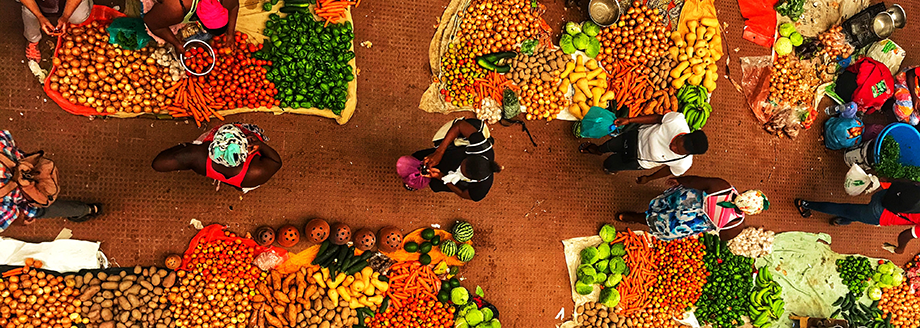
ALTHOUGH colonial legacies continue to shape the way Africans produce and consume food, African territorial markets are quietly redefining post-colonial consumption patterns by positioning agroecology and indigenous food systems.
This process is also providing alternatives for health-conscious citizens keen to de-link local food systems from Western five-course meals.
Against all odds, such as rapid rural urbanisation, African territorial food markets continue to silently dismantle the dominance of Western food and formal marketing systems that have traditionally influenced what the majority of urban consumers eat for breakfast, lunch and dinner.
Breakfast is no longer defined by wheat bread, thanks to several menus like boiled sweet potatoes, roasted nuts, mopani worms and many other variations of fruits that happen to be in season.
By providing space for diverse indigenous and local foods, territorial markets are protecting markets from corporate capture.
These markets are also building a resilient Africanist market narrative and decolonising the formal marketing theory through knitting together food, culture and identity.
Clarifying invisible supply chains
To an outsider, territorial markets may seem chaotic, but they have unique ways of clearly defining supply chains for different commodities from production to household kitchens, restaurants and hotels.
- Minister bemoans shortage of schools
- BCC joins Green Cities initiative
- Drunkard kills church pastor
- DripSol’s one-stop-shop for farmers opens doors
Keep Reading
For each commodity found in the market, sources, distribution pathways and quantities per given time are carefully matched with demand in ways that avert losses.
Each commodity has its own specialists who influence how it is produced, packaged, transported and bulk broken into different sizes in line with the different buying powers of diverse consumers.
In the same way, industrial agriculture has continued to promote hybrids and exotic food is being copied and improved by traders of indigenous food.
For instance, where industrial systems insist on using weighing scales, traders know that scales are not the best way of valuing indigenous food grown without chemicals because such food is not too heavy but nutritionally packaged by Mother Nature.
Creating space for agroecology
Whereas some people think organic and agro-ecologically grown commodities should have their own separate market, territorial market actors think these commodities can prove themselves in a competitive market landscape where consumers can actually see what is organic or agro-ecologically grown from what is produced using industrial means.
Unless consumers are exposed to what is available on the market, it becomes difficult for them to see and appreciate the differences.
Likewise, on the production side, farmers have to choose between mono-cropping and growing diverse commodities that have several nutritional advantages, not just yield per hectare.
Territorial markets empower agro-ecology farmers to explain the competitive advantages of food diversity.
These markets also provide advantages for farmers interested in capitalising on suitable climatic conditions to focus on a few agro-ecology commodities like forestry or natural herbal commodities that lend themselves to aggregation for several niche markets.
Modelling and commercialising smallholder production
Based on demand patterns and feedback from territorial markets, farming communities are learning appropriate ways of modelling and commercialising their collective food production.
For instance, in pursuing agro-ecology, some communities are beginning to imagine how they can use the little rainfall they receive annually to promote food diversity.
This is how they decide to build business models around selected agro-ecological economic drivers such as groundnuts, bambara nuts, traditional grains and small livestock that thrive under water-stressed conditions.
Many development organisations promote small livestock and small grains in the name of building resilience, yet communities in dry regions have been driving their sustenance from their own value chains, which corporate agriculture has been trying to infiltrate and destroy.
In some communities, the government is seen as rehabilitating irrigation systems for industrial crops.
However, supporting one crop like sugar cane or wheat under irrigation creates competition for labour as energetic youths end up going to work in irrigation schemes and neglect their local food systems.
Instead of conducting maize, wheat and sugar cane trials in irrigation systems in dry regions, trials should focus more on indigenous commodities that grow naturally in these regions.
Eventually, irrigation schemes can develop the natural conditions required by indigenous crops and forests.
When governments fully embrace agro-ecology, irrigation schemes will be designed to navigate communities the way roads move around communities.
That way, some of the irrigation water will flow into pastures and forests for the benefit of wildlife, natural fruits and forests whose products are now largely demanded in African territorial markets.
It also becomes possible for agro-ecology to ride on existing natural ecosystems.
Communities already have enough knowledge, which, if retained in line with the agro-ecology principle of co-creating knowledge, can lead to resilience.
Territorial markets are showing enormous potential for using indigenous knowledge systems to drive community sustenance against imported knowledge, which drives imported food and Western markets.
From a commercial exercise to a spiritual enterprise
If all traders in African territorial markets were motivated by money, no trader would specialise in small movers like traditional grains and natural herbs.
Everyone would be trading necessities and fast movers like vegetables, tomatoes and potatoes. Instead, what makes territorial markets different from any other market is that some traders take their work as a spiritual enterprise, not just a commercial venture.
These traders have been cultured to see the spiritual value of indigenous food, which cannot be fully expressed in dollars and cents.
For these traders, the market is not just for earning cash but also distributing rich streams of value through extraordinary indigenous food products whose production and preservation knowledge has been passed from one cultural generation to the other.
By holding and trading indigenous food, these traders use territorial markets as channels of increasing consumer intimacy with the soils and water used to produce these sacred commodities.
The presence of sacred commodities in territorial markets shows these markets’ unique contribution to upgrading the world through healthy and culturally appropriate food.