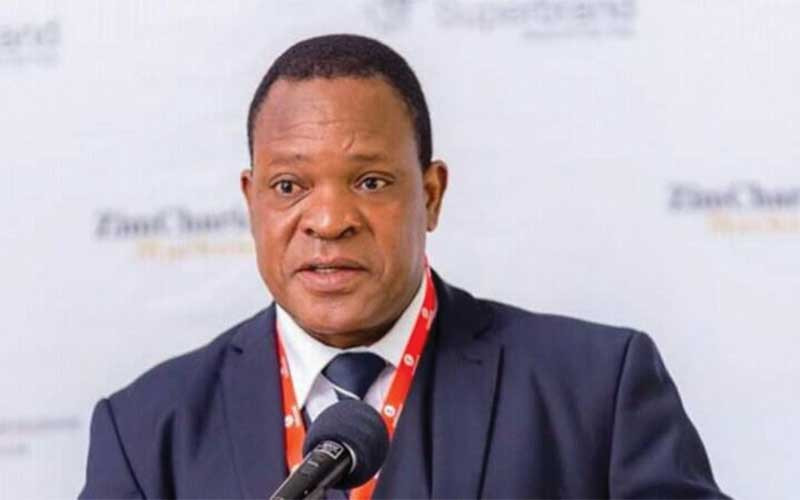
William Nyemba is a banker with vast local and international experience.
He successfully assisted in creating Ghana’s flagship merchant bank, Continental Acceptances Limited (CAL).
On returning to Zimbabwe in 1992, he spearheaded the formation of the first indigenous merchant bank, National Merchant Bank (NMB), where he was chief executive for nearly three years, later setting up and successfully leading Trust Bank to become the biggest bank in Zimbabwe in terms of balance sheet size and profitability in 2004.
He has won accolades including ZNCC Businessman of the Year, World Economic Forum, Global Leader for Tomorrow and Zimbabwe Institute of Management, Manager of the Year and subsequently Manager of The Decade.
NewsDay Assistant Editor Wisdom Mdzungairi caught up with him to discuss his opinion on the state of the banking sector, sanctions, indigenisation policy and how he juggles his multiple duties with other demanding social roles.
Below are excepts:
ND: You fled Zimbabwe with a number of top bankers and businessmen in 2004 at the height of bank collapses, but you were one of the first to test the waters of freedom when you returned to negotiate the revival of Trust Bank, which was forcibly disbanded and merged into the Zimbabwe Allied Banking Group (ZABG) by the Reserve Bank of Zimbabwe (RBZ) the same year. Do you still harbour ill feelings of how you and other bankers were hounded out of the country back then?
WN: Not at all; the banking sector faced unprecedented challenges at the time and the RBZ had to make some very tough decisions. We may not agree with the severity of the RBZ’s response back then, but what we can all agree today is that there is need for a concerted effort on the part of all parties to get the Zimbabwean economy decidedly on track for sustained development. I therefore prefer to stay in the present because that is what we can influence; the past is only good in that in gives us valuable experience. To answer your question again, I do not harbour any ill feelings.
- Chamisa under fire over US$120K donation
- Mavhunga puts DeMbare into Chibuku quarterfinals
- Pension funds bet on Cabora Bassa oilfields
- Councils defy govt fire tender directive
Keep Reading
ND: Do you think Trust Bank has the capacity to regain its former market share?
WN: Most definitely although the environment has changed significantly. We believe in the fundamental need for offering creative and innovative banking coupled with financial services solutions as we work hard to please our clients. For us the sky is the limit for such creative ideas. We have a young and dynamic team which is capable of shifting focus to meet market requirements, and we have already entered into structures that assist our clients though the market has strained liquidity.
ND: What differentiates Trust Bank from other banks?
WN: Trust Bank does not just talk about service excellence, but it’s a culture. We practice it starting internally and ultimately to our customers. We deliver “out-of-the-box” solutions that are driven by cutting edge and exciting technology while remaining innovative and sensitive in our product offering. We are unequalled in the quality of our customer service and in our ability to customise financial solutions to meet the needs of our clients. That we were the first to introduce Internet banking to the Zimbabwean market codenamed “Bank@easy” which became a darling of many of our customers, only serves to prove that we are capable of making the desired difference.
ND: What strategies have you introduced to attract customers?
WN: We believe that what people relate to most, beyond their financial needs, is sincerity. We will live up to our name, Trust. Our strategy to attract customers is very simple and consistent; we will always work harder than the rest of the market to ensure that our clients’ needs are met. We are genuine in our interest in them and in the solutions we offer them. This enables us to tailor-make our banking solutions to the specific needs of each customer and to recognise and acknowledge the individuality of every customer’s banking requirements — one glove size cannot fit all. One product that comes to mind is what we are calling “Anytime banking” and our clients just love this.
ND: What have been the major highlights since Trust bank reopened its doors to the banking public? WN: Indeed we have enjoyed a number of successes since we reopened our doors on the 10th of December 2011. We have been humbled by the open-hearted manner in which clients (old and new), our partners, former employees and the public at large have received us. This, by far, is the most outstanding highlight since we’ve reopened. Additionally, our deposits base has grown at a faster pace than our models projected. We have managed to open most of the branches we had before, now 12 in total. In addition to that we have opened two sub-branches at auction floors, one is at Boka and the other is at Millennium. We have opened about 10 000 accounts in three months.
ND: You are coming at a time RBZ has revealed seven other financial institutions are facing closure. Is there any guarantee that you can give to your clients that Trust Bank is safe and is not in any danger of closing down anytime soon?
WN: Trust Bank is a listed company on the Zimbabwe Stock Exchange and as such our financial position is public, the recently published results do show that the bank is adequately capitalised. We continue to monitor compliance and we have solid internal structures that guard stakeholders’ interests, especially in credit management which help to mitigate credit and liquidity risks that you have highlighted. We certainly are not in any danger, and we can sincerely reassure all our stakeholders that the bank adequately meets regulatory requirements.
ND: In a country with high formal unemployment rate, what strategies have you put in place to attract the informal sector?
WN: Without pre-empting the market, we have products that we will be rolling out soon that are targeted at the informal sector and are piloting a women’s product which has received resounding response. We fully appreciate the mechanisms of the local market and the need to accommodate the informal sector in our product offerings. We are currently building a business to address the specific needs of the SME sector. We see this sector as a key mechanism for job creation and productivity advances in Zimbabwe as well as the incubator for the country’s future large firms. A little secret about Trust: the way we build our bank is by helping our clients grow and prosper, so the SME sector is of particular interest to us.
ND: Given the tight liquidity constraints on the market, what are some of the greatest challenges the banking industry is facing?
WN: Linked to liquidity, we have a challenge of short-term funding at high cost which leads to stringent security requirements which negatively affects lending to viable businesses that may not have sufficient security. Our environment is thirsty for long-term capital injections for industry to become viable. In addition, one of the greatest challenge is the non-existence of an inter-bank market coupled with low national savings and lack of available financial negotiable instruments required to attract the little available capital; but at Trust, we embrace this set of problems as a call for greater creativity in our role as a financial intermediary.
ND: How would you describe the current state of the banking sector?
WN: The sector is in recovery mode just like the rest of the economy. The country’s deposits are increasing which is reflective of improved economic activity and confidence in the sector. Our sector needs to be more aggressive in playing its role as oiling the economic machinery of Zimbabwe. Trust is striving to do its part.
ND: How did you become a banker?
WN: It was purely by accident. As a school leaver I got an opportunity to train with ANZ Grindlays Bank, now Stanbic Bank. After a brief stint, I then moved to Rhodesia Acceptances Limited, now ABC Bank. This is when I decided to take up banking as a career, I never looked back.
ND: What do you consider to be the defining achievements of your banking career so far?
WN: The addition of every new client at Trust; I still remember when Trust Bank was just a good idea. Also, THL’s listing on the ZSE; I saw the massive oversubscription of our share as the measure by which the public desired to partner with us. I will always feel a heightened sense of achievement every time we earn the trust of a new client and with every new purchase of the THL share.
ND: Have you any regrets or unfulfilled ambitions?
WN: I don’t harbour regrets and any unfulfilled ambitions simply remain to be achieved.
ND: Besides banking what other interest do you have?
WN: Generally I try to help my friends in running their businesses given my wealth of experience with many sectors of the economy. Occasionally I play golf and squash.
ND: Is there anything that I haven’t asked which you would like us to know about?
WN: I would like to take this opportunity to say many thanks to all our stakeholders for the tremendous welcome back and may God bless you all.