HARARE, Jul. 20 (NewsDay Live) – Zimbabwe’s digital transformation is accelerating, with internet access and mobile phone ownership reaching record levels, although a widening gap in computer ownership underscores the country’s growing reliance on smartphones as the primary gateway to the digital economy.
The newly released 2025 Information and Communication Technology (ICT) Access by Households and Use by Individuals Survey, jointly conducted by the Zimbabwe National Statistics Agency (ZIMSTAT) and the Postal and Telecommunications Regulatory Authority of Zimbabwe (POTRAZ), shows that household internet access rose to 75.5% in 2025, up from 50.1% in 2020—a gain of 25.4 percentage points in five years.
The nationwide survey interviewed 9,245 households across all 10 provinces, achieving a 91.3% response rate, providing one of the most comprehensive snapshots yet of Zimbabwe’s digital landscape.
Mobile phones continue to drive connectivity, with 96.4% of households now owning at least one mobile handset, compared with 89.6% in 2020. Ownership is almost universal in urban areas at 99.2%, while rural areas have also recorded strong penetration at 94.5%.
The report shows that smartphones have become the country’s dominant internet access device, with 92% of internet-using households connecting through mobile broadband networks.
The findings reinforce Zimbabwe’s transition towards a mobile-first digital economy, where smartphones increasingly serve as tools for communication, financial services, education, e-commerce and access to government services.
However, the survey also exposes a significant weakness in the country’s digital ecosystem.
Household computer ownership declined to 11.2% in 2025 from 14.2% five years earlier. The disparity is particularly pronounced between urban and rural areas, with 21.2% of urban households owning a computer compared to just 4.7% in rural communities.
- Govt splashes US$60m on police
- Women must claim stake in digital space: Mutsvangwa
- From the small screen to Parly: Mavetera’s story
- New ministers speak out
Keep Reading
Among households with computers, laptops account for 84.4% of all devices.
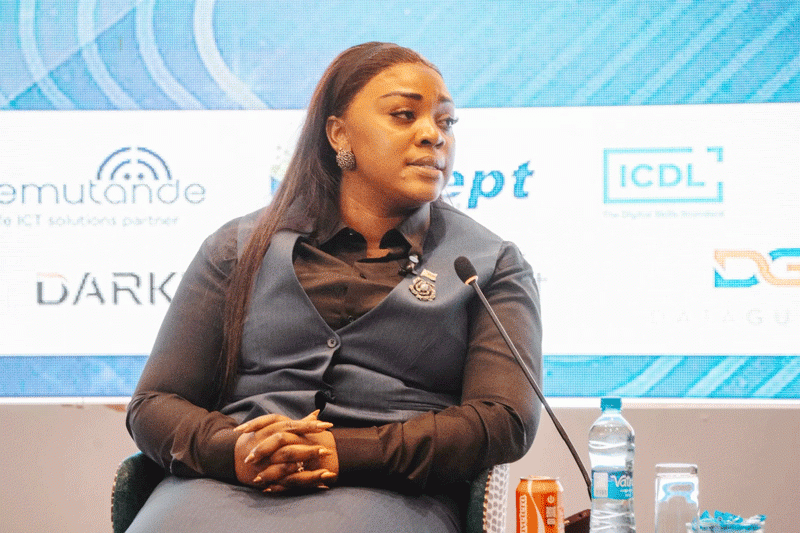
Information Communication Technology, Postal and Courier Services Minister Tatenda Mavetera said government is deliberately pursuing a strategy that leverages widespread smartphone ownership while expanding access to locally manufactured computing devices.
“We are building a mobile-first, computer-enabled system, with smartphones serving as our foundation,” Mavetera told NewsDay.
“Our goal is to empower digital creators. To achieve this, we are working closely with the Ministry of Skills Audit and Development to identify the specific skill sets required and to design a comprehensive curriculum. Additionally, we are engaging the Ministry of Finance to explore options for duty-free imports, as we aim to locally manufacture devices, including laptops.”
She said government aims to equip all national digital initiatives with devices by 2027.
“By 2027, we want to provide devices for all of our initiatives. To support this vision, we need to introduce tax incentives. Ultimately, we are pushing for a homegrown solution; we want to produce rather than import, though we highly appreciate the introductory steps like duty-free exemptions,” Mavetera said.
ZIMSTAT Director-General Tafadzwa Bandama said the survey will provide critical evidence for the implementation of the National Development Strategy 2 (NDS2) and Zimbabwe’s ICT Policy (2026–2030).
“It is anticipated that the findings will inform ICT policies, interventions and investment decisions, thereby bridging the digital divide in line with Zimbabwe’s national mantra of leaving no one and no place behind, as the country progresses towards Vision 2030,” Bandama said.
The survey comes as Zimbabwe seeks to position itself for an economy increasingly shaped by artificial intelligence, digital services and advanced connectivity. While rising mobile internet penetration signals significant progress, analysts say the decline in computer ownership highlights the need for greater investment in digital infrastructure, affordable devices and digital skills if the country is to fully participate in the global knowledge economy.