
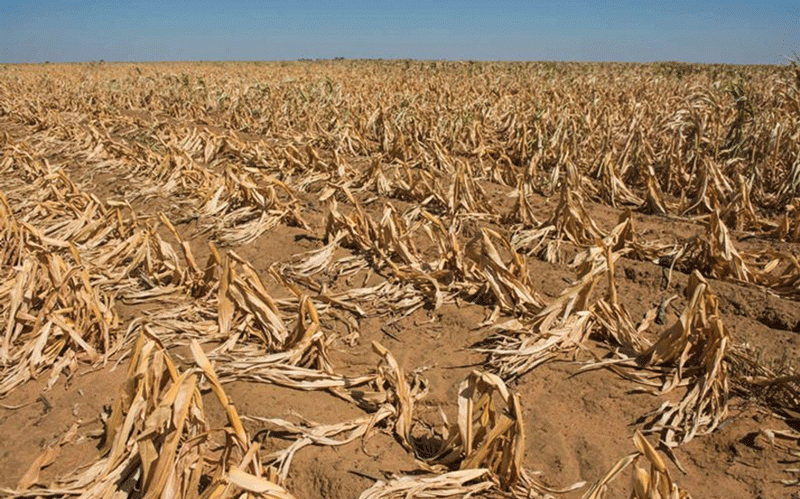
ZIMBABWE is among the Southern Africa countries hardest hit by worsening climate shocks, with floods, droughts and food insecurity exposing millions of vulnerable people, as children bear the impact of the crisis, a regional alliance of humanitarian organisations has revealed.
The region shifted from the severe El Niño-induced drought of 2023-24 to intense La Niña-driven floods and cyclones in 2025-26, affecting nearly 1,9 million people by mid-February 2026.
Heavy rainfall caused flash floods, displacing communities, destroying homes and damaging critical infrastructure such as roads, bridges, schools and health facilities.
In a joint statement, the East and Southern Africa Joining Forces Alliance said Zimbabwe alongside Zambia, Malawi and Mozambique, suffered massive crop losses ranging from 40% to 80% due to recurring droughts and erratic rainfall patterns linked to climate change.
“Persistent droughts have exacerbated food insecurity, with crop losses reaching 40-80% in key producers like Zambia, Zimbabwe and Malawi, where 70% of the countries' populations rely on rain-fed agriculture.
“These events compound vulnerabilities, heightening risks of disease outbreaks due to compromised water and sanitation systems and crowding in temporary shelters,” the statement read.
The alliance also said that the region was facing a dangerous “polycrisis” in which extreme weather events that were once rare had become almost yearly occurrences.
“From the devastating floods in Mozambique and Zimbabwe in early 2026 to the persistent agricultural droughts across the Limpopo Basin, the region is a frontline victim of a 1.3°C warmer world.
- Harare suspends Pomona deal
- Cartoon: December 19, 2022 edition
- In full: Statement by the Minister of Local Government and public works on the current rainfall season
- Flash floods hit Gokwe North.
Keep Reading
“Recent data from the University of Johannesburg (2026) indicates that agricultural drought is now the single greatest predictor of severe acute malnutrition in children, with orphans and vulnerable children being hit hardest due to lack of ‘parental buffers’,” the statement read.
The organisations noted the impact on children which was devastating, with droughts contributing to rising malnutrition, school dropouts and child labour.
“The 'silent killer' of the region, drought, has decimated subsistence farming, leading to a surge in child labour and school dropouts as families struggle to survive,” said the alliance.
The organisations further noted that weak disaster preparedness systems in Zimbabwe and across the region were worsening the crisis, particularly in rural communities where early warning systems often fail to reach vulnerable populations in time.
The alliance further expressed concern over declining international support for climate adaptation in Southern Africa.
“Joining Forces East and Southern Africa expresses grave concern over the widening gap between climate risk and climate investment, while global climate finance reached approximately US$43,7 billion recently, Sub-Saharan Africa requires upwards of US$190 billion annually to manage the transition (Climate Finance Lab, 2026).
“Donors favour high-profile mitigation in middle-income nations, thus excluding Southern Africa's life-saving adaptation for children,” the alliance said.
The alliance called on governments and donors to prioritise child-sensitive climate financing, resilient agriculture, improved water and sanitation systems, and strong community-level disaster response infrastructure.






