THE highly anticipated Castle Lager Premier Soccer League clash between newcomers Hardrock FC and football giants Dynamos FC at Chahwanda Stadium was supposed to be a historic and celebratory milestone.
It was the first-ever top-flight meeting between the two teams, played at a magnificent facility seemingly on the cusp of Fifa homologation.
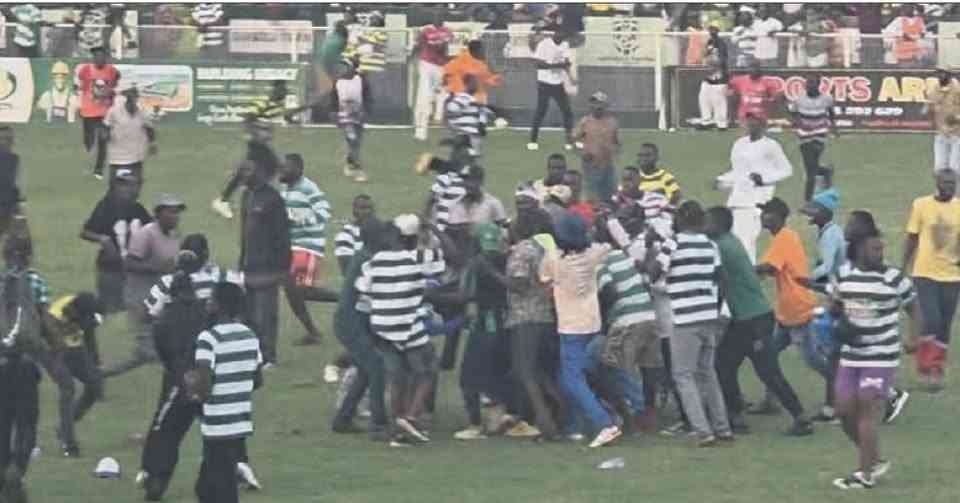
Instead, it degenerated into violence and chaos, forcing an abrupt abandonment after 80 minutes with the score tied at 1-1.
What transpired in Kwekwe was not merely a case of fan passion boiling over; it was a savage indictment of local football administration. It exposed how Zimbabwean football remains dangerously behind in match planning, safety protocols and crowd management.
The disturbing scenes from Chahwanda Stadium — fans scaling perimeter fence, rival supporters invading the pitch, vandalised infrastructure, and a ball boy struck by a missile — were a horrific advertisement for Zimbabwean football.
At a time when the nation is desperate to convince the Confederation of African Football and Fifa that local stadiums are safe for international fixtures, this disaster handed authorities every reason to keep the Zimbabwe national football team exiled to foreign venues.
The failures surrounding this match are layered and deeply embarrassing.
Despite a pre-match agreement specifying the deployment of 80 Zimbabwe Republic Police officers, reports indicate the number was drastically reduced in a bid to cut costs.
- Inside Sport: Local stadiums in urgent need of attention
- Bullets ease relegation fears
- FC Platinum move six points clear
- Clinical Herentals leapfrog Ngezi to sixth
Keep Reading
Relying on untrained civilian bouncers created a dangerous security vacuum.
Even more alarming, Hardrock FC’s chief executive officer was captured on camera physically assaulting a fan. When the CEO of a top-flight club becomes an active participant in the chaos, institutional authority completely collapses.
While referee Mhaka Magare’s controversial penalty decision ignited tensions, the stadium had already become a ticking time bomb long before kick-off.
Ironically, similar logistical failures and gate-control problems had already surfaced at Chahwanda Stadium during the season opener against Scottland FC.
Yet football authorities learned absolutely nothing from that warning sign.
This is the fatal flaw in Zimbabwean football governance: administrators are reactive instead of proactive.
We wait for fences to collapse before discussing perimeter security.
We wait for referees to be cornered before analysing police deployment.
We wait for fans to riot before addressing crowd control.
Until that culture changes, Zimbabwean football will remain trapped in a cycle of avoidable disasters.
While investigations must probe the conduct of hooligans and security personnel, the root cause of the chaos remains the catastrophic failure in crowd management.
In this day and age, there is no justification for professional football to rely on physical ticket sales at stadium gates on matchday.
Thousands of supporters travelled to Kwekwe only to encounter painfully slow-moving queues and a sold-out announcement moments after kick-off.
That incompetence directly created the frustrated and surging mob that breached the eastern gates and overwhelmed the stadium perimeter.
PSL must enforce mandatory digital ticketing for all high-profile fixtures.
Tickets should be purchased in advance, digitally linked to national identity credentials and capped strictly at safe stadium capacity.
If tickets are sold out days before kick-off, anyone without a valid digital barcode should have no business travelling to or milling around the stadium.
This single administrative reform could transform Zimbabwean football.
It eliminates dangerous gate congestion, reduce opportunities for ticket manipulation and provide the first line of effective crowd control.
The PSL leadership often criticised as the weakest since 1993 cannot afford to tiptoe around this crisis.
Hardrock FC must face severe sanctions for failing to secure their home ground and for the disgraceful conduct of senior club officials.
At the same time, Dynamos FC must also be held accountable for the destructive actions of their supporters, with fines ring-fenced for repairing damage at Chahwanda Stadium.
Good infrastructure alone does not guarantee safety; competent management does.
Until PSL drags its ticketing and security systems into the 21st century and replaces reactive habits with proactive planning, every major football match in Zimbabwe will remain a dangerous gamble with human live.
The transition to digital ticketing must happen now not after a stadium catastrophe claims lives.