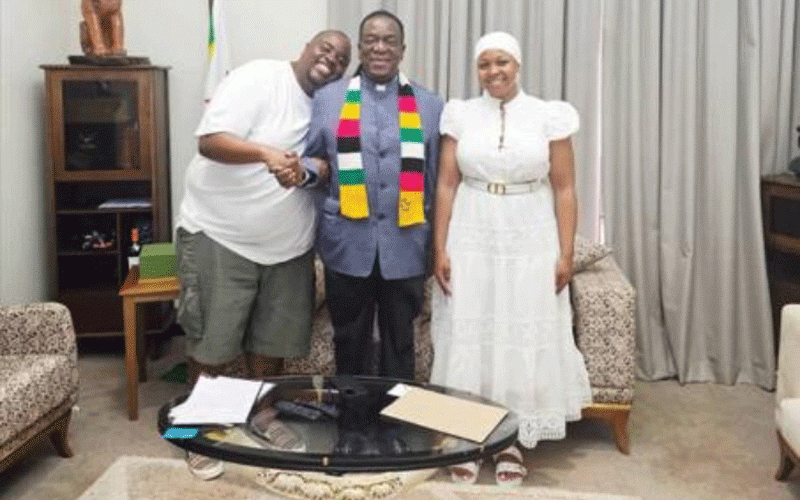
YESTERDAY marked eight years since President Emmerson Mnangagwa took over the reins, ushering in the second republic that promised heaven on earth to weary citizens eager to see the end of Robert Mugabe’s administration.
Ten days earlier, tanks had rolled down the streets signalling a coup. The military spokesperson said it was not a coup. Rather, the military had stepped in.
On November 18, thousands thronged the streets to exert pressure on Mugabe to go. The regional bloc, Southern Africa Development Community, was told to stay away as it was an internal matter.
The military-assisted transition was complete three days later, after Mugabe resigned, as lawmakers prepared the groundwork for his impeachment.
At a packed National Sports Stadium on November 24, 2017, Mnangagwa restored hope to millions of Zimbabweans who had resigned to fate.
He pledged to reaffirm Zimbabwe’s membership in the family of nations and expressed “our commitment to playing our part in all regional, continental and international organisations and arrangements to make our modest contribution towards a prosperous and peaceful world order”.
The “friend to all and enemy to none” campaign was a breath of fresh air, a departure from the brawling that characterised the first republic.
Zimbabwe’s plans to vie for a non-permanent seat on the UN Security Council for the 2027/28 term are part of the drive to sit and influence from the international table.
- NoViolet Bulawayo’s new novel is an instant Zimbabwean classic
- Lobby group bemoans impact of graft on women
- COP27: Zimbabwe’s opportunity to shine
- Corruption watch: Rogue cops: Blame it on the bosses
Keep Reading
Amid wild cheers, Mnangagwa told citizens to shed “misbehaviours and acts of indiscipline” which had “characterised the past”, a reference to the Mugabe regime.
Acts of corruption, Mnangagwa declared, must stop forthwith. Where these occur, swift justice must be served to show each and all that crime and other acts of economic sabotage can only guarantee ruin to perpetrators, he added.
He declared his administration’s full commitment to the fight against graft, warning that “grief awaits those who depart from the path of virtue and clean business”.
The government has lost the fight against graft. Each year, the Office of the Auditor-General flags graft and misbehaviour in ministries, departments and agencies. There has been no follow-up by relevant bodies to “guarantee ruin to perpetrators”.
The wheels appear to move faster when the target is the weak, but malfunction when the anti-graft drive lands at the doorstep of high-profile people.
Vice-President Constantino Chiwenga appears to be a lone voice in the fight against graft. So rife is the vice such that Zimbabwe scored 21 out of 100 points on the 2024 Corruption Perception Index (CPI). This was down from 24 points in 2023. Zimbabwe performed below the sub-Saharan average score of 33 and the global average of CPI of 43.
The highest Zimbabwe has scored since 2016 is 24.
Eight years ago, Mnangagwa said domestic politics had been “poisoned, rancorous and polarising”.
His goal was to preside over a polity and run an administration that recognises “strength in our diversity as a people, hoping that this position and well-meant stance will be reciprocated and radiated to cover all our groups, organisations and communities”.
Mnangagwa said, “We must always remember and realise that we hold and run this country in trust.
It belongs to future generations whose possibilities must never be foreclosed or mortgaged as a result of decisions of expediency we may selfishly make today out of fear of difficult choices and decisions that have to be made, he said.
Mr President, citizens are disillusioned. Hopes of a better tomorrow have turned into a mirage. Some have become so hopeless in the government that they look up to tenderpreneur Wicknell Chivayo, affectionately known as Sir Wicknell, to “answer their prayers”.