For a while, Zimbabwe has been grappling with two overlapping political crises. The current constitutional hardball being played by the ruling ZANU-PF cannot be understood without recognizing these twin political crises that have shaped our contemporary politics.
The first crisis is that of national leadership turnover. During Robert Mugabe’s long presidency from 1980 to 2017, Zimbabwe struggled to establish a credible mechanism for presidential succession at the national level. The Constitution laid a framework for regular elections, yet political reality made leadership turnover virtually impossible. Elections are, in a way, a periodic referendum on the president. Not in Zimbabwe, where elections have been a procedural formality to legitimize the incumbent rather than a genuine instrument for leadership change.
The 2008 elections produced a dramatic rupture in this crisis. A disputed election result, widespread violence, and regional pressure led to the 2009 Global Political Agreement, which created a temporary power-sharing government. For the first time, executive authority was partially redistributed. But it was not transferred. Robert Mugabe retained the presidency. Morgan Tsvangirai became Prime Minister, deputised by Arthur Mutambara in what was a fragile and uneasy arrangement - a marriage of convenience.
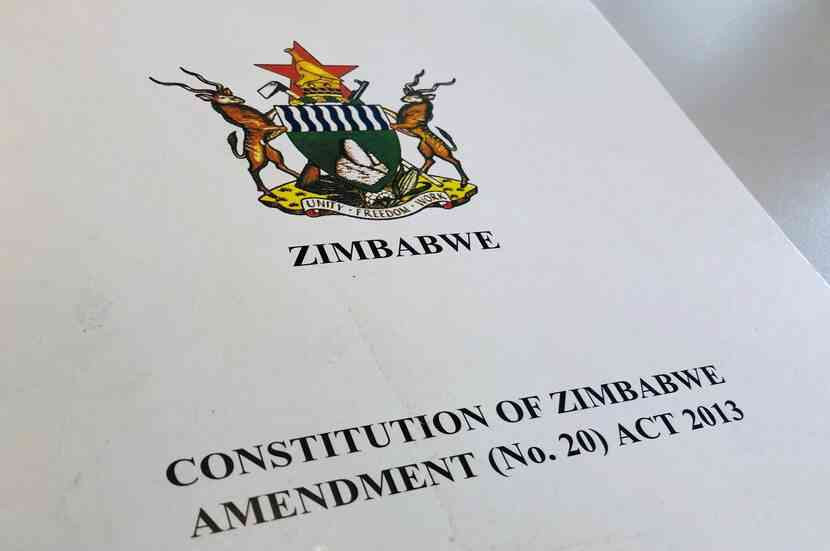
The underlying question of national-level leadership succession remained unresolved. When the 2013 Constitution introduced presidential term limits, Robert Mugabe maintained that these limits did not apply retrospectively to him. The political clock was effectively reset. A defiant Mugabe persisted that the principals had a final say in the constitution-making process: “sometimes parliament thinks that it is so, so sovereign - that it should control the acts dzema principals, ah kwete. Mwonzora! Na Mwangwana wako manga makuvhaira apa. Sometimes people fail to know where power is derived from.” Douglas Mwonzora, who represented the then MDC-T, and Paul Mwangwana (ZANU-PF) were co-chairs of the Parliamentary Committee on Constitutional and Parliamentary Affairs (COPAC). At some point during the drafting of the new constitution, a clause was introduced to impose an age limit on presidential candidates. The proposed 70-year age limit would have barred Mugabe, who was 88 at the time, from contesting future elections. Due to intense pressure from ZANU-PF, the clause was scrapped from the final draft of the constitution.
Because the two-term limit was not applied retrospectively and there was no age limit under the new constitution, Mugabe contested the 2013 elections, won by 61.88%, and signaled his intention to stand again in 2018. In effect, the 2013 constitutional reform did not produce leadership renewal; it prolonged Mugabe’s incumbency.
That unresolved tension over presidential turnover culminated in 2017, when the military intervened to arbitrate what had evolved into an acute succession crisis within the ruling party as Mugabe reached his dotage. The removal of Mugabe and the elevation of Emmerson Mnangagwa did not constitute a conventional and peaceful electoral transfer of power. If anything, it set a troubling precedent – that during moments of elite contestation over succession, power can be seized by force rather than constitutional process. The events of 2017 exposed the fragility of leadership transitions in personalistic and neopatrimonial regimes, in which state institutions are subordinate to factional calculations, and there is no precedence for orderly change. In 2017, the military adjudicated what was fundamentally a party dispute.
The 2017 episode produced the second crisis – an unresolved succession struggle within ZANU-PF itself. Given the ubiquity and electoral dominance of ZANU-PF, instability within it inevitably reverberates across the nation-state. When ZANU-PF sneezes, the country catches a cold.
The 2017 transition reshuffled leadership at the apex of the State, but it did not settle the question of the future succession procedure within ZANU-PF. As President Mnangagwa’s term approaches its end, ZANU-PF is reverting to its 2017 default settings. Operation Restore Legacy did not institutionalize a clear succession pathway; it reconfigured factions and redistributed influence within the ruling elite. But most importantly, it deferred, rather than settled, the deeper contest over who ultimately controls the party, and by extension, the State
- ED’s influence will take generations to erase
- ‘Govt spineless on wetland land barons’
- Govt under attack over banks lending ban
- Zim Constitution must be amended
Keep Reading
In a nutshell, this is the twin crisis Zimbabwe faces: uncertainty regarding the mechanisms of national leadership transition and uncertainty over the procedure governing succession within ZANU-PF itself.
Each crisis generates instability in distinct but overlapping ways. The national leadership crisis manifests as electoral tension. In Zimbabwe, the election season is a period of heightened political anxiety, and the political temperature rises to astronomical levels. Everyone remembers that bloody August 1st, 2018, when demonstrators were gunned down in the aftermath of disputed results. Presidential elections in Zimbabwe have become a national security threat.
The succession crisis within ZANU-PF produces a different, but equally dangerous, form of instability. Elite contestation at the top of the ruling party does not remain confined within party structures; it spills into the State. As we saw in November 2017, when tanks rolled into the streets, internal party rivalry can morph into a national security event. Because ZANU-PF’s succession rules are ambiguous and weakly institutionalized, factional competition becomes existential. Right now, to manage its internal succession dispute, ZANU-PF is on the verge of mutilating the constitution.
Together, these crises have produced an enduring uncertainty that, if left unresolved, deepens national anxiety. The boundaries between state politics and intra-party maneuvering have become dangerously blurred, to the detriment of the nation-state.
The Constitution of Zimbabwe Amendment Bill (No. 3), 2026, must be understood against this backdrop. The Bill appears to be designed to address both crises simultaneously. What ZANU-PF is trying to do is kill two birds with one stone. It is therefore no coincidence that the Minister of Justice, Legal and Parliamentary Affairs, Ziyambi Ziyambi, has justified the amendments as necessary to “enhance political stability and continuity…” and to “promote long-term national stability, inclusivity, and public confidence in constitutional institutions.” The diagnosis of the problem is correct. At least the Minister and the Cabinet that approved the Bill do not deny that Zimbabwe faces a stability problem. This acknowledgement is very important. There is no longer a pretense that all is well. This is a good starting point.
The twin crises outlined in this piece are neither imaginary nor trivial. Any Zimbabwean who desires a stable and democratic future must confront these issues honestly. However, the remedy proposed by the Minister is not sincere. The Bill, as presented, is manipulative, and some of its provisions are suspicious. Several of its provisions are not neutral adjustments; they appear strategically designed to insulate incumbency and manage competition rather than resolve underlying instability.
By rewriting the rules of executive succession, extending the tenure of incumbency, shifting presidential selection into a party-dominated parliamentary arena, and consolidating executive discretion over electoral and judicial institutions, it attempts to stabilise leadership through structural insulation.
This is the heart of the gamble: that by redesigning the architecture of power – by tampering with the Constitution itself – it can calm both national and internal instability. However, uncertainty that is rooted in unresolved political competition does not disappear simply because the rules are rewritten. As in 2017, such maneuvering only postpones the inevitable. This twin crisis won’t go anywhere. They will re-emerge in unpredictable forms. In 2017, it was tanks and guns. What will the next transition look like? It remains to be seen.
Zimbabwe’s political problem is not an episodic crisis; it is structural. That distinction matters. This proposed Bill should not be viewed merely as a set of amendments; it is a crisis-management tool. It attempts containment of the twin succession anxieties that have haunted the State since 2008 and reconfigured themselves in 2017. But containment is not resolution. Structural instability that is compressed by constitutional redesign does not vanish; it mutates. And mutation, by nature, is unpredictable. Even the architects of this Bill do not know the endgame. These are acts of desperation –this is trial and error, kungwavhangwavha, kukiya kiya (Shona terms often used in Zimbabwe that refer to the logic of utilizing shrewd, improvisational, and sometimes unconventional methods to navigate daily life and survival)
Regrettably, we Zimbabweans are mere pawns, and we will pay the price.
And gambles, by definition, do not come with guarantees.
Innocent Mpoki is a Zimbabwean national and a PhD candidate in Political Science at Boston College in the United States, specializing in African politics. He is a 2025–2026 Doctoral Fellow at the Clough Center for the Study of Constitutional Democracy.