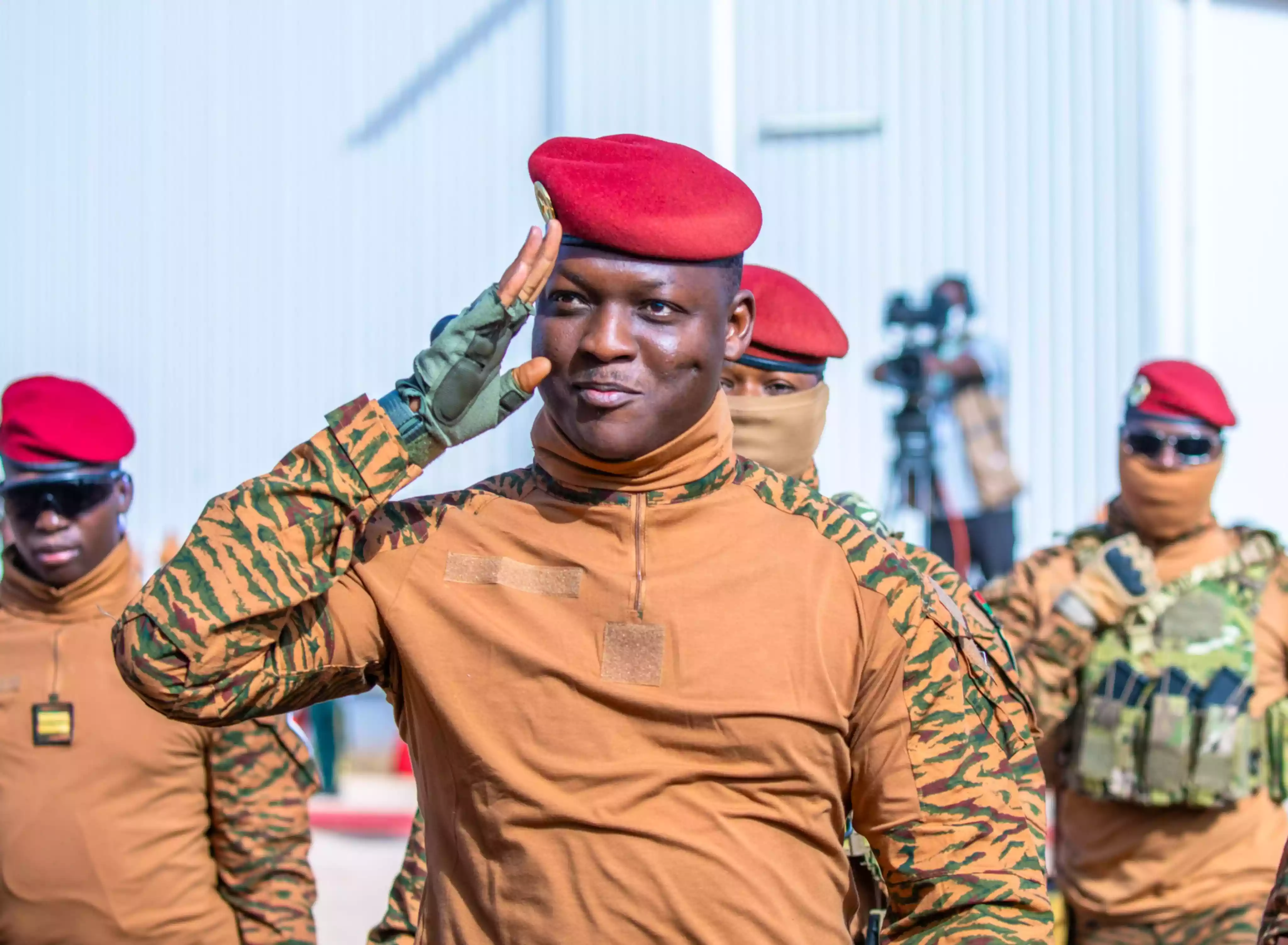
IN the heart of the Sahel, Captain Ibrahim Traoré is making a gamble few African leaders dare attempt: rejecting the Western development playbook and rebuilding Burkina Faso’s economy, culture and security on his own terms.
To his critics, he is a young soldier consolidating power.
To his supporters, he is the boldest Pan-African leader since Thomas Sankara.
Since seizing power in 2022, Traoré has wasted no time.
He nationalised parts of Burkina Faso’s gold sector, launched the country’s first large-scale gold refinery to keep wealth at home and invested heavily in agriculture so that farmers can feed the nation instead of importing food.
These are not abstract slogans; they are concrete steps to break free from dependency.
But what began as bold symbolism has evolved into a more ambitious development agenda.
In 2024 and 2025, a string of projects — from new factories to solar plants — have redefined Traoré’s leadership.
- The politics of mourning QE II
- Feature: Zim’s young chess queens checkmate early marriages, poverty
- Judge takes dig at Praz
- Zim’s citizenship-for-investor bait misinformed, misplaced
Keep Reading
The question is whether these moves will deliver lasting prosperity or fade into another tale of African strongmen overpromising and underdelivering.
Burkina Faso’s economy has long revolved around gold and cotton exports, leaving the country vulnerable to commodity swings.
Traoré’s answer has been to move up the value chain.
The government inaugurated its first gold refinery in 2024, aiming to refine up to 400 kilogrammes per day.
By halting the export of raw gold, Traoré has forced miners to process locally, capturing more revenue for the State.
The same logic is being applied to agriculture.
In Yako and Bobo-Dioulasso, tomato processing plants have been built to absorb surplus harvests that previously rotted in fields.
A new flour mill in Gampéla, capable of producing 220 tonnes of flour daily, has reduced dependence on imported wheat flour — a strategic hedge after global supply shocks spurred food inflation.
Most recently, Traoré laid the foundation stone for a 6,65 billion CFA franc (US$11 777 427,09) cashew apple factory near Bobo-Dioulasso.
Once complete in December 2025, it will process 5 000 tonnes annually into juice, vinegar, ethanol and other products, creating over a thousand jobs.
This push into agro-processing echoes Sankara’s 1980s call for “eating what we grow and wearing what we produce”.
The textile sector has also been revived.
Factories that lay dormant for decades, such as the Faso Fani textile mill in Koudougou, are humming again.
With cotton processing plants opening in Bobo-Dioulasso and Ouagadougou, Burkina Faso is positioning itself not just as a raw exporter but as a manufacturer of finished goods.
Agriculture remains the backbone of Burkina Faso, employing nearly 80% of the workforce.
Traoré has poured resources into mechanisation, distributing tractors, tillers and irrigation pumps across rural areas.
Improved seed distribution and irrigation schemes under projects like PARIIS-BF have rehabilitated nearly 2 000 hectares, benefiting tens of thousands of farmers.
The results are visible: millet production climbed from 907 000 tonnes in 2022 to more than 1,1 million tonnes in 2024, while tomato output rose from 315 000 tonnes to 360 000.
Student agricultural incubators in places like Bagré are drawing youth into farming, providing land, seeds and training in modern techniques.
For a landlocked nation facing recurrent droughts and insecurity, this shift towards food sovereignty is existential.
But sustaining it requires storage, transport and market linkages to prevent gluts.
For now, optimism outweighs caution.
No industrial drive can thrive without energy. Recognising this, Traoré’s government has accelerated solar projects, commissioning plants like Kodeni (38 megawatts, MW) and Nagréongo (30 MW).
These investments address chronic power shortages while aligning with global climate goals.
Roads and housing are also priorities.
In Ouagadougou and secondary cities, drainage systems, solar street lighting, and paved roads are transforming neglected districts.
In mid-2024, the government launched 1 000 social housing units for internally displaced people, signalling a recognition that conflict recovery requires more than military victories.
Plans for the Seenan Logistics Hub, a multimodal dry port near Ouagadougou, could reposition Burkina Faso as a trade facilitator rather than a landlocked bottleneck.
For investors, this is a clear sign that Traoré is thinking beyond symbolism to structural reforms.
Traoré’s project is not only economic. It is cultural and ideological.
Streets once named after colonial figures now bear African names.
Imported second-hand clothes have been restricted to encourage local textile consumption.
Court officials wear locally-woven garments rather than European gowns.
These moves are dismissed by critics as cosmetic, but in a country where symbols of subordination have lingered for decades, the cultural shift is part of economic sovereignty.
By stimulating demand for local goods, Traoré is reinforcing his industrial strategy.
The Achilles’ heel remains security.
Despite mass recruitment of civilian volunteers and tactical co-operation with allies like Mali and Niger through the Alliance of Sahel States, large portions of rural Burkina Faso remain under jihadist influence.
This insecurity threatens everything from farming to factory operations.
Meanwhile, Traoré’s political trajectory raises investor concerns.
Elections scheduled for 2024 were postponed; the electoral commission was dissolved and its functions absorbed by the interior ministry, effectively extending his rule until 2029.
In late 2024, the government was dissolved and restructured, consolidating his personal grip on power.
For global investors, this is a paradox.
Resource nationalism, political uncertainty and Russian alignment may look like red flags.
But Burkina Faso’s gold, cotton and potential as a renewable energy hub make it too strategic to ignore.
Companies are recalibrating risk, not walking away.
What Traoré represents is bigger than Burkina Faso.
In Mali and Niger, similar leaders are rejecting Western partnerships, expelling French troops and turning towards new alliances.
Across the continent, young Africans are asking why development must always be tethered to Brussels, Paris or Washington.
Traoré has become the most visible face of this generational challenge.
His rhetoric of sovereignty resonates, but it is his factories, tractors, and solar panels that give substance to the claim.
Whether he succeeds or fails will shape the choices of leaders from Dakar to Dar es Salaam.
The stakes are enormous.
If Burkina Faso manages to translate its resource wealth to durable infrastructure, feed its people and secure its territory, it will stand as proof that Africa can carve its own path — without International Monetary Fund prescriptions or foreign military tutelage.
If Traoré stumbles — if insecurity swallows gains, if factories fall idle, if authoritarian drift corrodes legitimacy — Burkina Faso risks becoming another cautionary tale.
The continent has seen many leaders rise on promises of sovereignty, only to falter when symbolism met the hard realities of governance.
Yet for now, Traoré has already shifted the conversation.
He has given voice to a generation tired of waiting, compromising and obeying.
He has built more in two years than many regimes managed in decades.
Whether rebellion becomes renaissance will depend not just on him, but on whether Burkinabè institutions, entrepreneurs and citizens can sustain the momentum.
For investors, for Africa and for history, the question remains open: Can Ibrahim Traoré turn defiance into development?