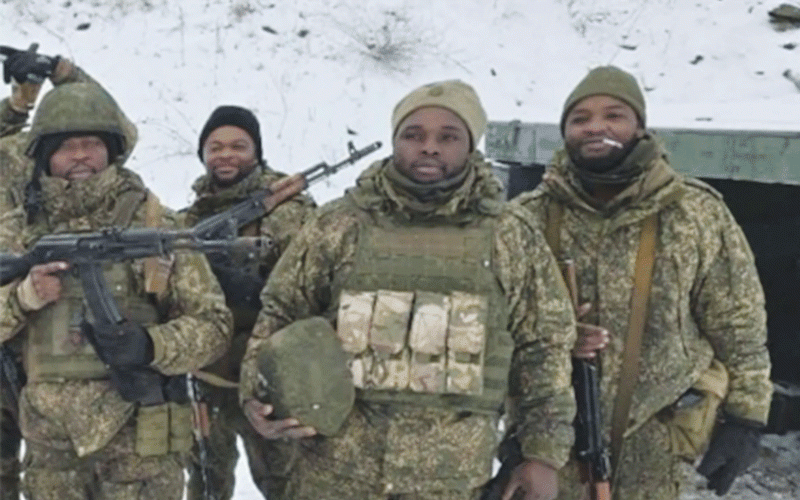
THE alleged recruitment of Zimbabweans to Russia’s war with Ukraine appears to be taking a new regional turn, with private investigators moving into Tanzania to trace people allegedly lured by promises of civilian jobs in Russia.
The reported operation raises fresh concerns that recruiters are changing tack and using regional countries as transit points as authorities tighten scrutiny of suspected recruitment activities in Zimbabwe.
Matrix private detectives lead investigator Tafadzwa Chidawa said a team from the firm was in Tanzania searching for Zimbabweans allegedly recruited under the guise of employment before being drawn into military service.
“A team of Matrix private detectives is currently in Tanzania to trace and locate a group of Zimbabweans who were lured with promises of decent jobs in Russia, only to discover that they were actually being recruited for deployment to the war front,” he said.
The claims could not be independently verified and it was not clear how many Zimbabweans were involved, where they were located in Tanzania or whether Tanzanian authorities have confirmed the operation.
If confirmed, however, the development points to an increasingly sophisticated recruitment network exploiting regional travel routes to move Zimbabweans to Russia.
For months, the recruitment problem appeared largely confined to a Zimbabwe-Russia route.
But arrests, investigations and reports of recruits travelling through third countries suggest a more complex operation involving local intermediaries, foreign handlers and multiple transit points.
- Mavhunga puts DeMbare into Chibuku quarterfinals
- Bulls to charge into Zimbabwe gold stocks
- Ndiraya concerned as goals dry up
- Letters: How solar power is transforming African farms
Keep Reading
In June, Russian national Leonid Koftov was arrested at Robert Gabriel Mugabe International Airport while allegedly preparing to leave Zimbabwe with a local recruit.
Prosecutors alleged that Koftov was working with an accomplice identified only as Constantine, who was believed to be in Russia.
Weeks later, Edward Kachingwe was arrested by detectives from the CID Counter Terrorism Unit while allegedly escorting a recruit towards a bus terminus.
Information published by Stop Russian Recruiters said investigators recovered Russian visas, air tickets and hotel reservations allegedly linked to recruits, while a Russian national identified as “Roman” remained at large.
The cases suggest that recruitment may involve several intermediaries, with local agents allegedly identifying potential recruits and arranging documentation and transport while foreign handlers co-ordinate their onward movement.
A senior security agent stationed at Joshua Mqabuko Nkomo International Airport, who spoke on condition of anonymity, said authorities intensified profiling of travellers suspected to be targeted by recruiters.
“We have been placed on high alert at ports of entry,” the official said.
“Our profiling has intensified, especially for young men travelling on single-way tickets with vague employment promises or suspicious transit routes through east and southern Africa.”
The official said tighter controls on direct routes could push recruiters towards neighbouring countries to evade scrutiny.
Legal practitioner Sessel Mahlangu said recruiting people for military service through false promises of civilian employment could amount to human trafficking.
“What we are witnessing is the classic definition of human trafficking through deception and fraud,” he said, adding that consent obtained through deliberate misrepresentation could not legitimise a recruitment process that ultimately placed victims in combat.
The reported shift towards Tanzania mirrors a recruitment pattern documented elsewhere in Africa.
A Reuters investigation reported in February that Kenyan recruits initially travelled through Turkey and the United Arab Emirates before routes shifted through countries including Uganda, South Africa and the Democratic Republic of Congo as airport surveillance intensified.
More than 1 000 Kenyans were reportedly recruited, according to a Kenyan intelligence report presented to lawmakers.
The issue has also become a growing concern in Zimbabwe.
In March, Information, Publicity and Broadcasting Services minister Zhemu Soda said 15 Zimbabweans died after being fraudulently recruited into the Russia-Ukraine war, while the government said it was working to repatriate 66 others who were alive.
NewsDay investigations previously found that recruiters allegedly used WhatsApp groups, Russian invitation letters, supposed employment contracts and scholarship offers to make the journeys appear legitimate.
Some victims were reportedly promised civilian jobs or educational opportunities before allegedly being redirected to military-linked roles.
The recruitment model exploits economic desperation, with potential victims offered what appear to be legitimate opportunities to work or study abroad.
The sophistication of the schemes lies in creating a convincing paper trail — including visas, hotel bookings, invitation letters and flight tickets — that makes the journey appear genuine.
By the time recruits discover that the promised opportunity is different from what they are getting into, they may already be thousands of kilometres away from home.
The experience of Zimbabwean Tatenda Tarwire, who is reportedly a prisoner of war in Ukraine, illustrates the dangers.
According to an account published by Stop Russian Recruiters, Tarwire said he was approached by a Moscow-based agent offering a military contract and was assured that Russian soldiers would assume the frontline because they understood the terrain and language.
The alleged recruitment of Africans has caused international concern.
In February, Ukraine accused Russia of using deceptive schemes to recruit more than 1 700 Africans for its war effort, with Ukrainian Foreign minister Andrii Sybiha saying Russia was seeking to draw African nationals into the conflict.
At least six Zimbabweans were subsequently identified by name on a list of African nationals reportedly confirmed dead while serving in Russia’s armed forces, according to Stop Russian Recruiters.
For Zimbabwe, the reported movement of investigators into Tanzania raises a new security question: whether the country is becoming part of a wider regional corridor used to circumvent increasingly stringent scrutiny at airports.
That issue requires close co-operation between Zimbabwean and regional authorities as well as strong public awareness of recruitment schemes offering jobs, scholarships or lucrative contracts abroad.