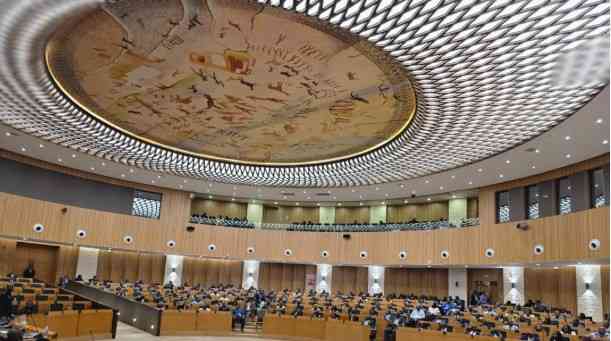
THE atmosphere in the National Assembly on the night of June 17 felt more like a high-stakes legal thriller than a routine legislative session.
As the clock neared midnight, lawmakers were locked in a fierce linguistic war over clause 16 (now clause 20) of the Constitution Amendment (No 3) Bill.
At its heart was a fundamental question that has haunted Zimbabwe for years: Should the military be an independent “guardian” of the State or merely a follower of Executive orders?
The original text of the Bill sought to repeal section 212 of the Constitution, which requires the Zimbabwe Defence Forces to “uphold the Constitution”.
The government initially proposed replacing this with a requirement that the military simply “act in accordance with” the law.
Opposition MPs immediately flagged this as a dangerous retreat.
Citizens Coalition for Change (CCC) MP for Bulawayo North Minenhle Gumede argued that “uphold” carried far heavier weight than mere compliance.
“The current term... imposes a positive constitutional duty,” she argued.
- Chamisa party defiant after ban
- Village Rhapsody: How Zimbabwe can improve governance
- Zimbabwe fall in T20 opener
- Zim T20 World Cup Qualifier preps in full swing
Keep Reading
“Parliament should prefer stronger constitutional language rather than a weaker language.”
Dzivarasekwa MP Edwin Mushoriwa (CCC) echoed similar sentiments, defining “uphold” as the proactive duty to “defend, protect and preserve” the supreme law.
The debate was inseparable from the legacy of the 2017 military intervention known as Operation Restore Legacy that led to the toppling of long-time ruler Robert Mugabe, who was replaced by President Emmerson Mnangagwa.
Hatcliffe MP Agency Gumbo (CCC) reminded the House that the High Court previously ruled that Operation Restore Legacy was legal precisely because the military was fulfilling its duty to “uphold the Constitution” from being usurped by “criminals around the President”.
“The court recognised that the military... have a right and obligation to play the role of guardian of the said Constitution,” Gumbo said.
He said the government by trying to delete this word, had made a calculated attempt at “coup-proofing” the presidency.
Justice, Legal and Parliamentary Affairs minister Ziyambi Ziyambi dismissed the fears as “slogans”.
He argued that the current wording created “textual ambiguity”.
Attorney-General Virginia Mabhiza buttressed this, stating bluntly that “the phrase ‘upholding the Constitution’ is unnecessary and it is part of the legal scrubbing that we remove it”.
Ziyambi maintained that the goal was to ensure that “no reading of our supreme law can place any institution above it or beside it with a parallel mandate of its own”.
Zanu PF’s Energy Mutodi provided the most candid justification.
Mutodi argued that in a new system where Parliament — not the people — elects the President, the military must be barred from acting as an independent judge.
“This clause specifically is supposed to remove the guardianship role, the guardianship loophole,” he declared.
“If Parliament and the Executive disagree, who does the military uphold?”
In a dramatic twist just before the House resumed at 10:45pm, Ziyambi was in a surprising U-turn.
Sensing the depth of the opposition’s resistance, he withdrew the plan to delete “uphold” and offered a compromise.
The new version of clause 20 restores the duty to “uphold the Constitution”, but adds a crucial legal leash.
The mandate now reads that the function of the defence forces is to protect Zimbabwe and uphold the Constitution, but this is now “subject to sections 207 and 208”.
Ziyambi explained the move by pointing to section 207(2), which explicitly states that “the security forces are subject to the authority of this Constitution, the President and Cabinet”.
By tethering the word “uphold” to these sections, the government has legally ensured that the barracks can only protect the law while remaining under the total command of the Executive.
For critical observers, this “victory” for the opposition — keeping the word “uphold” — is more symbolic than practical.
By making the duty to protect the state “subject to” the authority of the President and Cabinet, the “power of the sword” has been firmly returned to its scabbard.
As the House adjourned at 11:31pm, the legal reality was clear: the era of the military as an independent “guardian” is being legislated out of existence.
Under CAB 3, the barracks are being effectively “tamed”, and the President will hold both the handle and the key to the country’s security apparatus.
Last year, Mnangagwa’s loyalists led by Ziyambi accused Vice-President Constantino Chiwenga of attempting to “undermine a constitutionally-elected government” and “incite despondency” after the former army commander tabled a damning dossier before the Zanu PF politburo.
In the dossier, Chiwenga accused Mnangagwa of presiding over “corruption, State capture and betrayal” of the ideals of the coup against Mugabe.
At the time, Ziyambi accused the VP of advocating for the “unlawful removal of a constitutionally-elected President”.
CAB 3 is seen as an instrument being used by Mnangagwa’s loyalists to remove Chiwenga from the succession equation and weaken the ability of the military to stage a coup.