BY the time the floods come or the drought tightens its grip, women in Zimbabwe already know what it means to survive with little.
Climate disasters have turned that struggle into a daily emergency, especially for women in rural communities who depend on land, water and farming to feed their families.
From Chimanimani and Chipinge in Manicaland province, to Binga in Matabeleland North, Mwenezi and Chiredzi in Masvingo and parts of the Midlands, climate change has left a clear footprint: washed-away homes, empty granaries, broken livelihoods and women carrying the heaviest load.
Zimbabwe has been battered by repeated shocks such as Cyclone Idai (2019), Cyclone Freddy (2023), flash floods and long droughts linked to the El Niño phenomenon.
According to a UN Women regional report covering Zimbabwe, Malawi and Mozambique, climate disasters are deepening poverty and inequality, especially for women.
Women make up over 60% of the agricultural workforce and produce most of the food in rural areas.
When floods destroy crops or drought dries the soil, women lose both income and food.
Because of cultural norms, women often eat last and least when food is scarce.
- Game-changing oil rig Zim-bound
- Travelling & touring: Ever heard of a four-roomed cave?
- Matiza’s widow in estate wrangle
- AWF empowers victims of human-wildlife conflict
Keep Reading
The report also shows that only 13% of women in Sub-Saharan Africa own land, compared to men (36%).
In Zimbabwe, this means many women cannot access loans, compensation or government support after disasters because they do not have land titles.
In Runyararo settlement in Chimanimani, where families were relocated after Cyclone Idai, women say life is still far from safe or stable.
“There are no piece jobs here. Food is scarce here,” said Chipo Dhliwayo, a mother struggling to feed her family.
“On most days, we survive on manjoko (boiled maize kernels) and eat sadza in the evening because we do not have enough.”
She explained that even the houses they live in are not fit for people.
“Our places of residence are not suitable for human beings,” she said, as she walked to a Food for Assets programme at Runyararo Clinic.
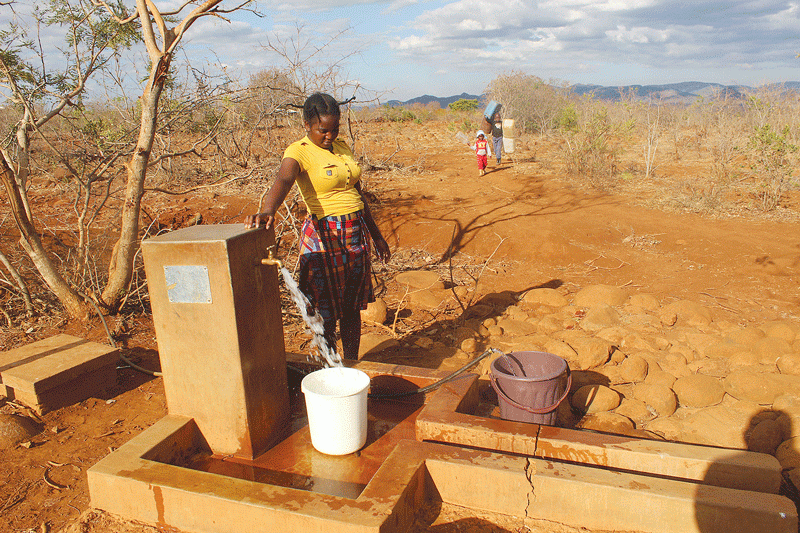
Water access has improved, thanks to donors, but hunger remains.
“The only good thing is that we are now fetching water near our houses. Before, we didn’t have nearby water sources, but a donor, WHH, drilled boreholes and helped us to establish gardens,” Dhliwayo added.
“But now it is too hot, we are not getting enough water. We can grow vegetables, but we do not have starch. The food handouts from government are not enough.”
For Chipo Mahembe, a 31-year-old mother of one, life in Runyararo is about survival, not living.
“I don’t work. I survive on menial jobs,” she said.
“The payments are very small. Sometimes you get one US dollar.
“Other times we clear people’s yards and are paid with a bucket of maize meal.
“We take it to the grinding mill and cook sadza as life goes on.”
Her story mirrors that of many women across Manicaland, Masvingo and Matabeleland South, where drought has destroyed crops and floods have wiped out small trading activities.
In drought-hit areas like Mwenezi, Gokwe South and Binga, women walk long distances to fetch water and firewood.
Climate change has made these journeys longer and more dangerous.
Girls are often pulled out of school to help at home, while some families marry off daughters early to reduce household pressure.
According to Unicef, 46% of girls in Zimbabwe and Malawi are married before the age of 18 and the numbers rise after climate disasters, when families lose everything.
When floods strike, women face new dangers.
Temporary shelters often lack privacy, lighting and security.
The UN Women report warns that gender-based violence increases during disasters, yet women’s safety is often ignored in emergency planning.
Early warning systems also fail many women. Messages are usually shared through male-dominated channels, meaning women receive information late or not at all.
Beyond Manicaland, women in:
Masvingo (Mwenezi, Chiredzi) face severe drought and hunger
Matabeleland North (Binga) struggles with water shortages and food insecurity
Matabeleland South faces recurring drought and livestock losses
Midlands has seen floods destroy crops and homes along river systems
Across these regions, women say aid is not enough and long-term support is missing.
UN Women and other humanitarian groups say solutions must put women at the centre of climate action.
Key recommendations include:
Early warning systems that reach women directly, using local languages and community networks
Climate-smart agriculture and support for small women-led businesses
Secure land rights for women, so they can access loans and disaster compensation
More funding for women-led organisations working on disaster response
Women’s representation in disaster planning committees, from village to national level.
Zimbabwe is part of the Sadc Gender Responsive Disaster Risk Reduction Plan (2020-30), but women on the ground say implementation is slow.
“We are not asking for too much,” said a woman in Chimanimani.
“We want food that lasts, water that is enough and work that can help us to stand on our own.”
Despite everything, women continue to rebuild — forming savings groups, tending small gardens and supporting each other.
But resilience has limits.
As climate disasters grow stronger, the future of Zimbabwe’s rural communities depends on whether women are finally seen not just as victims — but as leaders who must be supported, protected and heard.
In Zimbabwe, the climate crisis is not only about weather.
It is about women, survival and the fight for dignity.