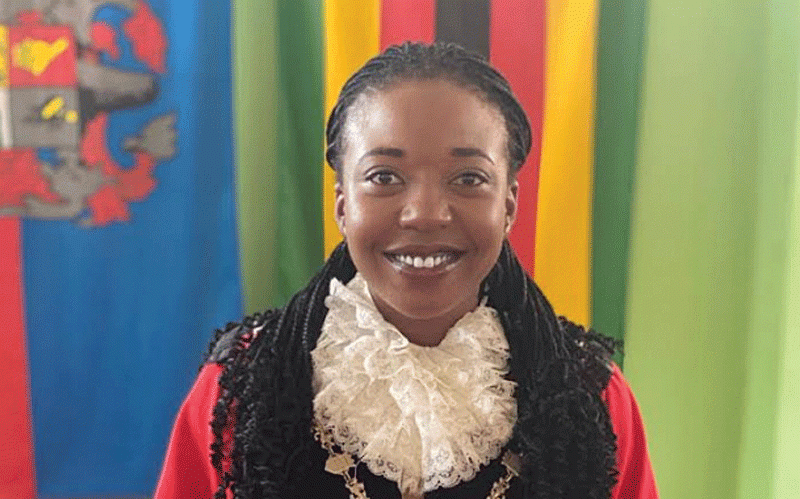
Shantiel Yeukai Chiwara (SC), a banker, always dreamt of becoming mayoressess but at times felt that this was far-fetched. Her dream, however, came to pass on September 19, when she was elected the first female mayoress for the City of Masvingo after defeating her rival Sengerayi Manyanga of Zanu PF by a wide margin. The Citizens Coalition for Change (CCC) councillor for ward 2 in Masvingo Central constituency recently shared some snippets into her journey to council chambers in an interview with NewsDay journalist Tafadzwa Kachiko (ND).
ND: Can you briefly describe yourself?
SC: Well, I am a 25-year-old lady who studied at Victoria High School from Form One up to Six. I then enrolled at the National University of Science and Technology and graduated with a bachelor of commerce degree in banking and investment management in 2021. Before I was elected ward 2 councillor and subsequently mayoress, I was a banker with a local bank. For now, I just took a break.
ND: When did you begin activism?
SC: Growing up, I was always passionate about change. In 2013, at 15, I was appointed as the MDC-T secretary for branch 5 (ward 2), which was ward 3 back then. I was then appointed ward secretary, then district secretary for tourism, and eventually Masvingo provincial secretary for gender.
ND: If one says you ride on the popularity of your father (James Chiwara), who is Masvingo's former deputy mayor, to run for councillor and mayoral post, how do you react?
SC: That’s completely not true. I ran my own race. I have always wanted to be mayoress, but I used to think that this was impossible. My passion for change and to give women an equal chance prompted me to contest for both positions.
ND: How do your relatives feel about your participation in politics?
- Corruption Watch: Get scared, 2023 is coming
- Corruption Watch: Get scared, 2023 is coming
- Letters: Ensuring Africa’s food security through availability of quality seeds
- Is military's involvement in politics compatible with democracy?
Keep Reading
SC: Many of my relatives are happy about the decision I made, and their wish is for me to reach greater heights.
ND: What does holding such a position mean to you?
SC: To be mayoress means representing, delivering, inspiring, and making a remarkable change in the community.
ND: Any setbacks yet?
SC: No, not really.
ND: Which three critical areas do you think need to be addressed in the short term in Masvingo City under your leadership?
SC: Areas that require urgent attention are water and sanitation, drug abuse and sewage management.
ND: How do you view the relationship between local authorities and the central government?
SC: The power of the local authorities is derived from the central government's authorization or decentralization of power.
ND: Do you feel the prevailing environment is conducive for local authorities to achieve their set targets?
SC: Failure to meet targeted goals is not necessarily due to the central government’s interference but can be attributed to a number of factors. However, set targets can be achieved in the face of constraints, but it’s not easy.
ND: What's your comment on the representation of youth and women in local authorities?
SC: I can safely say there has been an improvement in this political season, but we are hoping for even more numbers of women and youth.
ND: What's your reaction to the notion that women don't succeed in politics because they don’t support each other?
SC: That’s true; women don’t support each other in politics. If only we did, we could have the highest number of seats at every political level because we have the highest population.
ND: Women in politics get all sorts of tags, in particular being labelled prostitutes. Have you ever been a victim of that?
SC: Yes, I have been, and I decided to ignore that.
ND: What would you like to say to the people in Masvingo City?
SC: Let us expect a change in our city, and let us all play our part.