AS one quote gently reminds us that: “Flowers whisper what words cannot say; whether in sorrow or in joy.”
In like manner, as for George Chikuni, those whispers have become a new language of life and where his boots once marched and guns once defined duty, roses now bloom with quiet authority.
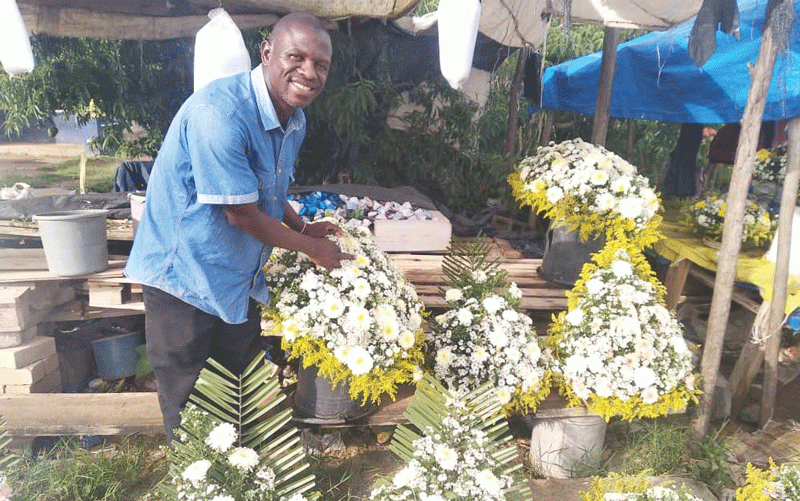
Chikuni, a retired sergeant in the military, has traded camouflage for colour, transforming his life from military precision to floral expression in Chitungwiza, just a stone’s throw away from a top funeral parlour in the dormitory town and its offices.
For 20 years, Chikuni served in the Zimbabwe National Army, a career built on discipline, resilience and obedience to command.
Today, those same qualities are visible in the symmetry of his bouquets, the patience in his arrangements and the calm confidence with which he serves customers navigating both grief and joy.
“I opted for early retirement to pursue personal interests, especially entrepreneurship,” Chikuni said.
“Interestingly, the flower business has kept me going, and I am more than ready to expand,” he added, with confidence.
His modest roadside workspace has become a quiet hub of emotion.
- Over 115 to exhibit at Mine Entra
- Young entrepreneur dreams big
- Econet bemoans power outages
- Govt opens ChiTown e-passport centre
Keep Reading
Upright and spread bouquets made from both natural and artificial flowers stand ready for funerals, weddings, birthday parties, church events and home décor.
What began as a livelihood choice has evolved into a calling that places Chikuni at the crossroads of human emotion.
Flowers, across cultures and generations, have remained silent witnesses to life’s most defining moments.
They speak when words fail, especially at funerals where grief is heavy, at weddings where joy overflows, and at celebrations where love is affirmed.
From birth to death, flowers accompany humanity, offering comfort, beauty and symbolism.
“Flowers say what the heart cannot and at a funerals, they cry with the mourners. At a wedding, they smile with the couple,” he suggested.
Transitioning from a military mindset to floral artistry was not without its challenges.
The army trains one to confront danger; floristry demands sensitivity.
Chikuni had to learn to soften his approach, especially when dealing with mourners whose pain is raw and personal.

“In the army, you are taught to be strong all the time. Here, you must understand grief. You must listen more than you speak,” he added.
This understanding has introduced him to what he calls a “new funeral psychology”.
Families no longer choose flowers at random.
Each bouquet carries meaning.
White lilies symbolise peace and purity, red roses express love and sacrifice, while mixed arrangements reflect celebration of life rather than mourning death.
“People now ask what flowers represent.
“They want bouquets that match the personality of the departed.”
Beyond funerals, his work has found its way into happier spaces.
Churches rely on his floral designs for weddings and services.
Homes are softened by his arrangements.
Parties are brightened by his colour choices.
In every setting, flowers continue to bridge emotion and memory.
From guns to roses, Chikuni’s journey is a powerful reminder that life after uniform can bloom beautifully.
In petals and stems, he has found peace, purpose and prosperity — proof that even the hardest hands can learn to handle beauty.