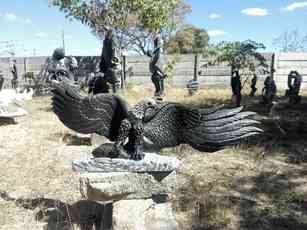
CHITUNGWIZA Arts Centre, potentially the largest sculpture hub in southern Africa, is opening its gates to local traders.
Organisers have made an open call to traders around the dormitory town to table commodities of every kind at the Saturday Market, scheduled to run weekly beginning October 18.
Located in Zengeza 4, the centre is home to more than 200 sculptors, plus a fistful of affiliated musicians and painters. It was jointly founded by the Arts and Culture ministry, the United Nations Development Programme (UNDP) and Chitungwiza Town Council in 1997.
Chitungwiza Arts Centre vice-chairperson Moses Mangenda said hosting a market of general interest would boost local exposure for the centre.
“The more people come here for different reasons, the more our artists are exposed,” Mangenda said.
Stone art is typecast as an export commodity for wealthy foreign consumers. However, the market has undergone generational shifts, handing contemporary sculptors over to frugal dealers rather than end users.
The Saturday Market will be one step towards fireproofing the artists against market shocks.
“We have people here in Zimbabwe who appreciate spending on art,” Mangenda said.
- Lupane man survives axe attack
- I don’t have depth: Bosso coach
- Farm wrangle sucks in Lands official
- In defence of Trevor Ncube
Keep Reading
“However, when we have market conversations, we tend to leave them outside.”
Zimbabwean sculpture is often tinged with cultural subtexts. These were the selling points of so-called Shona sculpture during its colonial-era heyday.
The indigenous customs articulated through stone may, however, be more celebrated by the Western anthropological establishment than by their living heirs.
Organisers of the Saturday Market are also looking to change this narrative.
“You don’t typically get European buyers coming to order their totems. But here you have got Mhofu, Hungwe, Shumba and so on, people who are assertive and expressive with their identities,” Mangenda said, adding that art already spoke to every Zimbabwean in at least one personal regard.
Shelton Mubayi, a noted sculptor at the centre, said engaging the public would improve art education.
“We have too many Chitungwiza natives who have never seen this place. Last week, a resident came here saying he had been referred by someone in Victoria Falls,” Mubayi said, adding that the initiative would acquaint more people with the treasure buried in their hometown.
He spoke approvingly about the heritage-based curriculum for factoring in a key role for the visual arts. Lustania, a private school in Masasa, and government schools around Chitungwiza often send students to the centre.
Chinhoyi University of Science and Technology students attached to the centre have been able to employ themselves before graduation.
Mubayi said his contemporaries thrived on notes and blessings from “first-generation” godfathers. Fanizani Akuda, Sylvester Mubayi, Edward Chiwawa, Nicholas Mukomberanwa and Henry Munyaradzi, in particular, relocated from legacy hubs such as Tengenenge to Chitungwiza.
Their self-driven workshop initiatives provided a focus for emerging talents who worked between the backyard and the roadside.
The late Stephen Chifunyise, then permanent secretary for the Arts and Culture ministry, brought together relevant government departments and UNDP to create a formal space for young talent.
Mubayi said interdisciplinary interaction at the centre would be just as important as intergenerational interaction.
“Chitungwiza has always been the home of art, going beyond sculpture to music, drama, painting and other disciplines. Let us make use of this place to share ideas the way elders like Oliver Mtukudzi and Dominic Benhura did in their mutual spaces,” he said.
Chitungwiza Arts Centre secretary Farai Nyakanyanza said the centre was still committed to its original vision of poverty alleviation.
“A mixed crowd begins to explore what is possible in terms of living our culture through art,” Nyakanyanza said.
“The good thing is art has no price, as the saying goes; what you get is the point where a piece meets an individual consumer.”