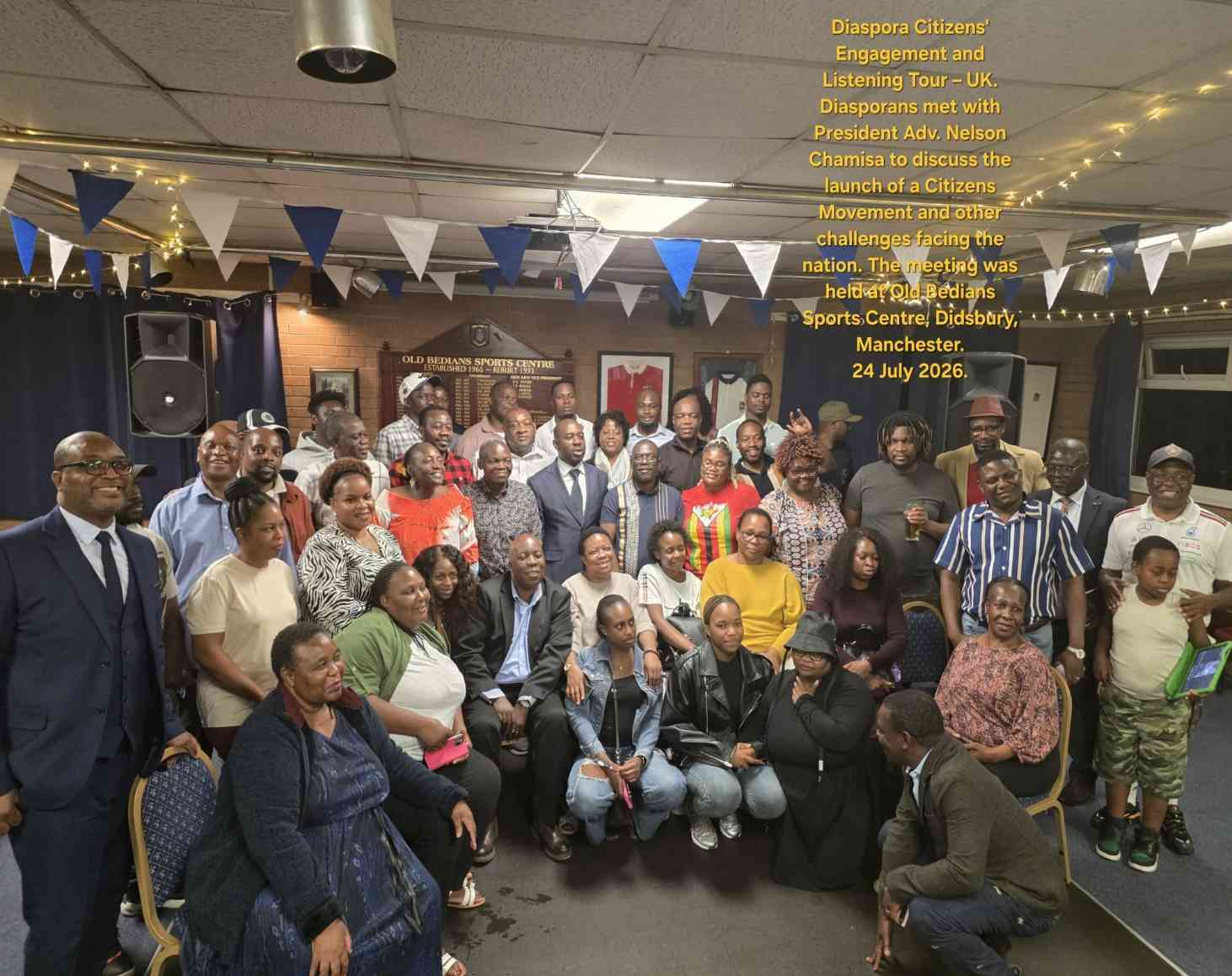
On 24 July 2026, a momentous occasion unfolded in Manchester as Advocate Nelson Chamisa embarked on his Diaspora Citizens Consultation, Engagement, and Listening Tour across the United Kingdom. The tour, which spanned London, Manchester, and Corby, provided a vital platform for Zimbabweans in the diaspora to connect with one of the nation's most prominent political figures and voice their concerns, hopes, and aspirations for the future of Zimbabwe.
I arrived at the Manchester venue a bit earlier than the scheduled time and was privileged to assist the other dedicated members in arranging the interior space to ensure a welcoming and orderly environment for the attendees. Alongside my fellow branch members, I also took charge of the register, meticulously recording the names of all who came to lend their voices to this important gathering. The atmosphere was one of anticipation and quiet determination as Zimbabweans from all walks of life streamed in, eager to engage with the man many regard as the beacon of hope for a new Zimbabwe.
The Manchester Branch was notably well-represented by a dedicated contingent of members, including Theophilas Mkuhlani, Margret Tashayawedu, Thomas Machingauta, Vengai Mutsawu, Osbert Tonderai Museta, Cuthbert Munyaradzi Chavinda, Taisekwa Ruth Matipa, Elizabeth Chitengo, Elizabeth Musonza, and Happiness Ncube. Their presence underscored the commitment of the Manchester diaspora community to the democratic cause and the vision espoused by Advocate Chamisa.
Not to be outdone, the Corby leg of the tour also drew a significant turnout of committed members from the Manchester Branch, including Francisca Chiduku, Michael Tinarwo, Glandman Mundingi, Rumbidzai Thelma Chidewu, Prince Tinashe Chidewu, Shorayi Chidewu, Brian Manyanda, and Genius Khatazile Mamwadhu. Their willingness to travel and participate further demonstrated the depth of engagement and the widespread desire for change among Zimbabweans in the diaspora.
A great number of people attended the consultation sessions across all three cities, a testament to the enduring connection that Zimbabweans abroad maintain with their homeland. Advocate Chamisa proved himself to be a man of profound wisdom, a stark contrast to the often-distorted portrayal of him in certain circles. The format of the event was an interactive question-and-answer session, during which every attendee was given the opportunity to freely express themselves and pose questions without any sense of intimidation or restraint. With remarkable composure and clarity, Chamisa addressed each query without hesitation, demonstrating his mastery of the issues at hand and his genuine commitment to transparency and dialogue.
His primary emphasis throughout the tour was on the importance of maintaining hope in the face of adversity. Despite the Zimbabwean government having passed the Constitution of Zimbabwe Amendment (No. 3) Bill, commonly referred to as CAB3, Chamisa urged Zimbabweans not to lose hope or succumb to despair. He reminded the audience that the country still belongs to all Zimbabweans and not to any single political entity, let alone ZANU-PF. He addressed the widespread speculation on social media and other platforms regarding his perceived silence, clarifying unequivocally that his restraint did not signify abandonment of the people. Rather, he explained that there are strategic plans currently in motion, and that the work of national transformation remains a work in progress requiring patience, perseverance, and collective effort.
Central to his address was the introduction of what he termed the "citizens' movement"—a paradigm shift in which the government is genuinely chosen by the people through democratic processes. However, he was careful to stress that this is not a one-day process but a long-term endeavour that requires sustained civic engagement, education, and mobilisation. He also spoke about the future of Zimbabwe and the critical importance of engagement with the Southern African Development Community (SADC) and the broader international community in fostering a conducive environment for democratic transition.
Importantly, Chamisa did not overlook the role of the diaspora in shaping Zimbabwe's future. He emphasised that Zimbabweans living abroad still have a crucial part to play, whether through online activism, raising awareness, or encouraging and supporting those back at home. He called on the diaspora to remain steadfast and to use their voices and platforms to amplify the call for democratic governance and human rights in Zimbabwe.
- Zim needs committed leaders to escape political, economic quicksands
- Chicken Inn knockout Harare City
- Ziyambi’s Gukurahundi remarks revealing
- Ngezi stunned by 10-man Herentals in Chibuku Cup
Keep Reading
The faces of the people in the room bore visible signs of relief and renewed hope. There was a palpable sense that, after a prolonged period of uncertainty and disillusionment, someone was finally listening and offering a coherent path forward. From what I personally experienced that day, I can confidently say that Advocate Nelson Chamisa is indeed the people's president—a leader who understands the struggles of ordinary Zimbabweans and who remains unwavering in his commitment to a better, more just, and democratic Zimbabwe.
The Manchester consultation was more than just a meeting; it was a reaffirmation of the unbreakable bond between the diaspora and the homeland, a testament to the enduring spirit of the Zimbabwean people, and a powerful reminder that the dream of a new Zimbabwe is very much alive. As the tour concluded, attendees left with a renewed sense of purpose, inspired to continue the work of building a nation where freedom, justice, and equality prevail for all.
Diana Machingauta is a Zimbabwean based in the Diaspora. She writes in her personal capacity.