British miner Kavango Resources Plc has extended the deadline to complete its acquisition of Zimbabwe’s Nara Gold Project to February 27, 2026, as the company and the seller work to finalise legal formalities.
The Nara Gold Project, comprising 45 contiguous gold claims, spans four historic mines that together produced over 90 000 ounces of gold. However, it has never undergone systematic modern exploration.
Located along the Filabusi Greenstone Belt in southern Zimbabwe — a historically productive yet under-explored shear corridor — the project presents significant exploration potential.
Kavango has three projects in Zimbabwe. The miner is currently focusing on its most promising project, Hillside, which consists of 44 gold claims covering 503 hectares.
The other two mining projects are the Nara Gold and Leopard.
“Kavango and the seller [the parties] have agreed to extend completion to 27 February 2026, to facilitate finalisation of the legal formalities. Both parties remain committed to completion and the execution of the Nara sale and purchase agreement as soon as possible,” it said.
In July, Kavango announced a US$5 million investment commitment from Purebond Limited, intended to fund the Nara acquisition and provide working capital for development. The funds are expected to form part of a fundraise linked to Kavango’s listing on the Victoria Falls Stock Exchange.
At Nara, Kavango is targeting both primary hard-rock mineralisation and gold recovery from surface tailings, with exploration currently focused on the historically productive Killarney Mine, where small-scale miners operate at upper levels.
- Elephant census under way
- Kaza releases elephant survey stats
- Gold miner seeks US$13m capital
- Illegal wildlife trade cripples Africa’s GDP
Keep Reading
“Kavango believes that flooding at deeper levels may have preserved significant unmined gold mineralisation until now,” the miner said.
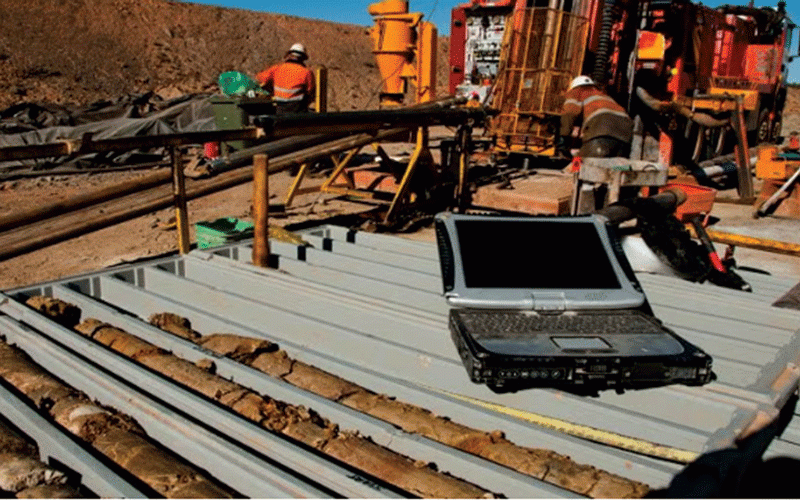
“Drilling at Killarney has confirmed a gold-bearing system beneath existing workings. Key results from hole NAKLDD001 intersected new mineralised hanging wall and footwall zones, supported by IP data identifying a strong resistivity low coincident with the core of the mine workings.”
The miner said these features suggest mineralisation may continue along strike and at depth.