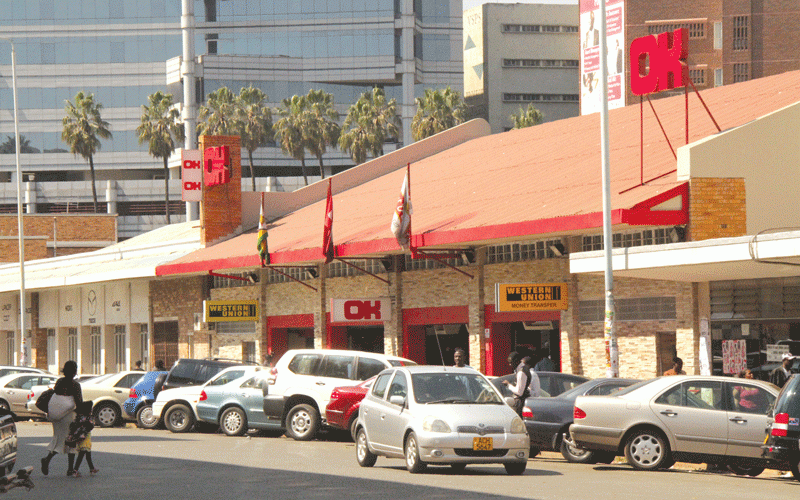
STRUGGLING retailer, OK Zimbabwe Limited (OK) has confirmed receipt of US$20 million following a capital raise in August and is now considering offers for some properties to raise an additional US$10,5 million amid confirming technical insolvency.
In August, OK successfully raised US$20 million through a renounceable rights offer, which was fully subscribed following strong shareholder participation and underwriting support.
The capital raise, along with the sale of some of its properties to raise US$10,5 million, is part of a strategy to deal with debt worth US$30,34 million.
As previously reported, failure by OK’s previous management to navigate exchange rate difficulties as well as high taxes, informalisation, and poor utility service delivery led to this significant debt burden.
Following this, the board resolved in February to recall seasoned former executives to support the turnaround of the company.
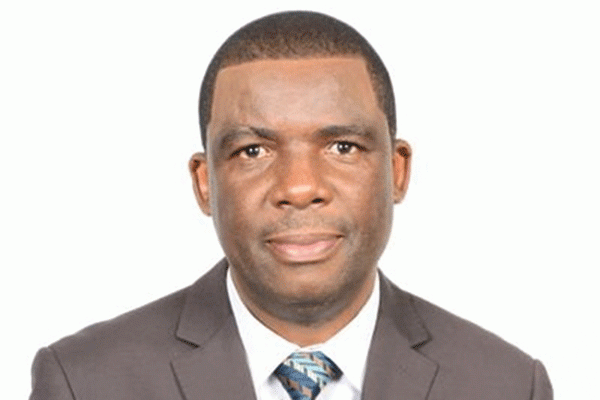
In a statement attached to the retailer’s financial year results for the period ended March 31, 2025, outgoing OK chairman Herbert Nkala said the properties to be sold include supermarket buildings.
“A rights issue exercise was successfully concluded in July 2025, and US$20 million proceeds received in August 2025.
“The capital raise plan of US$10,5 million through the sale of immovable properties is in progress, with offers received in August 2025 currently under consideration,” he said.
- OK ramps up expansion drive
- Zimbabwe’ banks are bleeding
- OK ramps up expansion drive
- Zimbabwe’ banks are bleeding
Keep Reading
“The properties on sale include supermarket buildings that will be disposed on a sale and leaseback basis.
“The leaseback arrangement is necessary to ensure the company continues to operate in its strategic store locations.
“Some of the funds raised will be applied to settle part of the company’s debt, and this is expected to unlock supplier credit support for restocking.”
He said the process of restructuring the company for survival and growth had already started to ensure proper management of debt to avoid insolvency.
However, despite this assertion, the firm recorded total current liabilities of US$44,22 million against current assets worth US$25,47 million.
This left the firm with just US$0,57 to every dollar of short-term debt, leaving the chain store technically insolvent as of March 31, 2025.
During the financial year, group revenue declined by 53% to US$240 million when compared to the prior year.
This was attributed to supply chain disruption, an unstable exchange rate, especially in the first half of the year, a liquidity crunch in the economy and heightened competition from the informal sector compounded by exchange rate controls that distorted pricing.
Consequently, OK’s loss-making position more than doubled to US$29,61 million against a prior year comparative of US$11,04 million.
“The board and management’s initial focus has been to stop the decline in performance and financial distress and to steer the business back to stability, profitability, and long-term sustainability,” Nkala said.
“The process of restructuring the company for survival and growth has already started to ensure proper management of debt to avoid insolvency, it operates with an appropriate organisational structure, efficient operations and that it adapts to changing market conditions.”
As of March 31, 2025, the company recorded trade and other payables of US$29,85 million of money it owes its suppliers, albeit being down 12,51% from the prior period.
“The group endeavours to settle its obligations to suppliers in accordance with agreed terms,” OK said.
“However, during the reporting period, the group did not have sufficient liquidity to settle all obligations as they fell due, resulting in delays in payments to creditors.”
Nkala said once the company was fully resourced and the stores were fully stocked, it was expected that employees would be more confident about the future.
“However, when the company was in decline, retail skills were lost as trained and experienced personnel left employment for better opportunities.
“It will, therefore, be essential to retrain and acculturate the existing staff to raise levels of customer service and standards of performance.
“Looking ahead, cost optimisation and in-store as well as online sales strategies will remain central to achieving and sustaining the required growth.
“The recovery of the company has started, but it will take some time to return to normal operations.”