
Ever wondered why people around the world prefer the Japanese used car market over buying cars locally? There must be a reason behind it. In this blog, we unpack those reasons with you. Japanese car auctions and dealers are two popular ways to buy your dream car. While both have their advantages and disadvantages, understanding the differences between these two can help you make the right choice for your needs. In this article, we inform you about auctions and dealerships in Zimbabwe and highlight which option offers you the best value for your money.
What are car auctions?
To put it simply, a Japanese car auction is a process where people who have a Japanese dealer license can bid for used Japanese cars. Each auction house allows Japanese car sellers to meet buyers from around the world. Auction houses offer a variety of car listings, along with an auction sheet. An auction sheet gives buyers all the necessary information they need to buy a car, including mileage, service history, and an inspection report. Sellers ultimately sell their car to the highest bidder. Auction houses have a very transparent and competitive environment. However, not everyone can bid for Japanese auctioned cars. Only licensed individuals or companies have the authority to do so.
Car Auctions in Zimbabwe
If you’re in Zimbabwe, then buying cars through auction is a viable option for you. Many licensed Japanese exporters have their operations in Zimbabwe, which has a huge market for used Japanese cars. Hundreds of Japanese Auction sites operate in Zimbabwe, so Zimbabwean buyers have access to a wide range of Japanese used cars for sale. These exporter sites have made it affordable to buy used cars for sale in Zimbabwe. The prices are typically much lower than what's available at dealerships.
How to Buy a Car in Japan Auction?
While it is true that not everyone can participate in Japanese auction bidding, because you need a license for that. Japanese exporter companies have made it easy for international buyers to buy a car in Japan auction. They do the auctions for you and give you access to a wide range of auctioned car models on their website. Now you can easily find your favorite car model at wholesale auction prices, sitting in any corner of the world. Zimbabwe has an emerging market for Japanese auctioned cars. Buying a car through car auction websites in Zimbabwe is becoming increasingly common, and exporters like SAT Japan have simplified the process. Just log onto the website, and the customer service will guide you through the process.
What Are Car Dealerships?
- Mavhunga puts DeMbare into Chibuku quarterfinals
- Bulls to charge into Zimbabwe gold stocks
- Ndiraya concerned as goals dry up
- Letters: How solar power is transforming African farms
Keep Reading
Imagine buying a car. You visit a website, browse the inventory, and add your favorite car to the cart. A dealership is primarily a business that sells new or used vehicles. Buying a car from a dealer is more of a traditional shopping experience, as it involves no bidding. Customers directly negotiate with the salesperson and find a vehicle that works well for their needs.
Auctions vs Dealership: Pros and Cons
Buying from a dealer or car auction online platform comes with its pros and cons. To begin with, let us weigh both options and see which one is less heavy on the pocket.
1- Transparency
Japanese Car Auctions
Online Japanese car exporter platforms provide their buyers with detailed vehicle inspection reports. These reports include a car’s maintenance history, making the car-buying process more transparent. These reports also give information about any previous accidents or repairs. This level of transparency helps you make an informed decision about the vehicle you’re interested in. Buying a car from a Japanese car exporter means you’d have access to an auction sheet from which you can easily cross-check a car’s specifications and mileage. It is easier to detect any misinformation when you have an auction sheet.
Most Japanese car exporters are members of the Japan Used Motor Vehicle Exporters Association (JUMVEA). As such, exporters must adhere to specific laws and ethical standards.
Dealership
Like Export companies, dealerships also give clients complete information on the vehicle’s history. For example, CARFAX is an online platform that allows buyers to access a vehicle’s complete information. However, there are some places within dealerships that lack transparency. To begin with, dealers usually have hidden fees, for example, they sometimes add paperwork charges. Where export auction sheets have complete information on the car’s flaws, dealers don’t disclose a used car’s complete list of flaws.
2- Price
Japanese Car Auctions
Every day, thousands of Japanese used cars are available in the market for bidding. There is a wide range of cars, starting from the cheapest vehicles to expensive models. People generally prefer buying auctioned Japanese cars from exporters for many reasons. One of the many reasons is that these cars have less upfront cost. How? It's because auctioned prices don’t have a profit margin, unlike dealers. When you buy through a local dealer, you’d have to pay a profit margin.
Japan’s Strict Inspection System
Auctioned cars are in excellent condition because Japanese users sell them during the early stages. Why? Japan’s Safety Inspection Ssytem– Shaken is very strict and Expensive. So car owners prefer to auction their cars before they have to pay for the inspection fees. This is the reason why Japanese used cars have low mileage.
Dealership
When you buy a Japanese car from a local dealer, your final price includes a huge profit margin. It is true that local dealers import cars at auction prices and then add their markup before selling them in the yard. This markup covers costs such as the expenses of running a showroom and employing staff.
3- Which has Better Variety and Availability?
Japanese Car Auctions
Imagine having access to a network of around 140000 to 150000 cars every week. Isn’t that huge? Well, Japanese auctioned cars are indeed available in large numbers, and the inventory changes daily. With auctions, you have access to some rare models and trims. One of the biggest advantages of buying through Japanese Auction exporters is that you have access to a wide range of car body types, from SUVs to Trucks to Buses.
Dealership
Think of a dealership as a distinct business model. Dealerships focus more on demand than on supply. For example, in the case of Zimbabwe, dealers keep those cars in stock that Zimbabweans ask for the most. The most popular cars in Zimbabwe are the Toyota Corolla and the RAV4. As for the car types, they primarily include sedans, Minivans, and SUVs. Of all the car body types, these sell the fastest in Zimbabwe. Toyota Zimbabwe reported that the RAV 4 (SUV) is among the best-selling models.
4- Which is more convenient?
Japanese Car Auctions
Convenience looks different for auctions and dealerships, but auctions have their own advantages. Choosing your Japanese exporter is just a click away. Most exporter websites list thousands of vehicles. You just filter your preferences and buy any model trim that you prefer. SAT Japan is one of the most reliable online japanese car auction websites. These websites feature a user-friendly system that provides Zimbabwean buyers with access to Japan’s extensive range of auctioned cars.
Dealership
Imagine walking into a showroom and taking your dream car on a test drive. This is an experience that you won’t get if you buy from auctions. A dealership gives you a hands-on experience, which helps you be more confident about your decision. You can view your car in person and show it to your family before making a purchase.
Another thing buyers value is the sense of assurance. When you buy from a dealer, you can be assured that your car is in Zimbabwe and ready to drive. You don’t have to worry about your shipment and anxiously track it. You also don’t have to run errands for paperwork. All paperwork is done in front of your eyes.
Auction vs Dealership: Which Costs More?
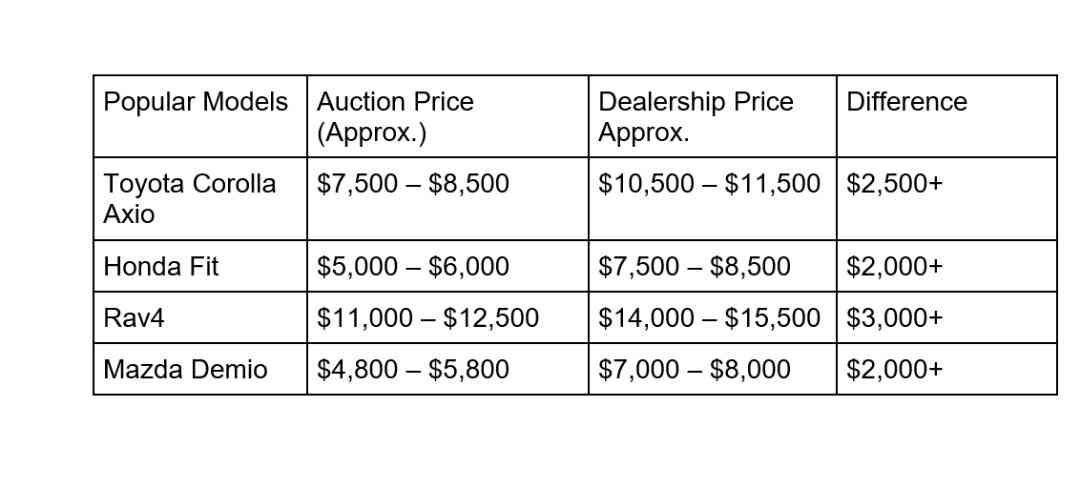
Now that we’ve weighed both the pros and cons of buying a car through auctions or a dealership, it's time to decide which one costs a buyer more. Japanese auctioned cars are indeed at wholesale prices, which are the buyer’s first choice. Therefore, we can safely say that auctions usually prevail in terms of financial cost. You will always find dealership cars to be more expensive than those listed on auction. While it is true that importing a Japanese car has lots of expenses (shipping and import duties), the total price still adds up to be lower than what you’d pay at a dealer’s showroom. Let's provide an example to clarify this for you.
Importing a Toyota Corolla Axio will cost around $8,000. You’ll find the same car priced at over $11,000 at a dealership.
Final Thoughts
Auctions are clearly the cost-friendlier option when it comes to buying used cars for sale in Zimbabwe. Not only are they light on the pocket, but they also offer transparency. You get access to a detailed auction and inspection sheet. However, when it comes to choosing the right option, it all comes down to what matters more to you as a buyer. A dealership is the better option if you want your car immediately, and waiting for shipment is not an option. Many Zimbabwean buyers auction through trusted Japanese exporters, such as SATJapan, a reliable Japanese exporter company.