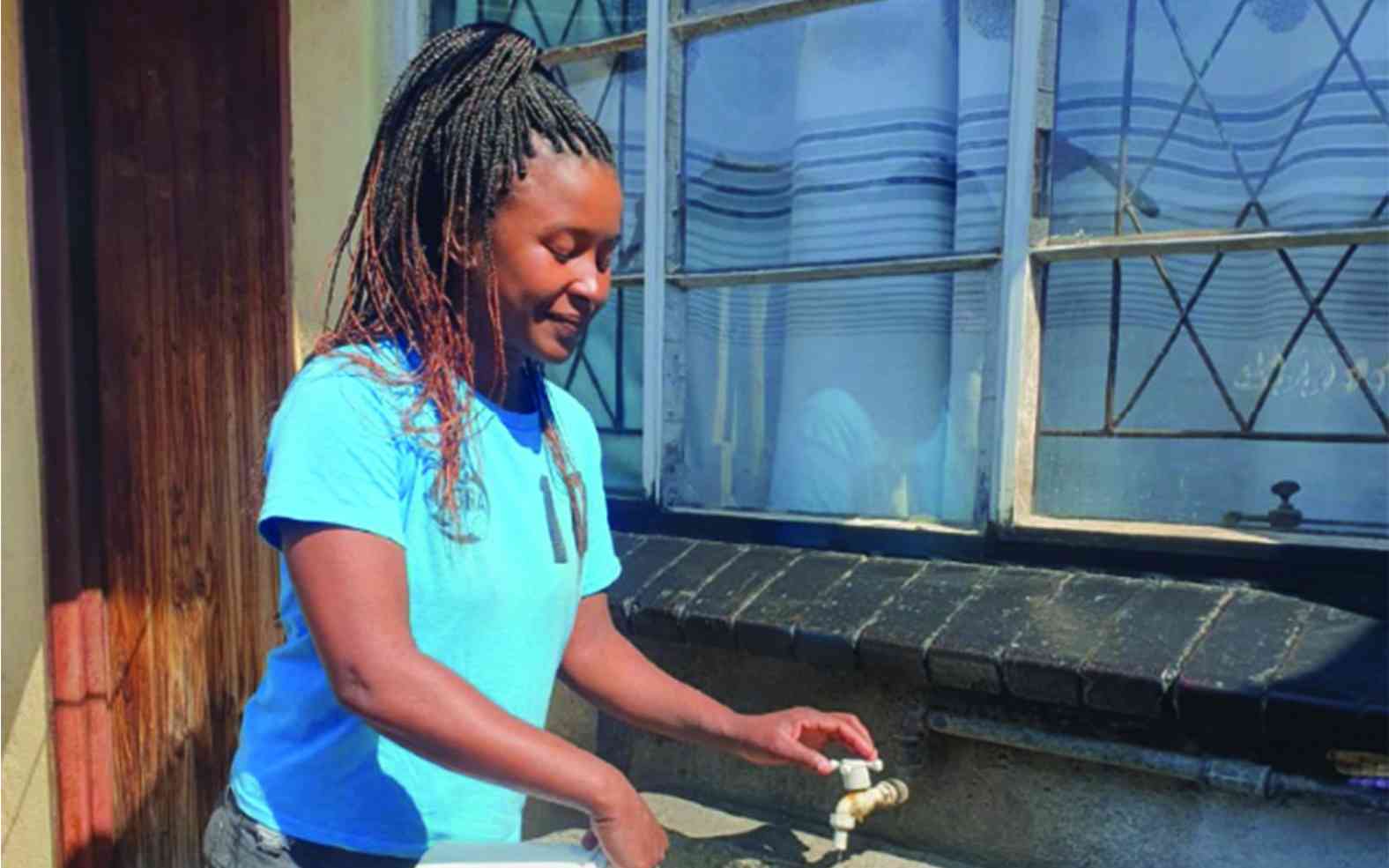
THERE is a particular kind of love that does not announce itself. It simply shows up — in a polished room in Mufakose, in a kitchen cupboard arranged with quiet care, in a container of cereal placed where small hands can reach it.
“My children love cereal,” says Melissa Bukuta (25), with the matter-of-fact certainty of a mother who has learned what her children need. “So, whatever I do, I have to make sure it is available.”
She says “my children” without hesitation. But they came to her through loss.
The weight she chose to carry
When Bukuta's sister died giving birth in 2022, she left behind three children — the youngest just a newborn, the middle child three and the oldest four. They were left in the rural areas under the care of an aunt when the mother passed away. But when Bukuta heard they were sick, she went and brought them to Harare.
Two of the children bore visible signs of kwashiorkor — a severe form of malnutrition that Unicef identifies as life-threatening without prompt treatment. Bukuta, then barely 23, had no medical training, no husband, no parents and no financial cushion.
“At one point, I was afraid I might lose them,” she says.
“I had to learn on the job.”
- Mufakose shines in RCZ national music competition
- Grandsons terrorise woman
- Be proud of your culture, govt urges youths
- ‘Drunk’ Mbare children case stirs debate
Keep Reading
Her first instinct, she admits, was to place them in a children's home. “Carrying three sick babies that young was not a walk in the park.” But she did not. She wrapped them up, brought them to Harare and began the slow, unglamorous work of keeping three small lives intact — nursing them back to health, obtaining their birth certificates, enrolling them in school and finding money to make all of it possible, every single day.
Milton Maregwede, a social worker at Kuda Vana — a Harare-based NGO supporting orphans and vulnerable children — was assigned to manage Bukuta’s case, with the founder of Kuda Vana working hand in hand with the Department of Social Development. The child rights advocate applauded the extraordinary work Bukuta does with so much grace.
“She has done well in building the foundation of these three children. She ensured they got birth certificates, accommodation, food and she is paying for their education and upkeep,” he said.
Kuda Vana sometimes supports Bukuta with groceries, rentals, school fees for the children and school uniforms. But Maregwede pointed out that as an organisation, they are struggling financially, so they are not able to support these families as often as they wished.
A childhood stolen, a womanhood forged.
To understand what Bukuta has given these children, you must first understand what was taken from her.
She never knew her biological father. Her mother died in 2010, when Bukuta was 10. She went to live with her grandmother in Guruve until a step-sister arrived with a promise to educate her in Harare, where the step-sister lived at the time. There was no school. “At 12, my sister put me to work as a domestic worker and she would collect every single cent of my earnings,” Bukuta said.
The International Labour Organisation estimates that millions of girls across sub-Saharan Africa are trapped in exactly this kind of invisible, unprotected domestic labour, of which Bukuta was one.
“I would play with the employer’s children instead of working because at that age I was still a child who knew nothing about work,” she recalled.
It was only after the employer confronted the step-sister for exploiting the child that Bukuta began receiving her wages. By then, her childhood was already gone. And by 2022, so was everyone else. Mother. Grandparents. Sister. The three children in the rural areas were all the family she had left.
When love meets a system that is not enough
Bukuta's story is deeply personal — but it is not exceptional and that is precisely the point.
Zimbabwe is home to approximately 1,1 million orphaned children, according to the United Nations International Children’s Fund; the vast majority are cared for not by the State but by relatives absorbing the burden quietly and without adequate support. Zimbabwe's Orphan Care Policy of 1999 places family reintegration at the heart of child welfare — a position reinforced by the United Nations Guidelines for the Alternative Care of Children, which designate institutionalisation as a last resort.
Yet the gap between policy and practice is wide. Maregwede explains that dysfunctional families often default to children's homes, creating what he calls a dependency syndrome that erodes family responsibility over time. He added that cultural barriers, financial hardship and the shortage of willing and capable caregivers all deepen the crisis. For those who do step up, structured support — skills training, economic empowerment, psychosocial care — remains largely out of reach.
Bukuta wakes up at dawn to sell everything from doughnuts to second-hand clothes. “If I don’t do that, fees will continue to pile up since I still have arrears,” she said. Sometimes, she negotiates with the school to provide labour in exchange for tuition.
“What worries me everyday,” she says, “is when I get sick — who is going to look after these children?”
It is a question that exposes the fragility beneath her resilience. But challenges continue, as she has to contend with negative perceptions within the community she lives in.
In some cases, she has been viewed as a loose woman, with three children as a consequence of recklessness. “It was the most painful and disheartening thing,” she says. She heard every word. And she kept going anyway — not out of stubbornness, but out of love. The same love that was modelled imperfectly for her and that she chooses to give so fully to them.
Bukuta lost her father before she could know him. She lost her mother at 10, her freedom at 12 and her last sibling at 23. She has been failed by family, by circumstance and by a system that has not yet found a way to truly hold people like her.
And yet, every morning before dawn, she rises. She wraps up doughnuts, laces up her shoes, and steps out to earn the day — for three children who are not hers by birth, but are entirely hers by choice.
“I do what I do because I love children,” she says simply. “And they are completing me now.”
That is not just love. That is a woman who was broken by life and chose, despite everything, to make something whole.