TEACHERS across Zimbabwe have raised concern over the state of the education sector, saying promises made at independence in 1980 have failed to improve their lives.
Leaders of the Progressive Teachers Union of Zimbabwe (PTUZ) and the Amalgamated Rural Teachers Union of Zimbabwe (ARTUZ) made the remarks ahead of the country’s 46th Independence Day commemorations held in Maphisa on Saturday.
The unions said teachers, once hopeful that independence would bring dignity and improved living standards, were grappling with poor salaries, rising living costs and declining morale. They accused the government of excluding educators from key salary reforms and warned that continued neglect can undermine the quality and stability of the education sector.
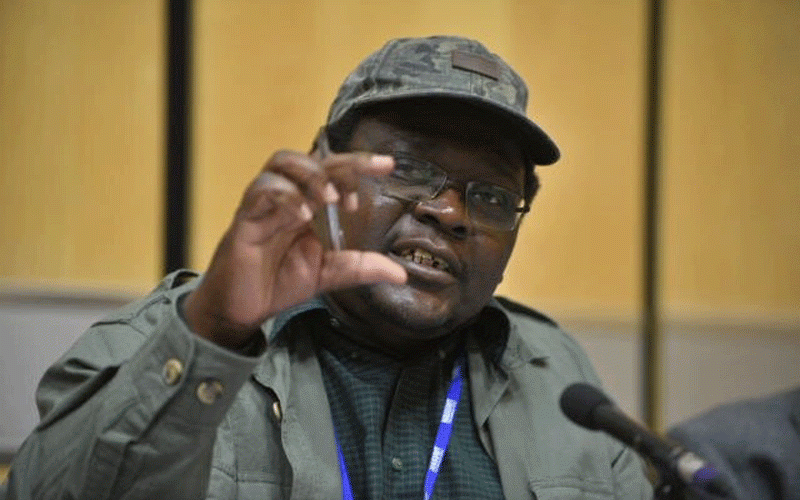
PTUZ president Takavafira Zhou said teachers were enduring “starvation and loss of dignity”, despite their historical contribution to the liberation struggle and nation-building.
“There was so much hope in 1980 that the plight of teachers would dramatically improve,” Zhou said.
“However, that promise has turned out to be elusive.”
He, however, acknowledged former Education ministers Dzingai Mutumbuka, Fay Chung and David Coltart for what he described as fostering early optimism in the sector. He said subsequent policy shifts and under investment had contributed to a steady decline in education standards.
Central to PTUZ’s grievances is a recent salary review conducted by the Public Service Commission, which the union claims excluded teachers and their representatives.
- Zim needs 100 000 teachers
- Zim needs 100 000 teachers
- Grade 7 exams in limbo
- Grade 7 exams in limbo
Keep Reading
Zhou said the review effectively downgraded teachers across multiple grades into a single level, resulting in reduced earnings.
“The exercise was shoddy and epitomises reform without teachers’ participation,” he said.
The union is demanding a minimum monthly salary of US$540, housing and transport allowances and the reinstatement of previously agreed benefits.
Zhou warned that failure to address teachers’ concerns will destabilise the education sector, while reaffirming the union’s commitment to national development.
Meanwhile, ARTUZ president Obert Masaraure said independence had become hollow, as workers could not afford the bread they bake or the roofs they maintain.
“We condemn any legal instrument that excludes the backbone of our service industry from the dignity of a fair, livable floor,” he said.
“For those in formal employment, we demand fair wages that track the cost of living. A paycheck should be a bridge to prosperity, not a receipt for struggle.”
Masaraure also called for economic transformation, urging Zimbabwe to move beyond a “dig and ship” economy.
“We demand value chain justice for artisanal miners, who deserve formalisation and fair prices; and for tobacco and cotton farmers, who should not be trapped in debt cycles but empowered as stakeholders on the global market,” he said.
Masaraure criticised the Constitutional Amendment No 3 Bill, saying it is a direct assault on the one-man, one-vote principle.
“By seeking to centralise power, it reverses the hard-won gains of our independence and frustrates every effort to unlock jobs and freedoms,” he said.
“One man, one vote forces accountability. When the ballot is sacred, the government is forced to deliver — or be replaced.”